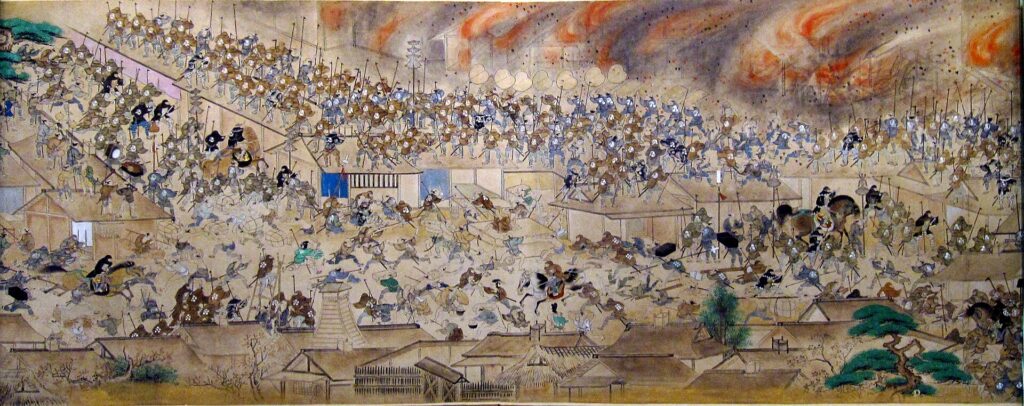
Stand at Ueno Hirokoji today and the name itself poses a question. Hirokoji means a broad street or open way, an unusual idea in a city famous for compact blocks and narrow lanes. The present intersection is not a perfectly preserved seventeenth-century firebreak, but the name carries a memory of how Edo repeatedly tried to create breathing room against fire.
Why did Edo burn so often? Not because its residents were uniquely careless. Edo was a rapidly growing city where wooden row houses and shops stood close together, daily life depended on braziers, cooking fires, lamps and candles, and dry winter-to-spring winds could throw sparks across roofs and lanes. Roads were often narrow, water and firefighting equipment were limited, and early suppression was difficult. Firefighters therefore relied heavily on demolition: tearing down buildings ahead of the flames to create a break. The Great Fire of Meireki in 1657 became a decisive turning point, prompting open spaces, wider routes, relocated estates and temples, new bridges and expansion east of the Sumida River.
A city built to burn
Edo was not literally made entirely of wood and paper. Storehouses with thick earthen walls, tiled roofs, stone walls, samurai compounds and temple precincts created important differences from district to district. Yet much of the commoner city consisted of timber townhouses and tenements, with wooden fittings, tatami, screens and household goods packed into tight plots. Board and thatch roofing remained common in some periods and places, while tile use expanded unevenly under changing regulations and costs.
Fire was woven into ordinary life. Households cooked with wood or charcoal, warmed themselves with hibachi, and used oil lamps or candles after dark. Eaves nearly touched across narrow lanes. A small flame could become a neighborhood fire, and strong seasonal winds could lift burning fragments over streets or canals. Water was essential for daily life and local firefighting, but Edo did not possess a modern network of hydrants, high-pressure pumps and fire engines. Access routes could also be blocked by crowds, carts and people carrying household goods.
Fire was ordinary—but never harmless
The saying “fires and fights are the flowers of Edo” is often used to suggest a swaggering urban culture. It should not be mistaken for evidence that people welcomed disaster. Fires killed and injured residents, destroyed rented rooms and workshops, erased inventories and tools, separated families and forced communities to move. Watchmen, fire towers, neighborhood patrols and repeated warnings to take care with flame show that residents understood the danger.
Preparedness was also unequal. A wealthy household might own a fire-resistant storehouse or have servants and transport. A tenant in a crowded nagaya tenement could lose home, tools and income in the same night. Recovery created work for carpenters, plasterers and suppliers, but rising prices and forced relocation placed heavy burdens on people with the fewest resources.
Three days in 1657: the Great Fire of Meireki
The Great Fire of Meireki struck Edo over three days, from January 18 to 20, 1657, according to the calendar conversion commonly used in English-language accounts. It was not simply one unchanging wall of flame. Several outbreaks, shifting winds and repeated spread across densely built districts turned the disaster into a citywide catastrophe.
Estimates vary, but the Tokyo Metropolitan Library describes roughly 60 percent of Edo as burned and gives a death toll range of about 30,000 to 100,000. Those numbers are estimates, not census totals. Contemporary population figures are also approximate. What is certain is that the fire destroyed a vast share of the city, including the keep of Edo Castle, and overwhelmed routes of escape.
The furisode story: legend, not a proven cause
The fire is popularly called the “Furisode Fire.” In the famous tale, a young woman dies after an unhappy love, her long-sleeved kimono is donated to a temple, and the garment bursts into flame during a memorial rite. It is a powerful story, but it is not a proven forensic explanation. The legend became attached to the disaster later; historians treat the precise ignition story with caution. The more important point is that whatever started individual fires, Edo’s density, wind, combustible buildings and restricted escape routes magnified them.
Why escape failed
Edo was a castle town shaped by moats, gates, walls, rivers and controlled routes. These features helped organize and defend the city, but during a major fire they could funnel or trap crowds. Bridges were limited, narrow streets filled quickly, and people carrying chests or bedding slowed movement. Strong winds drove sparks ahead of the main flames. The result was not simply destruction of buildings but a collapse of safe movement through the city.
The castle keep the shogunate chose not to rebuild
The Great Fire burned Edo Castle’s main keep. It was never rebuilt. This does not mean the entire castle was abandoned or never reconstructed: palaces and other structures were rebuilt and later burned again. The specific decision concerned the monumental keep. The commonly cited explanation is that leading officials, especially Hoshina Masayuki, prioritized urban recovery and practical government needs over restoring a costly military symbol.
That choice became one of the clearest signs that the fire changed political priorities. The shogunate still projected authority, but reconstruction required land, labor, money and decisions about where people could live.
Rebuilding Edo as a safer, larger city
Post-fire reconstruction was not a single modern master plan completed at once. Emergency recovery, land redistribution, fire prevention, population growth and commercial development overlapped over years. The shogunate relocated daimyo estates, temples, shrines and commoner districts; widened or opened routes; reserved open land; altered embankments and waterways; and encouraged expansion beyond the crowded core.
These measures created more separation between some built-up areas and made movement easier, but they also meant compulsory relocation. A safer city for the government could be a more disruptive city for a tenant, merchant, temple community or laborer ordered to move. Reconstruction redistributed risk and opportunity rather than eliminating either.
Hiyokechi, hirokoji and firebreaks are not identical
- Hiyokechi were open or restricted spaces intended to reduce the spread of fire.
- Hirokoji means a broad street or open way. Some hirokoji served fire-prevention purposes, but not every place with that name had the same origin or function.
- Dote were embankments that could relate to fire control, water management or both.
- Firebreak is a useful English umbrella term, but it does not capture every legal and spatial distinction of Edo.
Modern firebreak roads and belts belong to later planning systems. Ueno Hirokoji, Ryogoku Hirokoji and other named spaces must be studied individually rather than treated as one uniform design.
When open space became entertainment space
Open land in a dense city was economically tempting. Tea stalls, temporary shops, performances and spectacles gathered where crowds already passed. Because permanent construction could undermine the defensive purpose of a firebreak, use was often temporary or regulated. Ryogoku and Ueno show how disaster-prevention space could also become commercial and cultural space. Not every firebreak became an entertainment district, but the pattern reveals Edo’s ability to combine safety, circulation and urban pleasure—sometimes uneasily.
Ryogoku Bridge and the city beyond the Sumida
One of the most consequential post-Meireki changes was the construction of Ryogoku Bridge and the acceleration of development east of the Sumida River in Honjo and Fukagawa. The new connection improved evacuation and movement, while eastern expansion responded to land pressure, water transport and economic growth as well as fire prevention. The present bridge is not the original seventeenth-century structure, and its alignment and engineering have changed over time.
The name Ryogoku is traditionally explained as linking two provinces, Musashi and Shimosa. The bridge became more than infrastructure: the broad approaches and riverbanks supported commerce, dining, performances and seasonal crowds.
Ekoin: memorial, temple and public gathering place
Ekoin Temple was founded to memorialize people who died in the Great Fire, including unidentified and unclaimed victims. Its history makes Ryogoku a place where mourning and popular culture coexist. Later, fundraising sumo, displays of sacred objects and popular entertainments took place in and around the precincts. That later life should not obscure the temple’s origin as a memorial site.
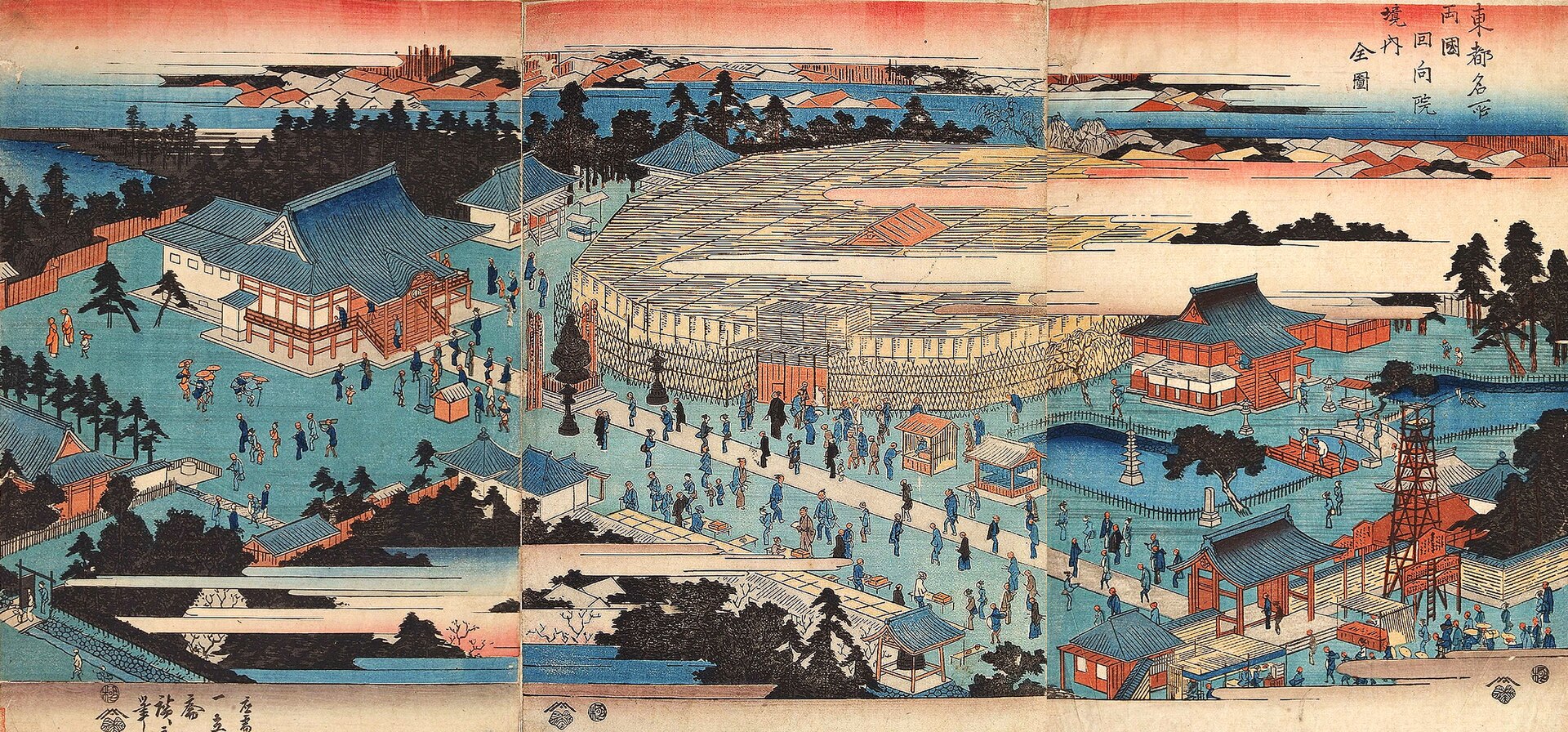
This print dates from 1842, not 1657. It documents the later precinct and its public life rather than the immediate aftermath of the fire.
Fires did not stop after Meireki
Later disasters—including the Tenna, Meiwa and Bunka fires—showed the limits of reform. Open spaces could be encroached upon, the city became dense again, strong winds carried embers over barriers, and affordable timber construction remained essential to urban life. Fire-prevention measures reduced or redirected some risks but could not make a giant preindustrial city fireproof.
Who fought Edo’s fires?
Edo’s firefighting system changed repeatedly. Early forces included hosho-bikeshi and daimyo fire brigades organized among warrior houses. Permanent shogunal units known as jo-bikeshi protected the castle and important samurai areas. Commoner districts increasingly relied on machi-bikeshi, town brigades supervised by magistrates but funded by the towns.
The Tokyo Fire Department distinguishes the establishment of town firefighting in 1718 from the mature organization of the Iroha forty-eight groups in 1730 under the reforms associated with Shogun Tokugawa Yoshimune and magistrate Ooka Tadasuke. The brigades were not modern municipal fire departments. Their members were commonly drawn from construction trades, especially steeplejacks, and their work was dangerous, competitive and tied to neighborhood identity.
Why firefighters tore buildings down
Without the ability to deliver large volumes of pressurized water over distance, firefighters often fought the path of the fire rather than the flames themselves. Using hooks, axes and ladders, they dismantled roofs, walls and buildings ahead of the fire to remove fuel. Water was still used where available; it is wrong to say Edo firefighters never used it. But demolition was often the decisive tactic.
A brigade’s matoi standard marked its position and identity, while coats, songs and ladder techniques became part of a celebrated firefighting culture. That visual culture should not hide the physical danger or the fact that destroying property to save a district created painful choices.
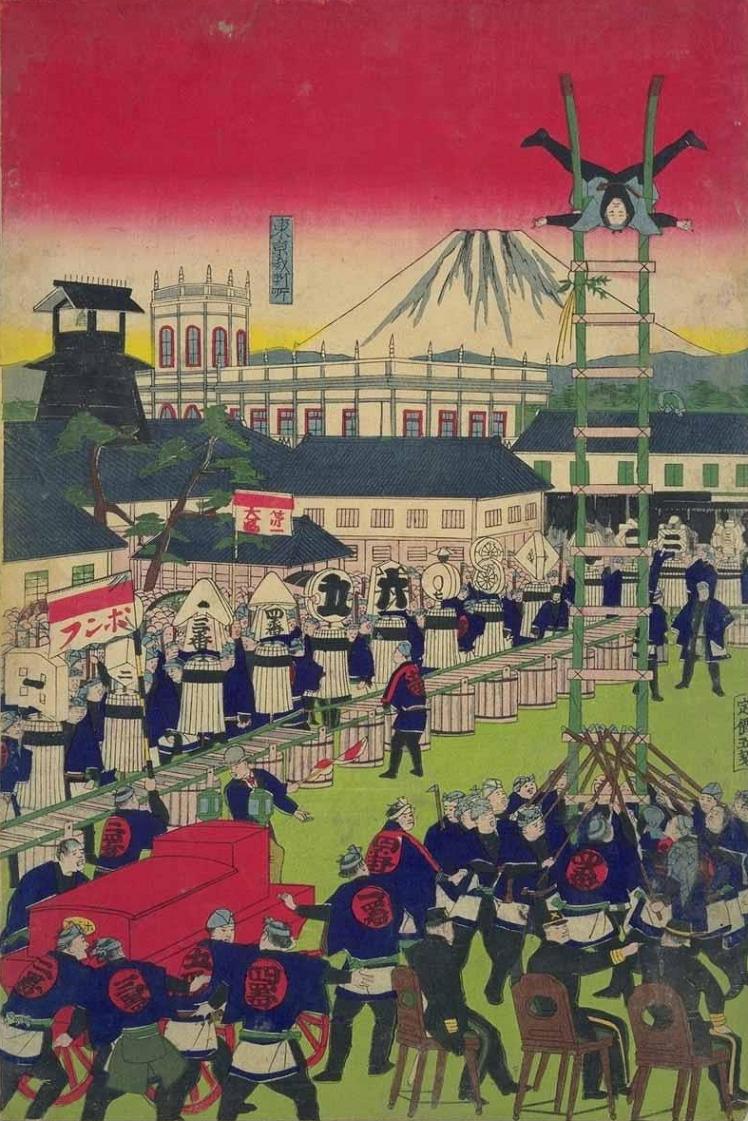
This 1876 print is by Utagawa Hiroshige III and depicts an early Meiji-era ladder performance, not Edo-period firefighters at an active fire. It is useful evidence of continuity between the culture of the town brigades and modern public firefighting ceremonies.
Meiji Tokyo: brick, pumps and a modern fire service
After the Meiji Restoration, firefighting moved toward police supervision, public brigades, modern pumps, communications and eventually fire stations. The transition was gradual. Older personnel, symbols and practices did not disappear overnight.
The 1872 Ginza fire prompted an ambitious brick district intended to demonstrate a more fire-resistant capital. Ginza Bricktown changed streets and architecture, but it was not a simple triumph. Construction was expensive, rents were high, some buildings were poorly suited to climate and local habits, and later earthquakes exposed new vulnerabilities. Modernization changed the material of risk rather than abolishing it.
1923: an earthquake became an urban fire catastrophe
The Great Kanto Earthquake struck at 11:58 a.m. on September 1, 1923. Building collapse was devastating, but simultaneous fires transformed the disaster. Cooking fires were one factor, alongside industrial and other ignition sources. Broken water systems, blocked streets, strong winds and household goods piled in evacuation routes made suppression and escape extremely difficult.
Tokyo Metropolitan Government materials state that about 3,465 hectares—roughly 44 percent of Tokyo City—burned. The geographic unit matters: this is not a figure for all of Tokyo Prefecture or the entire disaster region. The catastrophe also produced deadly rumors and mass violence against Koreans, Chinese and others. Urban disaster history must include both physical destruction and violence committed by people and authorities amid panic.
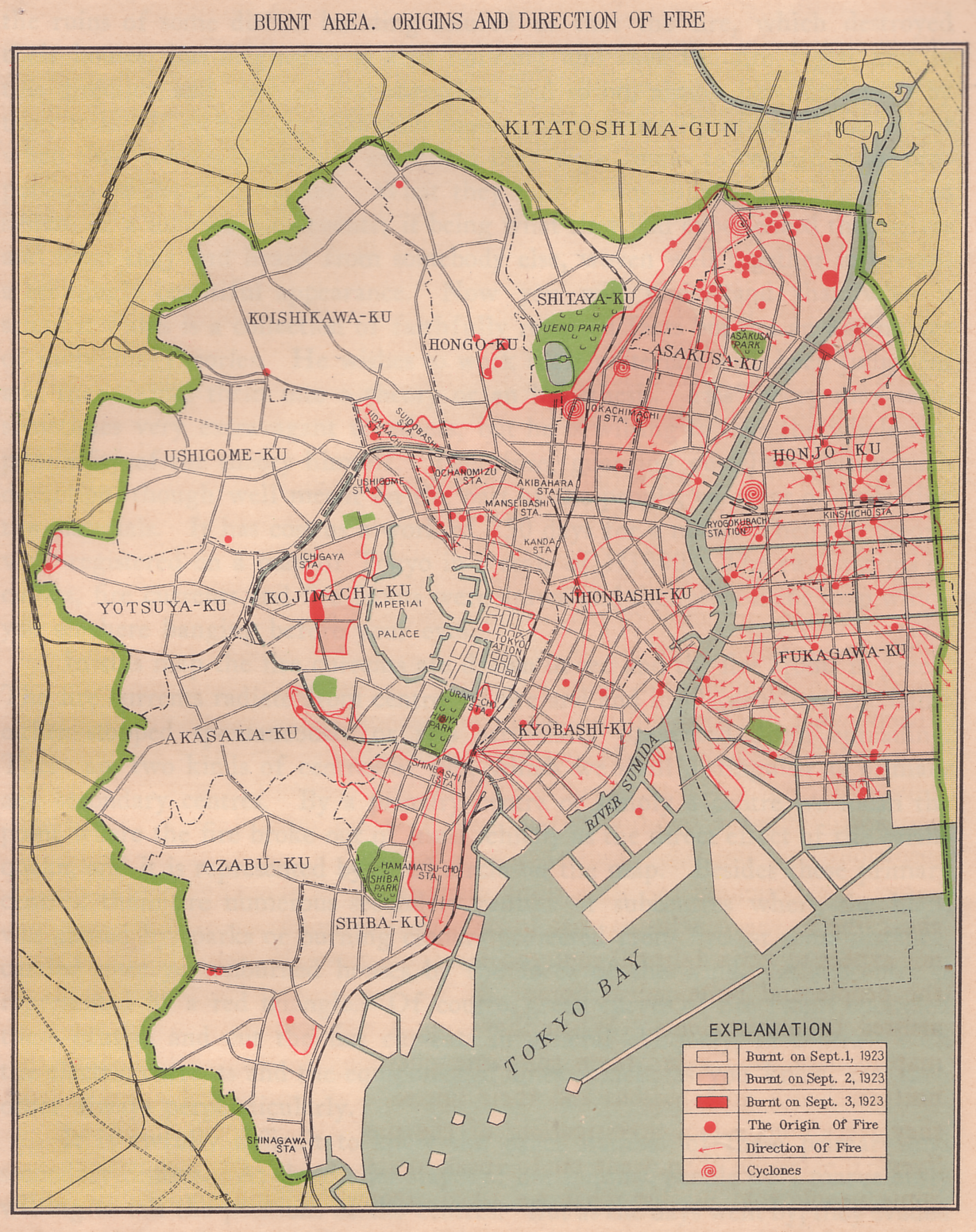
This is a burned-area map published in 1933, not a seismic-intensity map made during the earthquake.
Yokoamicho Park: where refuge became disaster
Many people fled to the former Army Clothing Depot site in Honjo, now Yokoamicho Park. Fire, extreme heat and fire whirls turned the open ground into one of the disaster’s deadliest sites. Today the Tokyo Metropolitan Memorial Hall and Tokyo Restoration Memorial Hall preserve the memory of the earthquake, reconstruction and wartime air raids. The park also contains memorials to child victims and to Koreans killed after the earthquake. It is a place of mourning, not merely a sightseeing stop.
Goto Shinpei’s reconstruction—and the plan that was cut back
Home Minister Goto Shinpei advocated a sweeping reconstruction program, but the initial vision was reduced through budgetary, political and property negotiations. The final work still reshaped Tokyo through land readjustment, arterial roads, bridges, parks, river improvements, reinforced-concrete schools and small parks paired with them. Showa-dori, Yasukuni-dori, Sumida Park, Hamacho Park and Kinshi Park belong to this reconstruction landscape.
It is misleading to say one man designed modern Tokyo. National and city governments, engineers, landowners, residents and assemblies fought over cost, land and implementation. The result was substantial but incomplete.
1945: fire used as a weapon
The air raids of 1944–45 were not natural disasters. Fire was deliberately used as a weapon against an urban population. The massive incendiary attack of March 10, 1945 devastated eastern Tokyo, where dense wooden neighborhoods were especially vulnerable. Civilians died in streets, rivers, canals and open spaces as familiar escape routes failed under bombardment and fire.
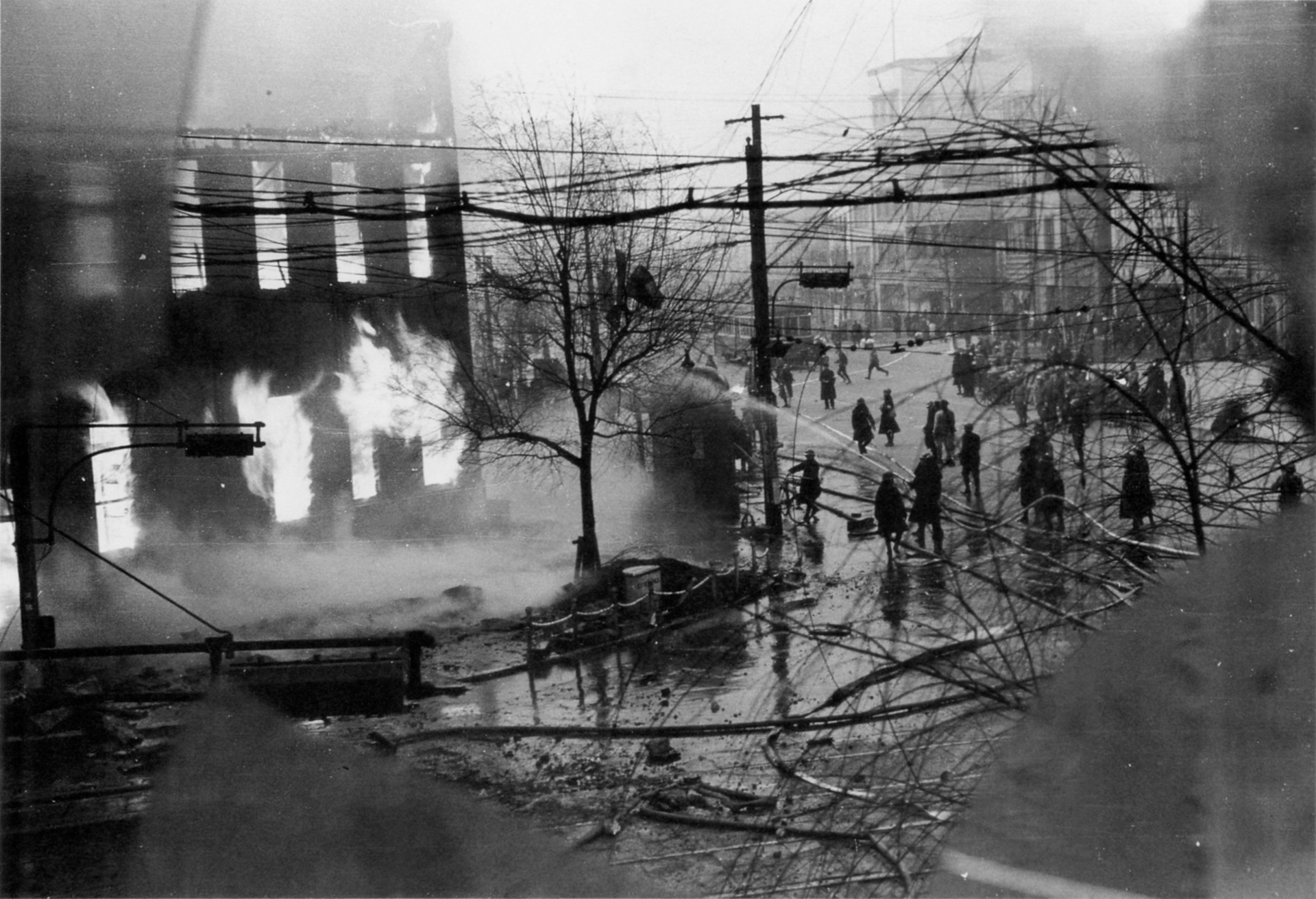
This photograph records the Ginza raid of January 27, 1945. It is not a photograph of the March 10 raid.
Postwar reconstruction: another plan, another political reality
Postwar planners proposed broad roads, green belts and land readjustment, but shortages of money and materials, occupation policy, property disputes and an urgent housing crisis forced major reductions. Some districts were comprehensively reorganized; others rebuilt rapidly on prewar street patterns. Tokyo did not emerge as a fully planned city.
This uneven implementation helps explain why parts of modern Tokyo still contain narrow roads and dense wooden housing. Contemporary disaster policy continues to address the danger of fire spreading after a major earthquake.
Three destructions, three different reconstructions
- 1657: an urban conflagration under the Tokugawa shogunate, answered through estate and temple relocation, open space, bridges and expansion of the castle town.
- 1923: an earthquake and multi-ignition fire disaster under a modern state, answered through statutory reconstruction, land readjustment, roads, bridges, parks and reinforced-concrete public buildings.
- 1945: wartime destruction by aerial bombardment, followed by a postwar plan constrained by defeat, occupation, scarcity, property rights and housing demand.
The common thread is not one continuous plan. It is the repeated struggle to create safer circulation, open space and more fire-resistant construction while negotiating who moved, who paid and whose losses were remembered.
What to see in Tokyo today
Ueno Hirokoji
Begin around Ueno Hirokoji Station and Matsuzakaya. The modern road system, railways and redevelopment have changed the area, so do not read the current intersection as an exact seventeenth-century outline. Instead, use the surviving place-name to ask why broad space mattered near the approaches to Ueno and the former Kaneiji temple district.
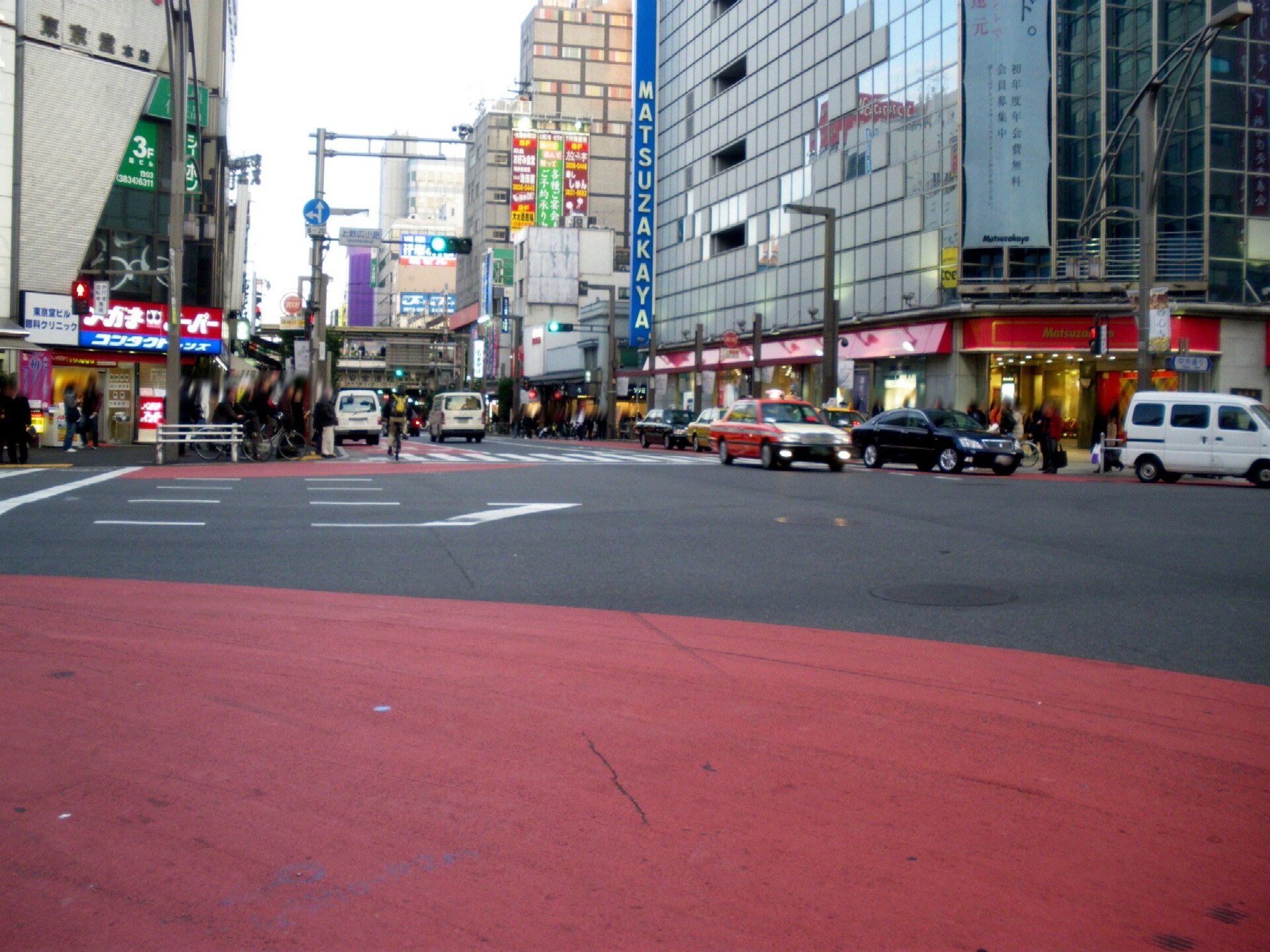
Ryogoku, Ekoin and Yokoamicho Park
Ryogoku brings several layers together: the Sumida crossing, the memory of broad riverside gathering space, Ekoin’s memorial origin, sumo culture and the disaster memorial landscape of Yokoamicho Park. The Edo-Tokyo Museum reopened after renovation on March 31, 2026; check its official website for current exhibitions and admission details before visiting.
The Tokyo Restoration Memorial Hall is generally open 9:00 a.m.–5:00 p.m., closed on Mondays, with free admission; official notices should be checked for temporary closures. Treat memorial buildings and monuments with the same respect you would give a cemetery or war memorial.
Fukagawa, Asakusa and Ginza
Fukagawa’s canals, temples and street pattern reveal the eastward growth of Edo after major fires. Asakusa preserves layers of temple-town relocation, commerce and entertainment, while Ginza tells a later story of the 1872 fire, brick construction, earthquake reconstruction and wartime destruction. Surviving markers and street patterns are evidence of change, not a complete brick district frozen in time.
Fire Museum in Yotsuya
The Tokyo Fire Department’s Fire Museum is the best practical introduction to firefighting from Edo to the present. It is at 3-10 Yotsuya, Shinjuku, directly connected to Exit 2 of Yotsuya-sanchome Station. Current official information lists opening hours of 9:30 a.m.–5:00 p.m., last admission at 4:30 p.m., generally closed on Mondays, and free admission.
Two practical routes
- East Tokyo route: Ueno Hirokoji, then take the subway or JR to Ryogoku for Ryogoku Bridge, Ekoin and Yokoamicho Park.
- Fire-history route: Fire Museum at Yotsuya-sanchome, then travel to Ginza to examine the later layers of brick-city planning, earthquake reconstruction and wartime rebuilding.
Frequently asked questions
Why did Edo have so many fires?
Rapid population growth, dense timber construction, daily open flames, dry windy weather, narrow roads and limited firefighting capacity combined to make small fires spread quickly.
Was Edo entirely made of wood?
No. Timber buildings dominated many commoner districts, but tiled roofs, earthen storehouses, stonework, samurai compounds and temple grounds created significant variation.
How often did Edo burn?
Frequently, but exact totals depend on how historians define a “major fire” and which records they count. Popular round numbers should not be treated as precise statistics.
What caused the Great Fire of Meireki?
The precise ignition causes remain uncertain. Multiple outbreaks and wind-driven spread mattered more to the scale of destruction than any single legendary origin.
Is the furisode story true?
It is a famous later legend, not a proven cause established by contemporary evidence.
How many people died in the Great Fire of Meireki?
Common official summaries give an estimated range of roughly 30,000 to 100,000 deaths. The wide range reflects uncertain records.
Why was Edo Castle’s keep never rebuilt?
The shogunate prioritized urban recovery and governance over reconstructing the expensive symbolic keep. Other castle buildings were rebuilt; the decision specifically concerned the keep.
What is a hiyokechi?
A hiyokechi was open or restricted land intended to slow the spread of fire.
What does hirokoji mean?
It means a broad street or open way. Some hirokoji had firebreak functions, but the term is not identical to hiyokechi.
Who were the machi-bikeshi?
They were town-funded brigades responsible mainly for commoner districts under magistrate supervision, reorganized in the early eighteenth century.
Why did firefighters demolish houses?
Removing roofs and buildings ahead of the flames created gaps in the fuel supply when high-pressure water delivery was unavailable.
What changed after the Great Kanto Earthquake?
Land readjustment, wider roads, bridges, parks, reinforced-concrete schools and modern public works reshaped large parts of the burned city, although the original plan was reduced.
What happened at the former Army Clothing Depot site?
Thousands of evacuees were killed there by fire, extreme heat and fire whirls in 1923. The site is now Yokoamicho Park and a major memorial landscape.
How did the air raids differ from Edo fires?
Edo fires were urban accidents and conflagrations. The 1945 fires were caused by deliberate aerial attack during war and must not be described as natural disaster.
Where is the best museum for firefighting history?
The Tokyo Fire Department Fire Museum at Yotsuya-sanchome offers the clearest overview from Edo brigades to modern firefighting.
Conclusion: reading fire in the modern city
Return to Ueno Hirokoji, Ryogoku Bridge or Yokoamicho Park and Tokyo’s open spaces no longer look accidental. Their present forms are modern, but their names, locations and functions preserve layers of response to fire, earthquake and war.
Disaster did not simply “make Tokyo better.” It killed people, destroyed livelihoods, forced relocations and produced unequal recoveries. Reconstruction created new safety and new opportunities, but also new burdens and exclusions. The most revealing way to walk Tokyo is to notice width, gaps, bridges, temple locations, old place-names and memorials—and ask what danger, decision or loss made that space possible.
TimeWalk Japan explores these layers through history articles and walks. As you move through the city, treat roads, open land and memorial sites not as empty background, but as evidence of how Tokyo has repeatedly negotiated survival.
Sources and further reading
- Tokyo Metropolitan Library: Reconstruction after the Great Fire of Meireki
- Tokyo Metropolitan Library: What was inside Edo Castle?
- Tokyo Fire Department: Firefighters of Edo
- Tokyo Fire Department: The Iroha Forty-Eight Brigades
- Tokyo Metropolitan Government: 100 Years Following the Great Kanto Earthquake
- Tokyo Metropolitan Government: The Changing Face of Tokyo
- Tokyo Fire Department Fire Museum
- GO TOKYO: Yokoamicho Park
Image credits
Featured image: Tashiro Yukiharu, Picture Scroll of Fires in Edo (1814), Edo-Tokyo Museum collection, via Wikimedia Commons. Public domain. The image was created 157 years after the 1657 fire and is not an eyewitness record.