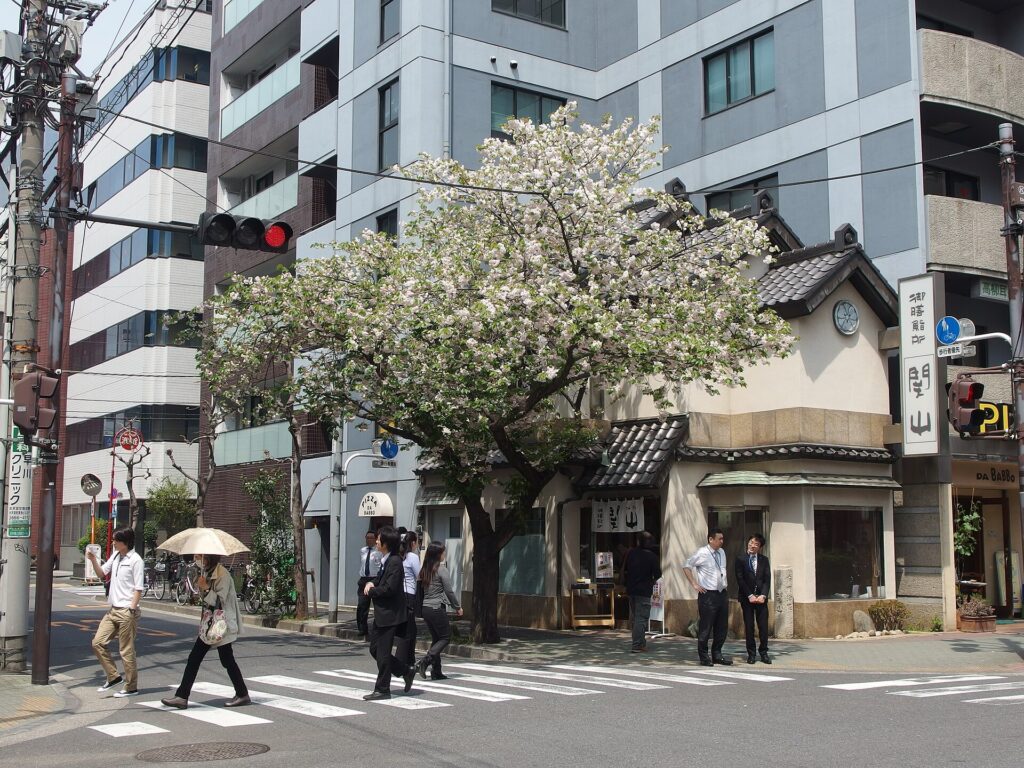
Ningyocho is known today for compact streets lined with food shops, traditional sweets, restaurants and small businesses. That street life began not with shopping alone, but with crowds moving between theaters, puppet shows, pleasure quarters and later religious sites.
The district kept its human scale because each lost destination was replaced by another. Edo-period theaters brought audiences. Suitengu brought worshippers. Yoshicho brought diners and performers. Amazake Yokocho linked the neighborhood with Hamacho and Meiji-za. Each new flow of people supported shops along the same short routes.
Ningyocho’s present identity therefore comes from a repeated urban habit: people arrive for one purpose, then walk, eat, buy gifts and meet others nearby. The theaters disappeared, but the street economy they created survived.
Entertainment Created a Neighborhood of Foot Traffic
When Tokugawa Ieyasu entered Edo in 1590, the land east of the castle was low, wet and crossed by tidal water. Building a capital required canals, raised ground, embankments and new streets. Ningyocho emerged within this wider transformation of Nihonbashi’s lowland.
Water carried food, timber, fuel and merchandise into the city. Streets distributed those goods through narrow town blocks. This combined network of waterways and roads later made the area suitable for entertainment, worship and small-scale commerce.
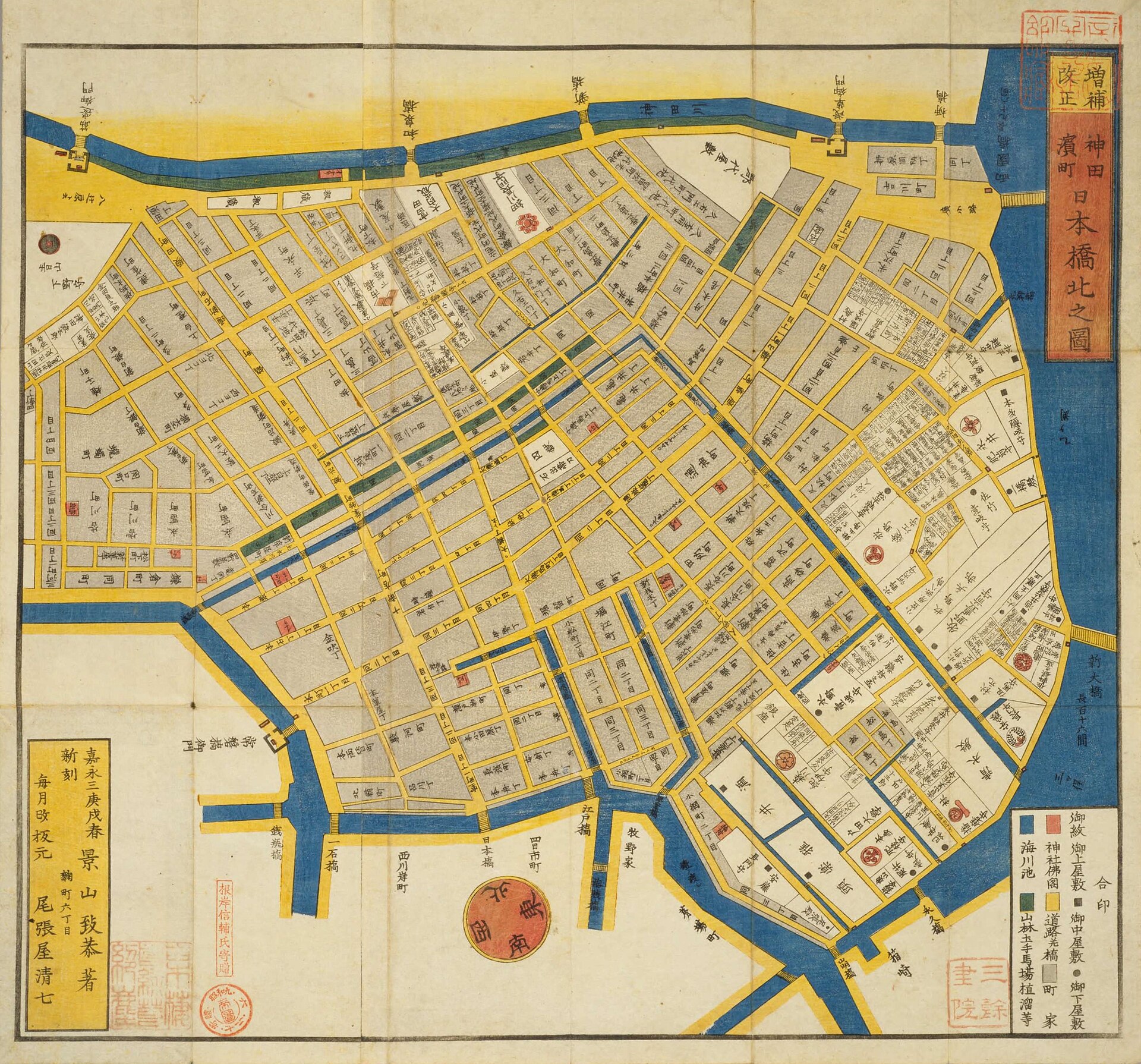
A kiriezu was a detailed printed neighborhood map rather than a modern survey. It helps show how theater streets, waterways, temple lands and roads formed one connected district.
Motoyoshiwara Concentrated Early Edo’s Licensed Nightlife
Early Edo’s licensed pleasure quarter stood near the future Ningyocho area. It later became known as Motoyoshiwara, meaning the “original Yoshiwara.” Sources often give 1612 for official planning or authorization and 1617 for regular operation.
The quarter concentrated licensed sexual commerce within a controlled area. It also supported cooks, clothing sellers, servants, transport workers, suppliers and moneylenders. The women working there lived under legal restrictions, debt and strict hierarchy, so Motoyoshiwara should not be remembered only as colorful nightlife.
The Great Fire of Meireki devastated Edo in 1657. During reconstruction, the shogunate moved the licensed quarter north of Asakusa to Shin-Yoshiwara. The later Yoshicho geisha district in Ningyocho was a different institution again.
Kabuki and Puppet Theaters Filled the Streets
Sakaicho and Fukiyacho developed into a shibai-machi, or theater town. Nakamura-za operated in Sakaicho, while Ichimura-za stood in neighboring Fukiyacho. Morita-za, the third licensed Edo theater, was in Kobikicho in present-day Ginza.
The theaters were large businesses. Performances depended on carpenters, painters, musicians, playwrights, costume makers, prop makers, ticket sellers, porters and fire-watch workers. Audiences needed meals, waiting rooms and help arranging seats.
Puppet joruri, storytelling, acrobatics, water tricks and temporary misemono shows also drew crowds. A misemono was a popular exhibition or performance built around novelty, skill or unusual objects.
Puppet theater required people to carve heads, assemble figures, sew costumes, repair parts, manage troupes and operate puppets onstage. The name Ningyocho—literally “puppet” or “doll town”—grew from this concentration of related work.
A Day at the Theater Began in the Street
Theater teahouses helped customers arrange seats, meals and service. Because performances took place during the day and could last for hours, food was part of the experience rather than an afterthought.
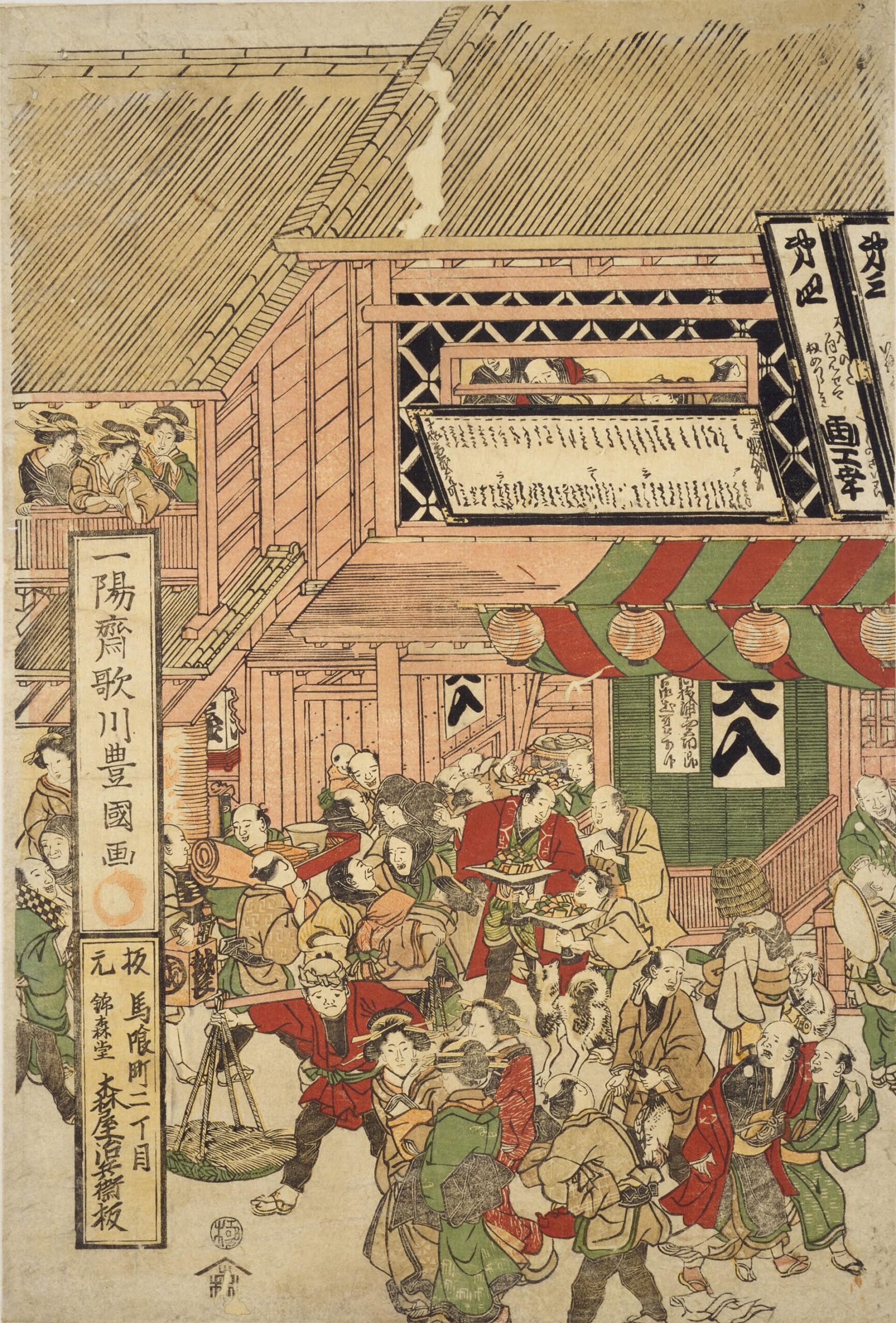
Toyokuni’s print captures an important urban fact: the theater opened directly into a busy commercial street. Cooks prepared boxed meals, brewers supplied drinks, textile workers made costumes, publishers sold actor prints and porters moved scenery and goods.
Women worked throughout this economy as proprietors, cooks, servers, performers and household managers. Much of their labor is less visible in official theater histories, but the district could not have functioned without it.
The Theaters Left, but the Commercial Pattern Remained
Wooden theaters were especially vulnerable to fire. During the Tenpo reforms of the 1840s, the government also targeted popular entertainment as part of a broader campaign of moral and urban control. Between 1841 and 1843, the licensed theaters were ordered to move to Saruwaka-cho near Asakusa.
The departure removed workers, teahouses and suppliers, but it did not erase the district’s advantages. Ningyocho still stood close to Nihonbashi’s markets, canals and residential areas. The stage disappeared, but compact streets and established habits of serving visitors remained available for new uses.
Suitengu Created a New Route for Visitors
Suitengu began in Edo as a branch shrine inside the residence of the Kurume domain’s Arima family. It became especially popular with people praying for safe childbirth and family protection.
After the Meiji Restoration, the shrine moved first to Aoyama in 1871 and then to Nihonbashi Kakigaracho in 1872. New roads and Yoroi Bridge improved access at about the same time. Worshippers began flowing through Kakigaracho and Ningyocho, supporting food shops, gift sellers and other services.
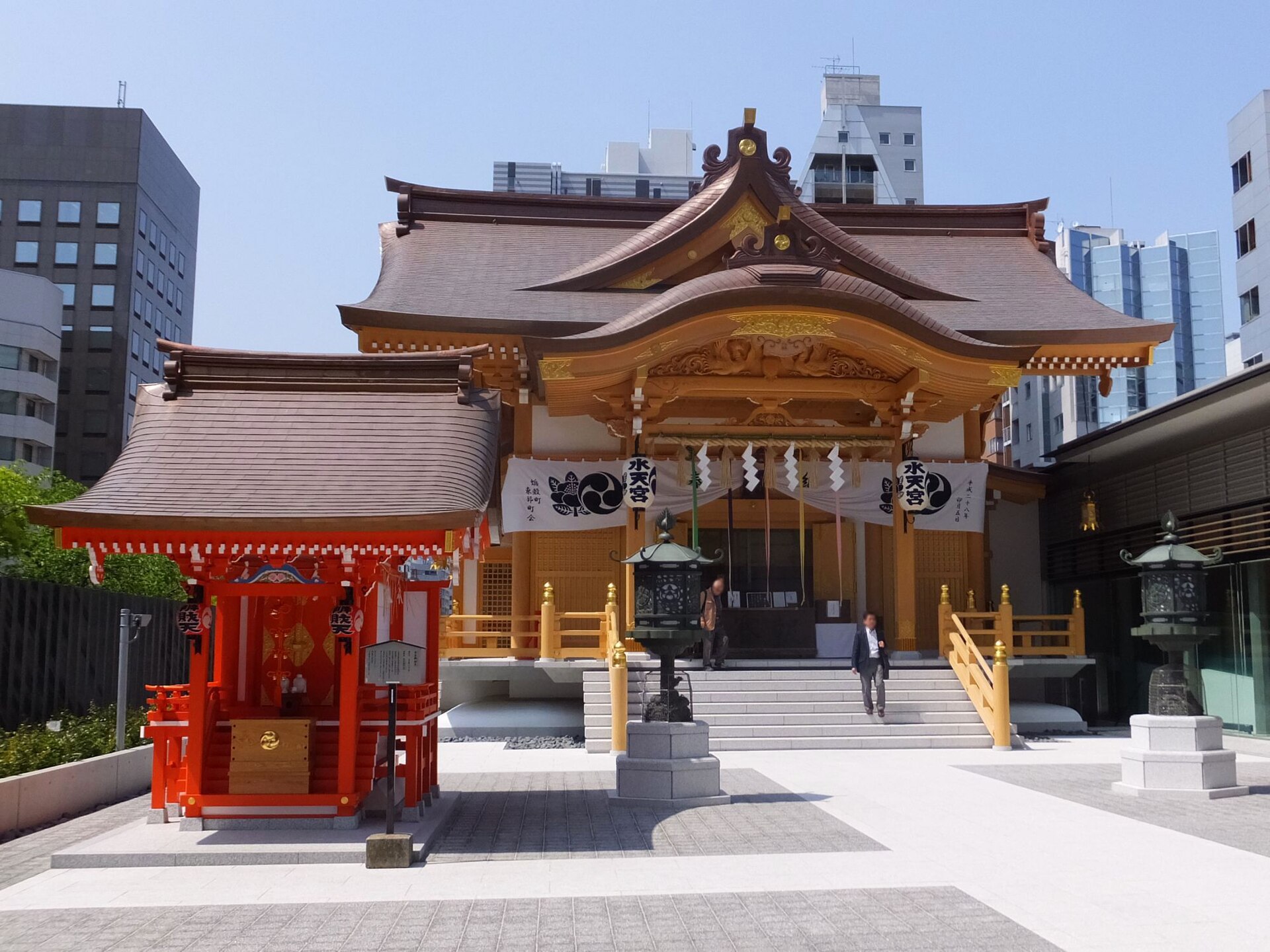
The present shrine buildings are modern, but the institution and its visitor flow continue. Suitengu gave the district a new destination after the old theaters had gone.
Yoshicho Turned Hospitality into Skilled Work
Yoshicho developed into a major geisha and restaurant district from the late Edo period through the Meiji, Taisho and early Showa eras. It should not be confused with Yoshiwara. A geisha district centered on trained performance, conversation and hospitality, while Yoshiwara was a licensed pleasure quarter organized under a different legal and occupational system.
Geisha trained in music, dance, song and the management of formal social occasions. Restaurants, teahouses and booking houses coordinated engagements. Hairdressers, dressers, musicians, cooks, servants and rickshaw pullers supported the trade.
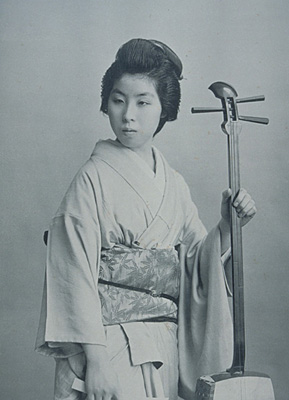
Yoshicho was also a lived-in neighborhood. Restaurants, training spaces and homes occupied the same streets. Its elegance depended on skilled labor and long working hours, not simply on a romantic image of geisha culture.
Amazake Yokocho Connected One Destination to Another
Amazake Yokocho takes its name from Owariya, a well-known shop that once sold amazake, a sweet fermented rice drink, near the entrance to the street.
The street succeeded because it connected places. Pedestrians used it to move between Ningyocho, Hamacho and later Meiji-za. Food shops, confectioners, restaurants and small retailers benefited from people passing through.
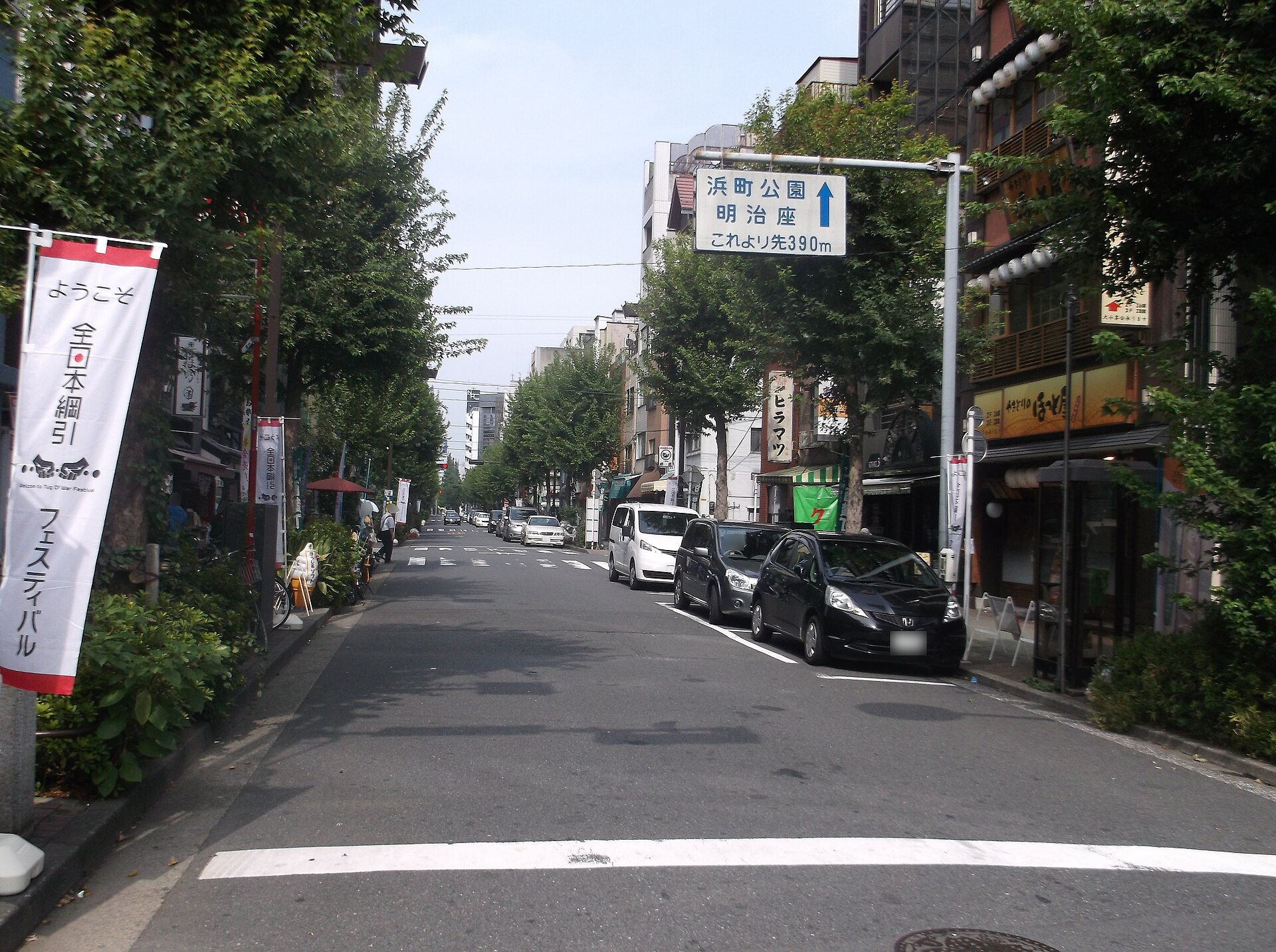
Individual businesses have changed, but the close relationship between pedestrians, food shops and the route toward Hamacho remains easy to see.
Earthquake, War and Reconstruction Changed the Buildings
The Great Kanto Earthquake of September 1, 1923, devastated much of Nihonbashi through collapse and fire. Roads were widened or realigned, plots were reorganized and fire-resistant construction became more important.
Ningyocho had existed as a popular place-name for centuries, but it became an official modern town name only in 1933. The neighborhood seen today is therefore partly a twentieth-century planning creation built over older theater, pleasure-quarter and commercial landscapes.
The March 1945 air raids brought further destruction. Some pockets survived more fully than others. Yoshi-ume Yoshicho-tei, an early Showa wooden restaurant building, preserves part of the prewar hospitality district and is now a registered cultural property.
Postwar Shopping Preserved Everyday Street Life
After the war, small shops, restaurants and services restored daily street life. Chuo City records that an arcade covered the Ningyocho shopping street from 1951 until August 1985.
The arcade was not an Edo survival, and its removal changed the street again. Yet shop owners, residents and office workers continued to share the same compact area. This mixture helped Ningyocho avoid becoming a single-purpose tourist district.
Why Ningyocho Still Feels Like a Merchant Neighborhood
Modern Ningyocho brings together old shops, sweets, festivals, Suitengu and memories of Edo entertainment. These are genuine parts of its identity, but they come from different periods.
What ties them together is not one untouched streetscape. It is the continued importance of walking and small-scale commerce. Ningyocho repeatedly turns visitors into customers and customers into street life.
What to Look For Today
The Former Theater Streets
Markers in and around present-day Ningyocho 3-chome identify Sakaicho and Fukiyacho. The theaters themselves are gone, so compare the plaques with the present street scale.
Suitengu and Kakigaracho
The shrine continues to bring families and worshippers into the district. Notice how restaurants, shops and transport routes gather around this active destination.
Amazake Yokocho
Notice how the street works as a route toward Hamacho rather than only as a row of famous shops.
Yoshicho Lanes and Yoshi-ume Yoshicho-tei
Selected lanes and the registered restaurant building preserve part of the prewar hospitality district. These are working and residential spaces, so observe from public streets and respect privacy.
How Ningyocho’s History Fits Together
| Historical layer | Main destination | Street economy | What remains today |
|---|---|---|---|
| Motoyoshiwara | Licensed pleasure quarter | Food, clothing, transport and services | Place memory, shrines and markers |
| Sakaicho and Fukiyacho | Kabuki and puppet theaters | Teahouses, meals, crafts, publishing and lodging | Theater-town markers and the Ningyocho name |
| Suitengu district | Shrine pilgrimage | Food, gifts and family-related commerce | Suitengu and surrounding visitor routes |
| Yoshicho | Restaurants and geisha entertainment | Performance, hospitality and specialist services | Selected lanes and Yoshi-ume Yoshicho-tei |
| Amazake Yokocho | Shopping route toward Hamacho | Food shops, sweets and daily retail | The street’s pedestrian commercial character |
| Contemporary Ningyocho | Heritage, worship, work and residence | Tourism beside everyday business | Compact streets where several audiences overlap |
Timeline
- 1590s–early 1600s: Edo expands through canals, raised ground and new town blocks.
- 1610s: Motoyoshiwara is authorized and opened in stages.
- 1624 onward: Licensed kabuki develops in Edo; Nakamura-za and Ichimura-za later settle in Sakaicho and Fukiyacho.
- 1657: The Great Fire of Meireki leads to the relocation of Yoshiwara.
- 1841–1843: The licensed theaters move to Saruwaka-cho near Asakusa.
- 1872: Suitengu moves to Kakigaracho.
- Late 1800s–early 1900s: Yoshicho flourishes as a geisha and restaurant district.
- 1923: The Great Kanto Earthquake devastates the area.
- 1933: Ningyocho becomes an official town name.
- March 1945: Air raids destroy large parts of the wider district.
- 1951–1985: An arcade covers the Ningyocho shopping street.
- Present: Worship, food, offices, tourism and residence continue to share the same compact streets.
Frequently Asked Questions
Why is the neighborhood called Ningyocho?
The name means “puppet” or “doll town.” It reflects the area’s Edo-period concentration of puppet theaters and the craftspeople who made, repaired, sold or operated puppets and dolls.
Was Yoshicho the same as Yoshiwara?
No. Motoyoshiwara was a licensed pleasure quarter. Yoshicho was a later geisha and restaurant district centered on trained performance and hospitality.
Why does Ningyocho still feel old-fashioned?
Its character comes less from one untouched streetscape than from compact blocks, pedestrian movement, small shops, food businesses and active institutions that continue older patterns of street life.
The Audiences Changed, but the Street Economy Survived
Ningyocho’s present form exists because the district repeatedly replaced one destination with another without losing its compact commercial routes.
Theaters first filled the streets with audiences and specialist workers. Suitengu redirected worshippers through the same area. Yoshicho added restaurants and performance culture. Amazake Yokocho linked later destinations with shops along the way.
That is why food shops, traditional businesses and everyday street life remain so visible today. Ningyocho is not simply a preserved fragment of Edo. It is a neighborhood whose old audience economy kept finding new customers.
Sources and References
- Ningyocho Shopping Street Cooperative: History of Ningyocho
- Chuo City: Ningyocho Then and Now
- Chuo City: Place-name history of Nihonbashi Kakigaracho
- Chuo City: Admission Tokens of the Three Licensed Edo Theaters
- Suitengu official history and shrine guide
- Japan Arts Council: The licensed Edo theaters and Saruwaka-cho
Related Neighborhood Histories
Explore the history of Nihonbashi for the wider merchant and transport district, or the history of Asakusa for Saruwaka-cho and the later geography of popular entertainment.
Walk Tokyo’s History with TimeWalk Japan
Ningyocho rewards slow observation: theater markers, shrine routes, food shops and lanes all reveal how the district replaced one audience with another. See upcoming English-friendly and bilingual events on the TimeWalk Japan Meetup page.