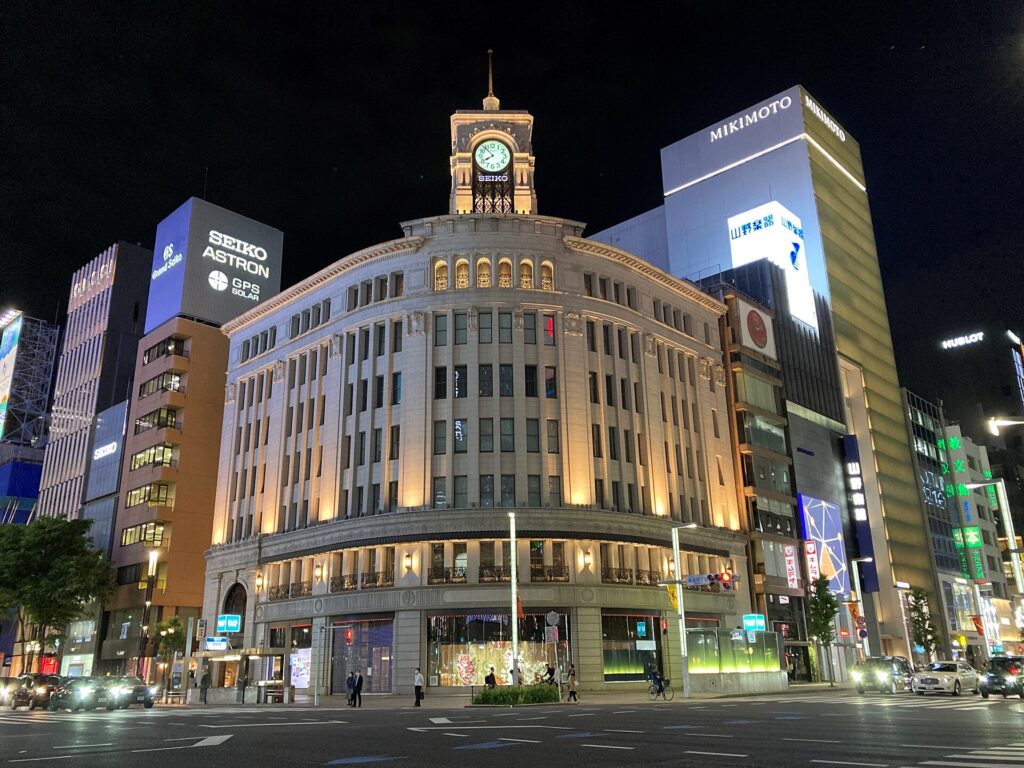
Tokyo’s most famous luxury street was originally a government mint—and its modern reputation began with a fire that destroyed almost everything. Ginza’s polished façades, clock tower and flagship stores can look timeless, but the district has repeatedly been burned, rebuilt and rebranded. Its prestige was manufactured through silver, brick, newspapers, streetcars, department stores and carefully managed public space.
The name itself preserves the first layer. In the early seventeenth century, the Tokugawa shogunate established a ginza, an officially authorized organization connected with silver coinage, in this part of Edo. More than two centuries later, the Meiji government used the ruins of the 1872 Ginza Fire to build a Western-style Bricktown near Japan’s first railway terminus. The buildings initially suited neither every merchant nor every household, yet they turned the district into a national showcase for modern urban life.
Modern Ginza exists because each reconstruction strengthened the same basic role: this was the place where Tokyo displayed what was new. Newspapers and telegraph poles made information visible; cafés and department stores transformed shopping into leisure; earthquake and wartime rebuilding produced larger commercial blocks; and the pedestrian precinct turned the avenue itself into an attraction. Luxury did not create Ginza. Ginza’s long history of staging modernity created the value that luxury brands later came to buy.
Quick Facts
- Japanese name: 銀座
- Municipality: Chuo City, Tokyo
- Main access: Ginza, Higashi-ginza, Ginza-itchome, Yurakucho and Shimbashi stations
- Historical core: Ginza-dori and the surrounding former Kyobashi districts
- Main historical layers: silver mint, Edo commerce, Meiji Bricktown, newspapers and advertising, cafés and department stores, earthquake reconstruction, wartime destruction, postwar recovery and pedestrian-oriented retail
Why Ginza Became Tokyo’s Showcase
Ginza occupied a strategic corridor between the political center around Edo Castle, the commercial districts of Kyobashi and Nihonbashi, the theater world of Kobikicho, the foreign settlement at Tsukiji and the railway gateway at Shimbashi. The north–south avenue was therefore not an isolated shopping street. It connected government, transport, entertainment, trade and international contact.
This location repeatedly attracted institutions that depended on visibility. Mints needed official control, newspapers needed fast access to information, advertisers needed crowds, department stores needed transport and luxury companies needed prestigious addresses. Ginza became valuable because it allowed organizations to be seen at the center of Tokyo’s public life.
The Silver Mint behind the Name
The place-name comes from the shogunate-authorized silver-mint organization established here in the early Edo period, commonly dated to 1612. The word za referred to an organized and licensed body rather than a modern bank or factory. Silver coinage required official supervision, testing, metal supply and specialized labor.
The minting function later moved away, but the name remained. This survival is important: Ginza’s identity continued even after the institution that created the name disappeared. The district would repeat that pattern many times, retaining prestige while its buildings and businesses changed.
Ginza in the Edo Commercial City
Edo-period Ginza formed part of a dense wooden city crossed by roads, bridges and canals. It stood near Nihonbashi’s wholesale economy but did not duplicate it. Craftspeople, retailers, food sellers, money-related businesses and service trades occupied the district, while nearby waterways connected it with the distribution system of the castle town.
The modern address called Ginza includes areas that once had other names, including parts of Kobikicho and neighboring Kyobashi districts. Historical Ginza is therefore best understood as a changing commercial corridor rather than a perfectly fixed boundary.
The 1872 Fire Created an Urban Experiment
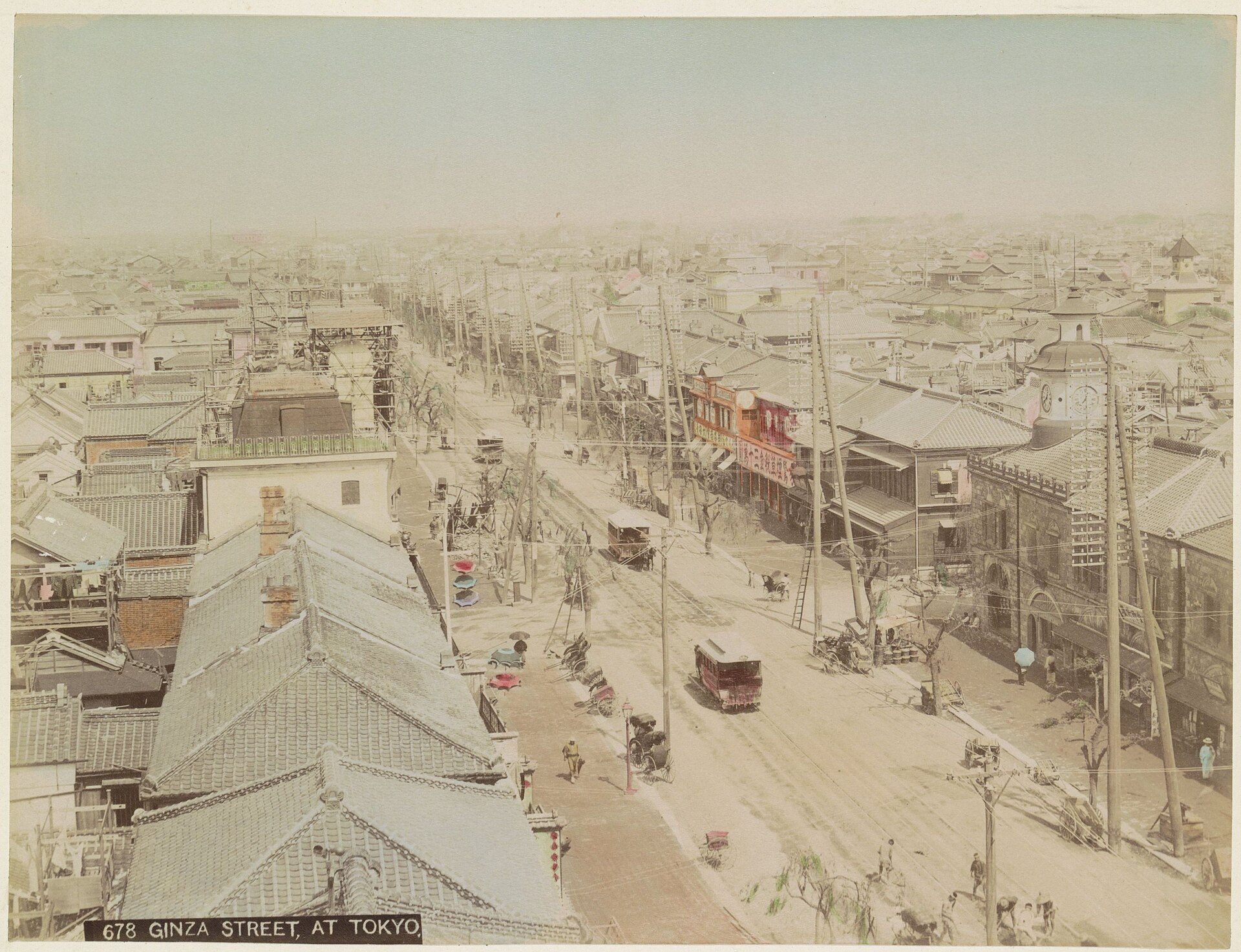
On April 3, 1872, a major fire destroyed much of Ginza and surrounding districts. Fire had long been a recurring danger in wooden Edo, but the new Meiji government treated this disaster as an opportunity to demonstrate a different kind of capital.
The timing was politically powerful. Japan’s first railway between Shimbashi and Yokohama opened later that year. A rebuilt Ginza could connect the railway terminus with central government while presenting foreign diplomats, travelers and Japanese residents with a visible symbol of modernization.
Bricktown Was Impressive—and Impractical
The government planned broad streets, sidewalks, drainage, gas lighting and rows of Western-style brick buildings. British engineer and architect Thomas James Waters played a central role. The resulting district became known as the Ginza rengagai, or Bricktown.
The project introduced coordinated fire-resistant construction and a regular street façade, but it did not work exactly as officials imagined. Buildings were expensive, some layouts did not suit Japanese patterns of shopkeeping and residence, and tenants faced unfamiliar rents and maintenance problems. Vacancies appeared.
Yet the imperfect project permanently changed Ginza’s image. The wide avenue, brick façades, gaslights and proximity to Shimbashi made the district a stage on which businesses could advertise novelty. Bricktown’s greatest success was symbolic: it established Ginza as the place where Tokyo displayed the future.
Newspapers Turned the Street into a Medium
Newspaper publishers, printers and photographers found the new district useful. Ginza became associated with press offices, news gathering and advertising. Reporters, compositors, messengers, writers and advertisers moved through the same streets, while headlines and posters transformed building façades into channels of information.
This concentration changed commerce. Shops used newspaper advertisements, branded packaging and increasingly elaborate window displays. Ginza did not merely sell modern products; it taught urban consumers how modern products should look and how they should be desired.
Railways and Streetcars Created a Mass Audience
The Shimbashi railway terminus brought passengers close to Ginza from 1872. Horse-drawn streetcars, electric streetcars and later the subway increased the number and variety of people passing through the district. Ginza Station opened in 1934 as the underground line extended toward Shimbashi.
Transport changed more than access. It made corner sites, signs and shop windows more valuable because businesses could address people moving through the city rather than only nearby residents. Ginza became an urban sequence viewed from cars, streetcars and sidewalks.
Cafés and Department Stores Made Shopping into Leisure
Shiseido, founded in Ginza in 1872 as a Western-style pharmacy, opened a soda fountain in 1902 and later developed the restaurant associated with Shiseido Parlour. Cafés multiplied during the 1910s and 1920s, serving coffee, alcohol and Western-style food. Some became meeting places for writers and artists; others belonged to a commercial nightlife economy shaped by female service labor.
Department stores deepened the transformation. Matsuzakaya opened in Ginza in 1924, Matsuya Ginza in 1925 and Ginza Mitsukoshi in 1930. Their elevators, restaurants, exhibitions, food halls and seasonal displays turned shopping into a family excursion. Customers could browse goods in a managed environment without negotiating every purchase.
Large stores did not eliminate specialist businesses. Stationers, confectioners, watch dealers, jewelers, tailors, galleries and restaurants gave Ginza a dense commercial texture. Department stores supplied crowds; distinctive smaller shops supplied expertise and character.
The Great Kanto Earthquake Built a New Ginza
The Great Kanto Earthquake struck on September 1, 1923. Fire devastated Ginza and destroyed most of the nineteenth-century Bricktown landscape. The disaster demonstrated that brick walls alone could not make a city safe: roofs, interiors, neighboring buildings, water supply and firefighting access all mattered.
Reconstruction widened roads and encouraged larger reinforced-concrete buildings. Taimei Elementary School, completed in 1929, survives as an important reconstruction school. Commercial rebuilding accelerated the rise of department stores and modern retail blocks. The Ginza that became famous in the 1930s was therefore largely a post-earthquake city rather than a surviving Meiji streetscape.
War Destroyed the District Again
Wartime controls restricted luxury consumption and redirected materials. Air raids in 1945 burned most of Ginza. After Japan’s surrender, some prominent buildings were requisitioned by Allied forces, while food shortages and damaged infrastructure shaped daily life.
Recovery required more than rebuilding façades. Merchants had to restore supply networks, train staff, reopen shops and rebuild customer trust. Ginza’s prewar prestige gave businesses an advantage, but its luxury image had to be created again under postwar conditions.
Why Global Luxury Brands Chose Ginza
During Japan’s high-growth decades, rising incomes and suburban rail travel enlarged the consumer market. Japanese businesses—including Wako, Shiseido, Matsuya, Mitsukoshi, Itoya and specialist merchants—developed sophisticated traditions of service, packaging, architecture and seasonal display.
International fashion houses later chose Ginza because the district already carried this accumulated prestige. Their flagship buildings strengthened its global luxury image, but they did not invent it. They purchased access to a place-name whose value had been produced by centuries of institutional and commercial history.
The Street Itself Became an Attraction
The pedestrian precinct introduced in the postwar era added another layer to Ginza’s history of managed movement. Closing part of the avenue to vehicles created space for walking, window-shopping and people-watching. The street became a shared commercial environment rather than simply a route between stores.
Local merchant and street organizations help coordinate festivals, cleanliness, lighting, public information and the district’s visual identity. Ginza’s reputation is therefore collectively managed. The neighborhood functions as a brand, but that brand depends on constant cooperation among businesses and public authorities.
What Historical Traces Can Be Seen Today
- Ginza 4-Chome Crossing: the symbolic center of the modern district.
- Wako clock tower: the 1932 landmark connecting watchmaking, transport and urban time.
- Ginza Brick Monument: a reminder of the Meiji Bricktown project.
- Ginza-dori: the avenue shaped by fire reconstruction, streetcars, retail and pedestrian use.
- Taimei Elementary School: a surviving reinforced-concrete reconstruction school completed in 1929; view respectfully from public streets.
- Shiseido, Matsuya and Mitsukoshi: institutions that helped make Ginza a center of modern consumption.
- Kabukiza and Higashi-ginza: evidence of the long relationship between theater, media and commercial crowds.
- Side streets and small shrines: finer-grained traces that survive behind large flagship façades.
Timeline
| 1612 | The shogunate’s silver-mint organization is commonly dated as moving to the future Ginza area. |
| 1872 | A major fire destroys the district; the Bricktown project and Shimbashi–Yokohama railway follow. |
| 1870s | Brick buildings, gaslights, sidewalks and drainage reshape the avenue. |
| Late nineteenth century | Newspapers, advertising and modern transport strengthen Ginza’s public role. |
| 1923 | The Great Kanto Earthquake and fires devastate the district. |
| 1924–1930 | Major department stores establish Ginza as a consumer destination. |
| 1932 | The present Wako clock-tower building is completed. |
| 1934 | The subway reaches Ginza. |
| 1945 | Air raids burn most of the district. |
| Postwar decades | Retail, restaurants and cultural life recover; pedestrian use becomes a defining feature. |
| Today | Japanese institutions and international flagship stores share a carefully managed luxury district. |
Why Modern Ginza Exists
Ginza became Tokyo’s most influential shopping district because repeated destruction gave governments and merchants repeated opportunities to redesign it. The silver mint created the name. The 1872 fire created Bricktown. Newspapers made the avenue a center of information. Transport brought a mass audience. Cafés and department stores turned consumption into public culture. Earthquake and war produced larger rounds of reconstruction, while local organizations made the street itself part of the experience.
The polished district visible today is therefore not a timeless enclave of wealth. It is the latest version of a place that Tokyo has used for four centuries to display authority, technology, taste and commercial confidence.
Related Neighborhood Histories
Continue with the history of Nihonbashi, explore the nearby international and market district in the history of Tsukiji, or browse all Tokyo Neighborhood Histories.