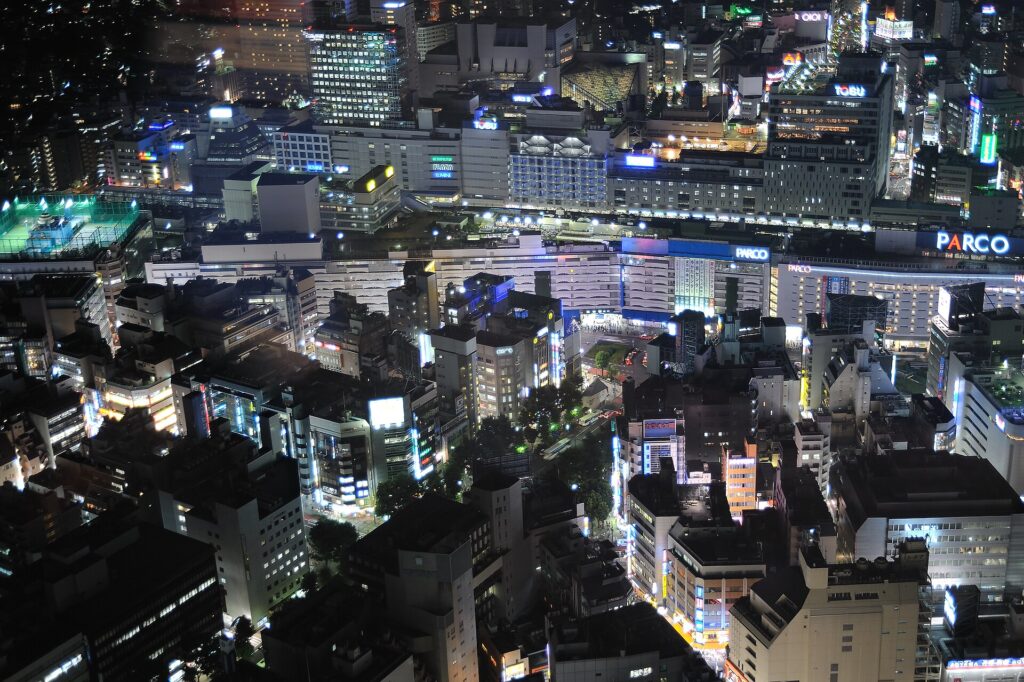
Ikebukuro’s best-known skyscraper stands on part of the site of a former prison where wartime leaders were executed.
That contrast is not an isolated curiosity. Modern Ikebukuro grew where radically different landscapes met: a farming village on the Musashino Plateau, a railway junction built outside an established town center, suburban lines reaching into Saitama and western Tokyo, an educational quarter around Rikkyo University, artists’ studios, Sugamo Prison, wartime ruins, postwar markets and metropolitan redevelopment. Sunshine City’s transformation from closed institutional land into offices, shops and entertainment is the district’s most dramatic example of this repeated reinvention.
Modern Ikebukuro exists because transport concentrated people while large institutions divided the land around them. Railway companies and department stores shaped the station, Rikkyo University gave the west side an academic character, and the prison site later enabled large-scale redevelopment in the east. War and postwar markets added another commercial layer. The result is not one uniform “Ikebukuro culture,” but a divided and connected subcenter whose contrasting parts preserve the history of how they were made.
Quick facts
- Japanese name: 池袋
- Municipality: Toshima City, Tokyo
- Main access: Ikebukuro Station and Higashi-ikebukuro Station
- Core historical layers: rural village, railway junction, private-railway suburbs, university district, artist colonies, prison landscape, wartime destruction, postwar markets, department stores, subcenter planning and contemporary cultural industries
- Ikebukuro Station: opened in 1903
- Rikkyo University: moved to Ikebukuro in 1918
- Sunshine City: developed on part of the former prison site and opened in stages from the late 1970s
Why Ikebukuro became a railway, retail and cultural subcenter
Ikebukuro became one of Tokyo’s major subcenters because different transport and urban systems accumulated around the same node. The station linked the western side of the future Yamanote loop with routes toward Akabane and northern Japan. Private railways later brought commuters and shoppers from expanding suburbs. Their terminal businesses placed department stores directly beside the platforms. Rikkyo University and new housing shaped the west, while the prison site and later large-scale commercial development shaped the east.
War destroyed much of the station district, but it also created cleared and contested spaces in which markets, cinemas and new retail networks appeared. Postwar railway companies, merchants and public planners then reinforced Ikebukuro’s role as a northern gateway. Tokyo’s subcenter policy and the conversion of former institutional land into Sunshine City added offices, hotels, entertainment and a high-rise skyline. Contemporary anime, manga and stage culture grew within this already dense system; it was not the automatic successor of any single prewar artistic movement.
Ikebukuro Village on the Musashino Plateau
Before the station, Ikebukuro was a village landscape on the Musashino Plateau. Fields, farmsteads, woodland and narrow roads occupied ground that now appears completely urban. The plateau was relatively well drained, but agriculture depended on wells, small watercourses and careful use of the land. The name Ikebukuro is old, although explanations connecting it to a particular pond or bag-shaped hollow vary and should be treated as local etymology rather than certain fact.
During the Edo period, Ikebukuro Village lay beyond the dense built-up city. Nearby highways and post towns mattered more to long-distance traffic than the village itself. Produce and labor moved toward Edo, but there was no large castle town, temple precinct or market here to predetermine a future urban center. That absence later became important: the railway station could reorganize land around a new point rather than simply serving an existing downtown.
Why the railway station changed the area
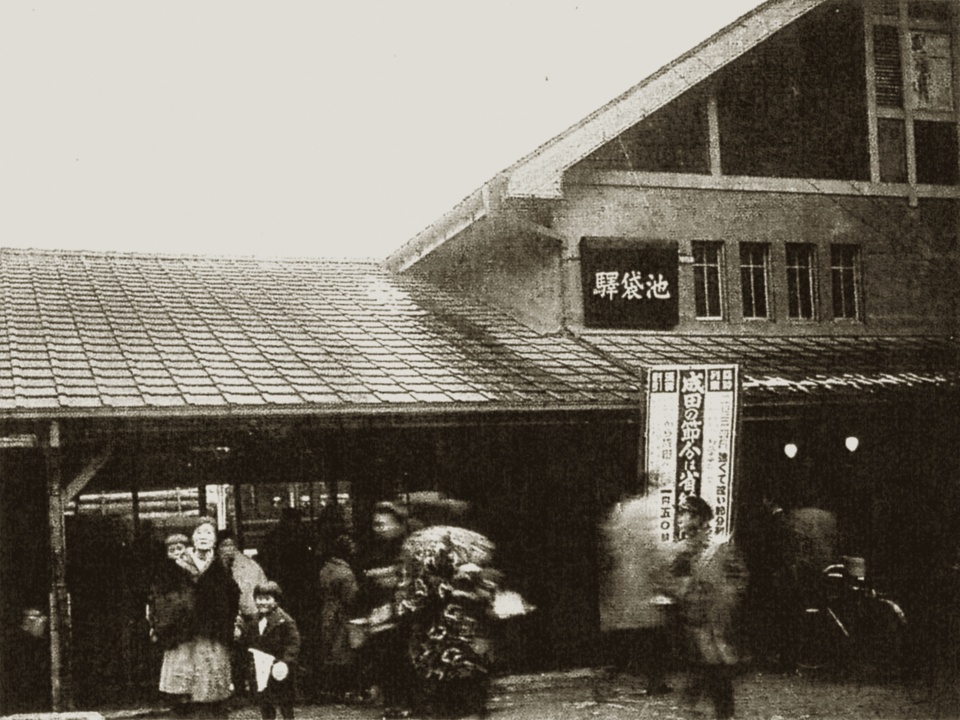
The early railway did not initially make Ikebukuro an important stop. The Shinagawa Line, opened in 1885 between Shinagawa and Akabane, crossed the area as part of the network that later became the western Yamanote Line. Ikebukuro Station opened in 1903 when a new line toward Tabata created a junction. In 1909 the connected routes were grouped under the Yamanote Line name, and the loop was completed through central Tokyo in 1925.
A junction station changes more than travel time. It concentrates transfers, railway employment, freight handling and land speculation. Roads are redirected toward entrances, shops appear along passenger flows, and housing becomes attractive within walking distance. Because Ikebukuro lacked a strong pre-railway center, the station itself became the organizing principle of the modern district.
The growth of the Yamanote Line and private railways
Ikebukuro’s reach expanded when suburban railways made it their Tokyo terminal. The line now known as the Tobu Tojo Line opened from Ikebukuro in 1914, connecting the station with northwestern suburbs and the Kawagoe area. The Musashino Railway, predecessor of today’s Seibu Ikebukuro Line, began service from Ikebukuro in 1915 toward western Saitama. Later subway lines and through services multiplied the station’s connections.
These railways did not merely deliver passengers. They helped create the suburbs from which the passengers came. Residential development, leisure destinations, schools and commercial facilities along the lines increased traffic, while terminal shops captured spending in Ikebukuro. The station therefore became both a transfer point and a marketplace for a growing northern and western metropolitan region.
Why the east and west sides developed differently
The railway tracks divided movement and land use. On the east side, the Seibu terminal, major retail, entertainment streets and the road toward Higashi-ikebukuro became dominant. Farther east stood Sugamo Prison and, later, Sunshine City. On the west side, the Tobu terminal faced neighborhoods shaped by Rikkyo University, residential development and smaller commercial streets. The two sides were connected through the station but did not share the same institutions or sequence of growth.
Department-store names make the geography memorable but also confusing: Seibu is on the east side, while Tobu is on the west. This arrangement reflects the terminals and corporate histories of the railway groups, not the cardinal directions in their names. Each company used retail and property development to secure passenger flows, but municipal projects, independent merchants, schools and entertainment businesses also shaped the district.
Rikkyo University and the western residential district
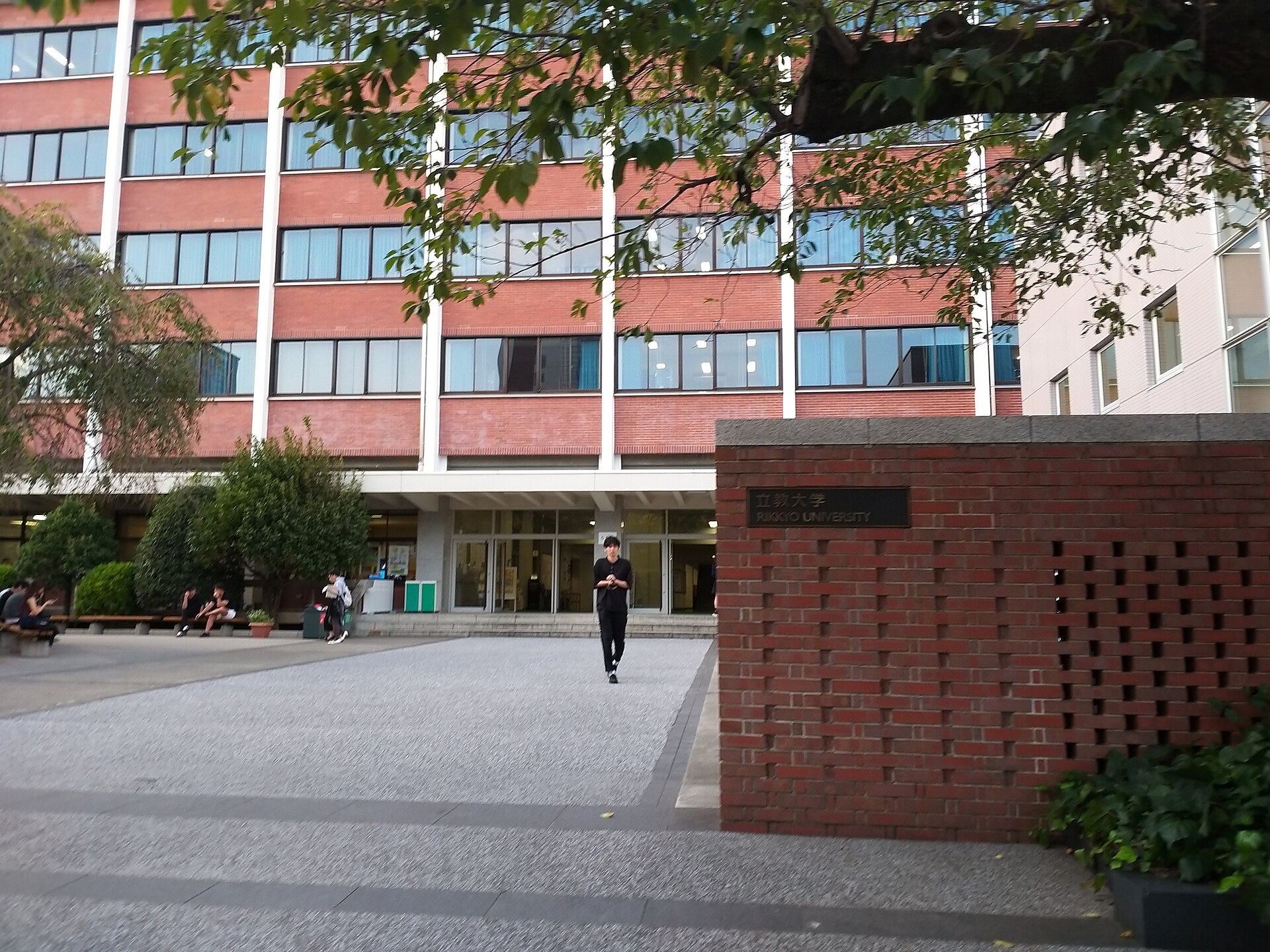
Rikkyo traces its origin to a school founded in Tsukiji in 1874. It relocated to Ikebukuro in 1918, when the area still had a suburban character and offered enough land for a campus. The university’s brick buildings, chapel and tree-lined grounds created a durable institutional center west of the station. The move brought students, faculty, housing demand, bookshops, cafes and everyday services.
The campus did not instantly urbanize all of western Ikebukuro, but it gave the area a different rhythm from the eastern terminal district. Educational activity and residential streets coexisted with railway commerce. As Tokyo expanded, the once-suburban campus became an architectural enclave inside a dense city.
Ikebukuro Montparnasse and the artist villages
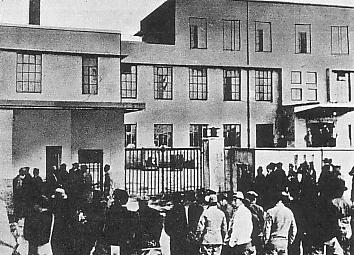
From the late Taisho into the early Showa period, inexpensive land and access to central Tokyo attracted artists to the wider Ikebukuro area. Purpose-built rental studios and clusters of modest ateliers appeared around what are now western Toshima neighborhoods. Writers and artists later used the name “Ikebukuro Montparnasse,” comparing the scene to the Paris district associated with modern art.
The label describes a network rather than a single bounded quarter. Painters, poets, actors and other cultural workers met in studios, cafes and small theatres, but their styles and politics differed. Some achieved national recognition; many lived precariously. Wartime mobilization, censorship, conscription and air raids broke apart the prewar communities, while redevelopment erased many physical traces.
Ikebukuro’s contemporary subculture should not be presented as a direct continuation of these atelier villages. The two histories share a district and an association with creative work, but they arose from different industries, audiences and urban conditions. Remembering both reveals repeated cultural reinvention rather than one unbroken lineage.
Sugamo Prison and the eastern edge of Ikebukuro
East of the station stood a very different institution. A modern prison was established here in the Meiji period and became known as Sugamo Prison. It formed part of Japan’s modern penal system and held political prisoners as well as people convicted of other offenses. High walls, controlled access and government land separated the prison landscape from the commercial streets developing near the station.
The name can mislead modern visitors because the site was close to Ikebukuro and Higashi-ikebukuro rather than today’s familiar Sugamo shopping district. Its location on the eastern side later made the prison site central to one of Tokyo’s most dramatic changes in land use.
Tokyo air raids and the destruction of the station district
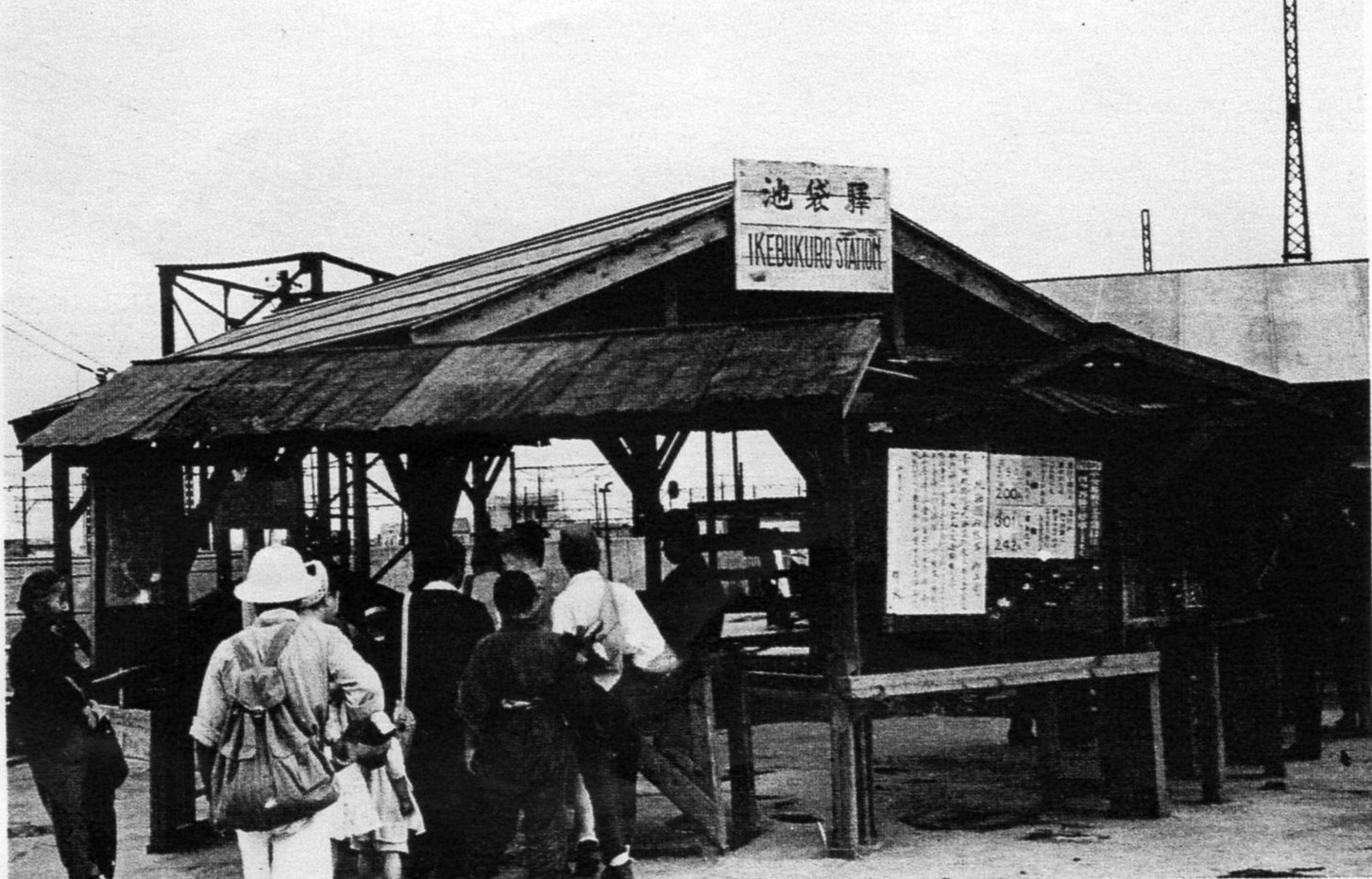
Air raids in 1945 devastated large areas around Ikebukuro. The station and surrounding neighborhoods suffered severe damage, homes and shops burned, and transport operated under emergency conditions. Destruction was not confined to one night or one side of the station. The experience of bombardment, evacuation and loss reshaped the population and the built environment.
Photographs of the temporary postwar station show infrastructure functioning amid ruins. They should be read as evidence of emergency recovery, not as a picturesque stage in inevitable progress. Railway service was essential for food, work and the movement of people at a time when formal distribution systems were weak.
Black markets and new commercial networks
In the first postwar years, markets appeared around major stations because people needed food, clothing and household goods that official rationing could not reliably supply. Ikebukuro’s passenger flows and damaged urban land made it one of the places where informal and semi-formal commerce expanded. Vendors, returning soldiers, displaced families, established merchants and organized groups competed and cooperated in unstable conditions.
These markets helped restart urban life, but they do not alone explain today’s commercial district. Municipal regulation, land readjustment, railway-company investment, department stores, cinemas and later redevelopment transformed or displaced many early postwar businesses. The modern entertainment streets are products of repeated reorganization, not preserved black markets.
Department stores, cinemas and entertainment
Terminal department stores made the station itself a destination. The Seibu and Tobu groups expanded retail on opposite sides, combining transport, shopping, dining and cultural programming. Independent stores and shopping streets filled the surrounding blocks. Cinemas, music venues, game centers and nightlife businesses benefited from an audience already passing through the station.
Ikebukuro’s entertainment geography was never uniform. Family-oriented retail, adult nightlife, student cafes and large cultural institutions occupied nearby but distinct zones. Their coexistence came from the station’s enormous catchment area and from land uses produced in different periods.
Sugamo Prison under the Allied Occupation
After Japan’s surrender, the Allied occupation authorities used Sugamo Prison to detain people accused or convicted of war crimes. Seven Class-A war criminals, including former prime minister Tojo Hideki, were executed there in December 1948. Other prisoners served sentences or were released as occupation policy changed. The site therefore carries difficult memories of imperial Japan, war, occupation justice and later political debate.
The prison was returned to Japanese control, continued under the name Tokyo Detention House and closed after that institution moved to Kosuge in 1971. Demolition and redevelopment followed. Sunshine City was built on part of the former complex, not by simply converting the prison buildings themselves.
From prison site to Sunshine City
The redevelopment of the former prison land replaced a closed state institution with offices, shops, a hotel, exhibition facilities, an aquarium and entertainment. Sunshine 60, completed in 1978, became one of Japan’s most prominent high-rise buildings and gave eastern Ikebukuro a new skyline. The larger Sunshine City complex opened in stages and drew pedestrian movement beyond the immediate station frontage.
The transformation was symbolic but incomplete. A memorial stone in Higashi-ikebukuro Central Park marks the execution site, preserving a fragment of the prison’s history beside spaces of recreation and commerce. The contrast is one of Ikebukuro’s clearest examples of layered land use: the present does not erase the past, but neither does the current complex preserve the prison intact.
Tokyo’s subcenter policy
Postwar Tokyo planners promoted subcenters outside the traditional central business districts to distribute offices, shopping and transport demand. Ikebukuro, Shinjuku and Shibuya were already major railway nodes, so policy reinforced trends created by private railways and commercial investment. Road projects, station improvements, high-rise development and public facilities strengthened Ikebukuro’s metropolitan role.
Policy did not produce a perfectly coordinated city. Pedestrian routes remained complicated, east-west movement depended heavily on station passages, and redevelopment projects proceeded at different speeds. Ikebukuro’s power as a subcenter comes partly from this mixture of planned complexes and dense, incremental street development.
The Tokyo Metropolitan Theatre and public culture
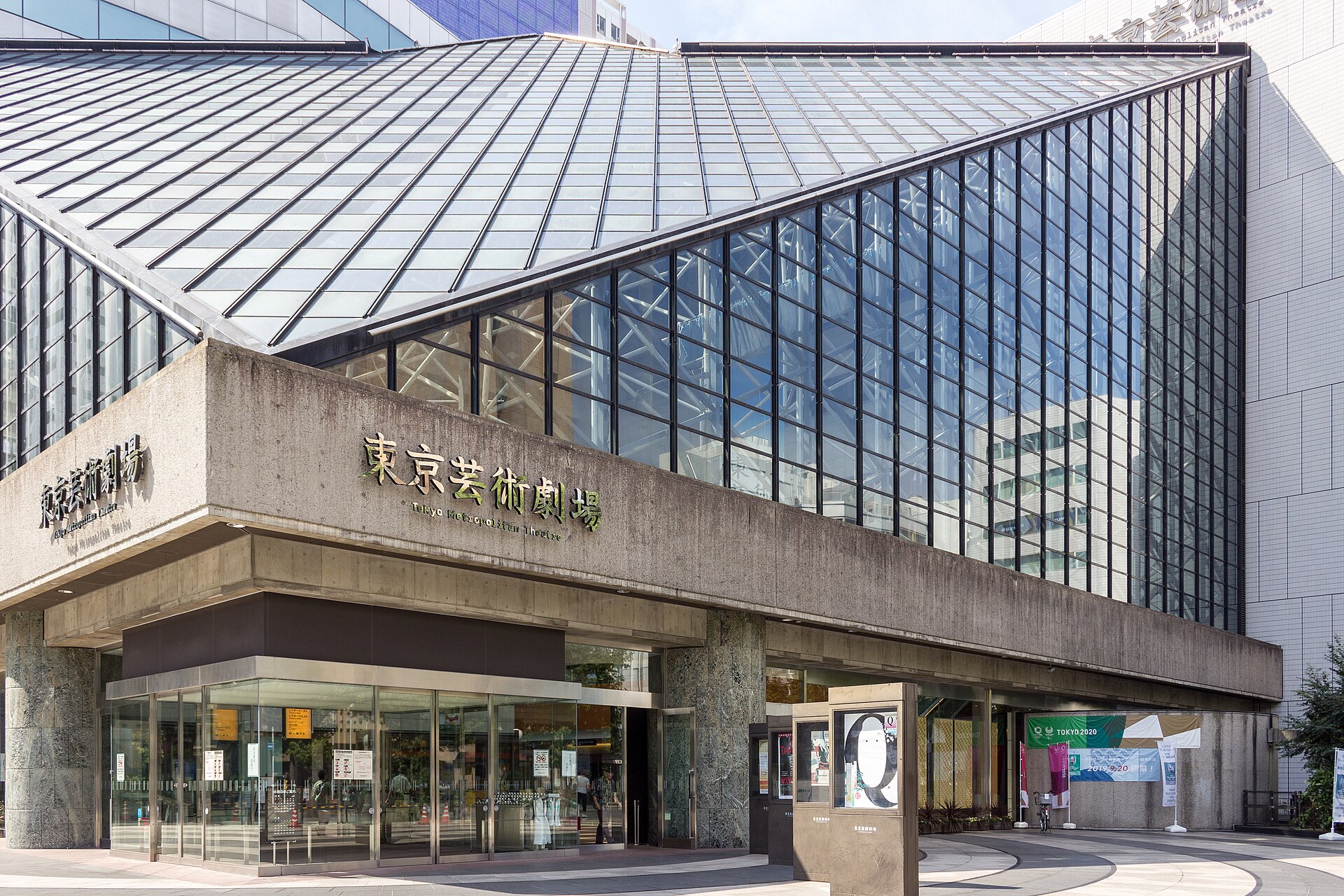
The Tokyo Metropolitan Theatre opened beside the west exit in 1990. Its concert hall and performance spaces gave public cultural policy a major architectural presence near the station. The theatre joined Rikkyo University, commercial stages and smaller performance venues in a western cultural landscape distinct from the large retail and entertainment complexes of the east.
Anime, manga, theatre and contemporary subculture
Contemporary Ikebukuro is a major center for manga, anime, games, cosplay and live performance. Large stores, themed cafes, event spaces and cinemas cluster especially east of the station and around Sunshine City. Otome Road became known for businesses serving female fans, helping distinguish Ikebukuro from the electronics and male-oriented fan culture often associated with Akihabara.
This cultural economy rests on retail concentration, railway access, publishing and media industries, event infrastructure and active fan communities. It changes quickly: individual shops open, move and close. The durable historical point is the district’s ability to assemble specialized audiences at a metropolitan transport hub.
International commerce and the changing north side
North and northwest of the station, restaurants, food shops, travel services and other businesses connected with Chinese-speaking communities have become increasingly visible. This international commercial landscape reflects recent migration, education, tourism, entrepreneurship and metropolitan labor networks. It should not be treated as an unchanged continuation of the immediate postwar market.
The area also contains hotels, nightlife and long-established Japanese businesses. Its character is mixed and constantly changing. Describing it only as a single ethnic enclave would hide the diversity of residents, customers and enterprises that share the streets.
What historical traces can be seen today
- Ikebukuro Station: the railway junction remains the organizing center, although its buildings and passages are products of repeated reconstruction.
- Rikkyo University: the campus preserves the institutional presence established by the 1918 relocation; the present photograph above shows the modern campus, not its original suburban setting.
- Former atelier-village areas: markers and local cultural projects recall Ikebukuro Montparnasse, while most studios have disappeared.
- Higashi-ikebukuro Central Park: a memorial marks the former prison and execution site near Sunshine City.
- Sunshine City: the complex reveals the scale of redevelopment on former government land.
- East-west terminal landscape: Seibu on the east and Tobu on the west make railway-company urbanism visible.
- Tokyo Metropolitan Theatre: the west-exit plaza shows the postwar addition of large public cultural facilities.
- North-side commercial streets: contemporary international businesses reveal a newer layer of metropolitan migration and commerce.
Timeline
| Date | Event |
|---|---|
| Edo period | Ikebukuro is a rural village on the Musashino Plateau outside the dense city. |
| 1885 | The Shinagawa–Akabane railway line opens through the area. |
| 1903 | Ikebukuro Station opens as the line toward Tabata creates a junction. |
| 1909 | Connected routes are organized under the Yamanote Line name. |
| 1914 | The predecessor of the Tobu Tojo Line opens from Ikebukuro. |
| 1915 | The Musashino Railway, predecessor of the Seibu Ikebukuro Line, opens from Ikebukuro. |
| 1918 | Rikkyo relocates from Tsukiji to Ikebukuro. |
| 1920s–1930s | Artists’ studios and networks later called Ikebukuro Montparnasse develop in the wider area. |
| 1945 | Air raids destroy much of the station district. |
| 1945–1950s | Postwar markets, entertainment and commercial reconstruction reshape the station area. |
| 1945–1958 | Occupation authorities use Sugamo Prison for suspected and convicted war criminals. |
| 1971 | The detention facility closes after its functions move to Kosuge. |
| 1978 | Sunshine 60 opens as the central tower of the new Sunshine City complex. |
| 1990 | The Tokyo Metropolitan Theatre opens at the west exit. |
| Late 20th–21st century | Anime, manga, theatre and international commerce add new cultural layers. |
Frequently asked questions
Was Ikebukuro important before the railway?
It was an established farming village, but not a major Edo commercial center. The railway junction created a new focus for urban growth.
When did Ikebukuro Station open?
Ikebukuro Station opened in 1903, when the new connection toward Tabata made the site a junction.
Why are Seibu and Tobu on “opposite” sides?
Seibu’s terminal and department store are on the east side, while Tobu’s are on the west. The names belong to railway companies and their historical routes, not to the station exits.
What was Ikebukuro Montparnasse?
It was a loose network of artist studios and cultural circles in and around prewar Ikebukuro, not one official district with fixed boundaries.
Was Sunshine City built directly from Sugamo Prison?
No. The detention facility closed, buildings were removed and the land was redeveloped. Sunshine City occupies part of the former complex, while a nearby memorial preserves the prison’s history.
Is today’s anime culture a continuation of Ikebukuro Montparnasse?
Not directly. Both belong to Ikebukuro’s cultural history, but they emerged from different periods, media industries, audiences and urban networks.
Conclusion: read Ikebukuro as a divided and connected city
Ikebukuro’s history cannot be reduced to the arrival of a railway. The station mattered because it became a junction, private railways tied it to expanding suburbs, university and residential development gave the west a distinct institutional character, and prison land constrained and later enabled large-scale change in the east. War destroyed the existing town, postwar markets restarted commerce, railway groups and independent businesses rebuilt entertainment, and metropolitan policy reinforced the district as a subcenter.
Walk from Rikkyo’s brick campus to the west-exit theatre, cross the station beneath the tracks, continue through the east-side retail streets and finish at Sunshine City and the prison memorial. The route reveals not one historical Ikebukuro but several urban systems pressed together. That compression—village, junction, suburb, campus, artist colony, prison, market, department store, theatre and media district—is what made Ikebukuro distinctive.
Related stories and walks
- The History of Tsukiji — follow Rikkyo’s earlier history from the Tsukiji foreign settlement before its move to Ikebukuro.
- Tokyo Neighborhood Histories — compare Ikebukuro with other districts shaped by railways, institutions, disaster and redevelopment.
- Self-Guided Walks — browse currently published historical walking routes.
Walk Tokyo with us
TimeWalk Japan organizes history, art and walking meetups in and around Tokyo. Visit the HOJ — Hang out in Japan Meetup page to see current events.
Sources and further reading
- Toshima City official website — local history, cultural policy and urban planning materials.
- Toshima City Local History Museum — exhibitions and research on the district’s history.
- JR East: history of the Yamanote Line.
- Rikkyo University: History and Mission.
- Tokyo Metropolitan Theatre official website.
- Sunshine City official website.
- Tokyo Metropolitan Government Bureau of Urban Development — subcenter and redevelopment planning materials.
- National Diet Library Digital Collections and Tokyo Metropolitan Archives — historical maps, photographs and planning records.