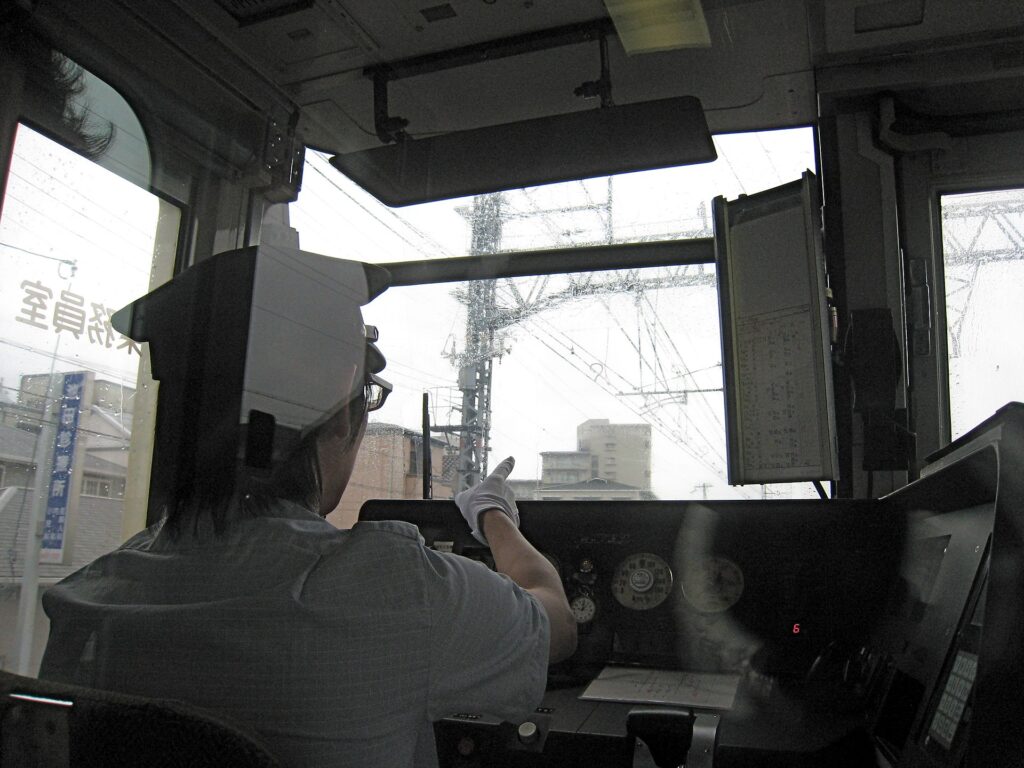
Japanese railway workers point and call because the action turns a routine check into a deliberate, multisensory act. The worker directs the eyes and hand toward a specific signal, indicator, platform area or operating condition, then states what has been seen or what must happen next. This makes a mismatch easier to notice before an action is taken. In Japanese the practice is commonly called shisa kankō (指差喚呼), usually translated as “pointing and calling.”
To passengers, the movement can look theatrical: an extended arm, a clear voice and a sharply defined pause in an otherwise fluid sequence of work. Yet it is not a performance for its own sake. It is a human-factors technique designed for safety-critical work, especially work that is repetitive enough to become automatic. Its value lies not in the finger alone, but in making the object, the spoken description and the intended action agree.
The practice developed in Japanese railway operations and later spread into stations, maintenance, construction, manufacturing, road transport and other fields. Similar methods are also used outside Japan. Names, gestures and phrases vary by company, job and operating environment, so no single photograph or shouted phrase can represent every railway.
What exactly is pointing and calling?
Shisa kankō combines two elements. Shisa means pointing at a target. Kankō means calling out a confirmation. A worker may point at a signal aspect, a speed indication, a door-status lamp, the end of a platform, a switch position or another defined object. The call identifies the condition or the next required action. The purpose is self-checking: the same person creates an observable link between perception and action.
Related Japanese terms are not always used identically. Shisa koshō (指差呼称), “pointing and naming,” is common in occupational safety and often emphasizes naming the object and its state. Shisa kakunin (指差確認), “pointing confirmation,” can describe a check that includes pointing but may not imply a vocal call. Railway organizations often use shisa kankō, but terminology differs across industries and historical sources. These labels overlap; they should not be treated as perfectly interchangeable technical standards.
The call is also not simply a stock phrase. “Shuppatsu shinkō,” often rendered as “departure, proceed,” is widely recognized in popular culture, but real calls depend on what is being checked and on company procedures. A driver checking a signal, a conductor checking the platform and a maintenance worker checking an isolation point are performing different tasks.
Why a large gesture helps in repetitive work
Railway work contains many highly practiced sequences. Skill is essential, but skill also creates a risk: actions can become automatic. A person may look in the right direction without fully processing what is there, or may carry out the usual action when conditions are unusual. Pointing and calling inserts a small interruption into that automatic flow.
The gesture makes the target concrete. Instead of a broad glance at a control panel or platform, the worker selects one object. The spoken call gives that object a verbal label. The slight delay gives the brain time to compare the observed state with the expected state. If the two do not match, the discrepancy has a chance to surface before the next operation.
The five human-factors mechanisms
The Railway Technical Research Institute (RTRI) has described five mechanisms by which pointing and calling can reduce errors. These mechanisms should be understood as experimentally examined functions of the method, not as a claim that every use in every setting has the same effect.
1. Pointing focuses visual attention
A finger acts as a physical index. It helps direct the eyes toward a defined target and can reduce the chance of confusing adjacent signals, timetable entries, switches or indicators. RTRI research on gaze concentration found that pointing can help focus visual attention on the intended object.
2. Pointing slows action by one beat
The added motion makes a sequence slightly slower. In most contexts, speed is valued; in a safety-critical check, a short delay can be useful. The pause gives the worker enough time to process the condition consciously rather than responding purely from habit.
3. Speaking leaves a stronger memory trace
Saying the condition aloud can make the act easier to remember. This matters when a worker later asks, “Did I actually check that?” The spoken phrase distinguishes a completed check from a vague sense of having looked.
4. Speaking exposes an error before action
Verbalization forces the observed state or intended action into words. A worker who is about to act on an incorrect assumption may hear the mismatch in the call. This resembles read-back in other safety-critical domains: information is not merely received but actively restated.
5. Movement and voice help maintain alertness
The muscular action of pointing and speaking can counter a momentary drop in arousal. RTRI also cautions that exaggerated force and unnecessary shouting can cause fatigue; the method is not improved simply by making every movement as large or loud as possible.
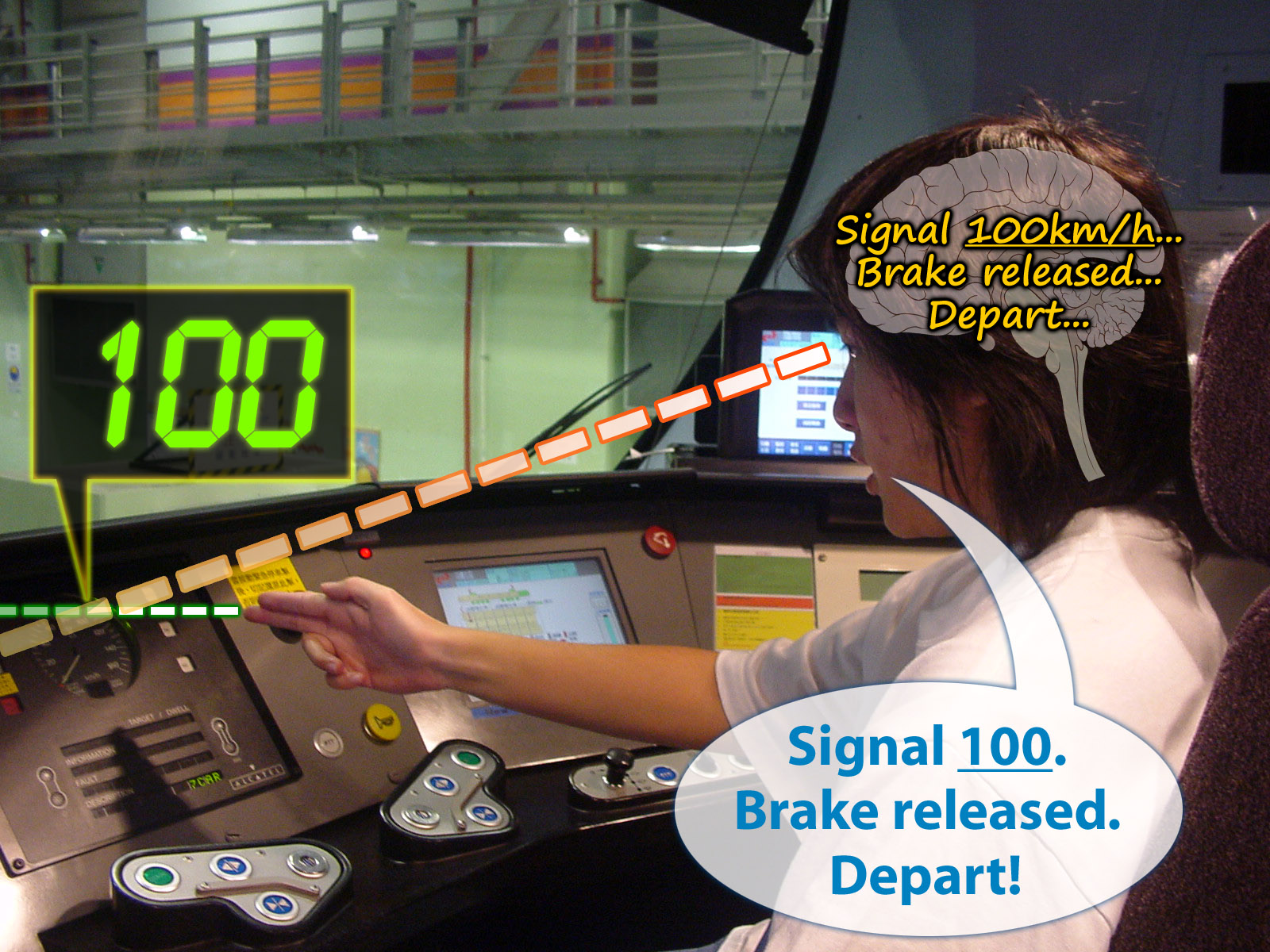
The diagram above is a conceptual illustration created by a Wikimedia contributor. It is not an official RTRI scientific figure or a medical anatomy diagram. The scientific claims in this article are based on RTRI, government safety information and research literature.
What the often-cited experiment actually found
A frequently repeated claim says that pointing and calling reduces errors by 85 percent. That wording is misleading because it turns a laboratory task result into a universal accident statistic. The Japanese Ministry of Health, Labour and Welfare’s Workplace Safety Site summarizes a 1994 experiment in which participants performed a choice reaction task under four conditions.
- Doing the task without pointing or calling.
- Calling only.
- Pointing only.
- Pointing and calling together.
The reported error rates were approximately 2.38 percent with neither action, 1.00 percent with calling only, 0.75 percent with pointing only and 0.38 percent with pointing and calling. In that task, the combined condition produced roughly one-sixth the errors of the no-action condition.
That result supports the idea that the combined method can reduce selection errors under controlled conditions. It does not show that railway accidents fall by exactly 85 percent, that every worker gains the same benefit, or that a railway using the method is 85 percent safer. Real accidents are rare, multi-causal events involving equipment, rules, supervision, fatigue, communication, maintenance, environment and organizational decisions. Laboratory error rates and operational accident rates are different measures.
Later RTRI work, including a 2014 report by Takayuki Masuda, Masayoshi Shigemori, Fuminori Sato and Shigeru Haga, tested error-prevention effects and mechanisms in more detail. The research supports the method as a useful human-factors control, while also showing why its benefit depends on how the task is designed and performed.
From steam locomotives to a wider safety practice
Pointing and calling is commonly traced to railway signal confirmation in the steam-locomotive era. Steam locomotive cabs were noisy, physically demanding environments with restricted visibility and divided responsibilities. Clear, shared confirmation of signals had obvious operational value. Historical accounts describe pointing and vocal confirmation developing in the government railway system before the creation of Japanese National Railways (JNR) in 1949.
This distinction matters. Japan’s government railways existed under changing administrations and ministries long before JNR. It is therefore inaccurate to say simply that “JNR invented pointing and calling” if the practice predates JNR as an organization.
Some accounts identify a locomotive engineer named Yasohachi Hori as an originator and attach a precise date or personal story to the practice. The National Diet Library’s Reference Collaborative Database shows that sources discuss the old government railway and differences in terminology, but the surviving evidence does not justify presenting one neat invention story as settled fact. This article therefore does not describe Hori as the sole inventor. The safer conclusion is that pointing and vocal confirmation developed within early railway operations and were subsequently standardized, taught and expanded.
Over time, the practice moved beyond locomotive crews. Station staff, conductors, maintenance teams and other workers adopted forms suited to their own checks. Occupational-safety organizations later promoted related pointing-and-naming techniques in factories, construction and hazard-prediction activities.
A driver’s check is not a conductor’s check
The visible motion is similar across jobs, but the object and consequence differ. Publicly observable examples can illustrate the range, though company manuals and current rules are not always fully public.
Train drivers
A driver may use a point-and-call check for signal aspects, speed restrictions, timetable points, departure conditions, instrument indications or a planned control action. Some railways also use prospective calling: stating a coming restriction or action in advance so that the future requirement remains active in memory. The exact wording and timing vary by railway, rolling stock and signaling system.
Conductors and platform sweeps
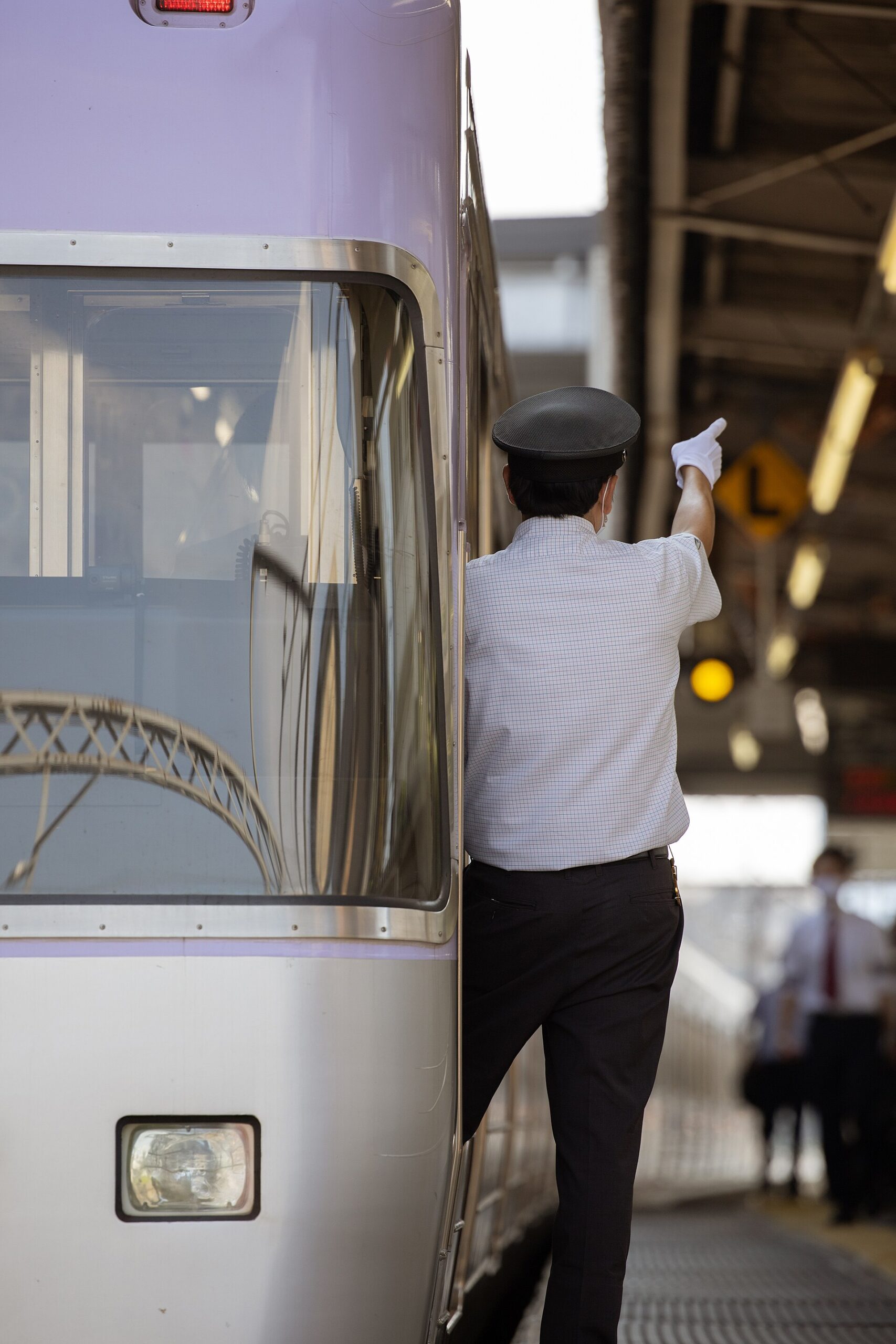
A conductor may inspect the platform before closing doors and again before departure. The check can include the side of the train, door areas, platform conditions and departure indicators. A visible sweep of the platform helps structure attention across a long, changing space. A photograph, however, cannot establish the exact target or words used at that instant.
Station staff
Station staff may confirm platform safety, signals or indicators, door closure, train movement and the completion of assigned duties. At busy stations, checks can be distributed among several workers. Pointing and calling helps each worker anchor attention, but it does not remove the need for clear responsibility and communication.
Maintenance and engineering staff
Maintenance personnel may use the method when confirming switch positions, electrical isolation, tool counts, work limits, protection arrangements or the identity of equipment. In such contexts, a wrong target can be as serious as a wrong state. The spoken call can include both the object and its required condition.
Procedures vary by railway, train and station
There is no single national choreography used identically by every Japanese railway. Differences arise from operating rules, signaling, train type, platform design, staffing, visibility, automatic systems and local risk assessments. A procedure documented in 2008 should not automatically be treated as unchanged in 2026.
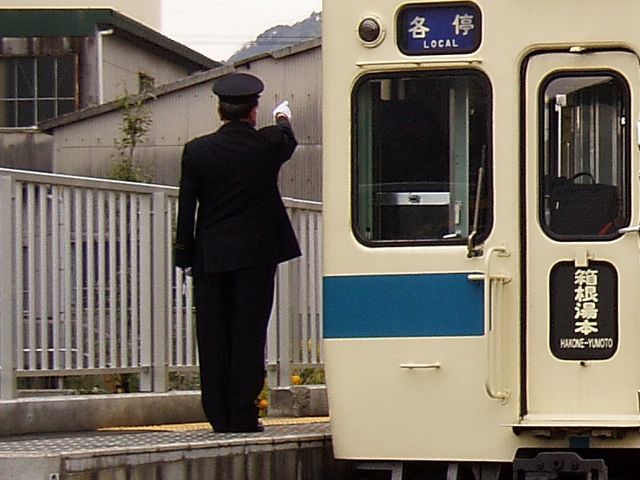
The image shows an Odakyu conductor at Kazamatsuri Station in 2008. It documents a moment of safety checking, but not the exact confirmation target or call. Rolling stock, station equipment, uniforms and procedures can change, so historical photographs must not be used as complete descriptions of present practice.
Why the method can fail
Pointing and calling is not self-enforcing. A gesture can become detached from real observation. Workers may say the expected word while their attention has already moved elsewhere. This is sometimes described as ritualization or procedural drift: a meaningful control gradually becomes a form completed by habit.
Several organizational conditions can encourage that drift. A procedure may be too frequent, poorly matched to risk, difficult to perform in the actual workspace, or taught as obedience without explaining its purpose. Time pressure, fatigue, understaffing, conflicting goals and weak supervision can all reduce the quality of the check. Blaming an individual for “not paying attention” may hide these conditions.
Prevention therefore requires more than demanding a larger gesture. Training should connect each point-and-call check to a defined hazard and target. Supervisors should observe whether the worker is actually looking, speaking and acting in sequence. Procedures should be reviewed when equipment or work changes. Near misses and deviations should feed organizational learning rather than only punishment.
RTRI’s human-factors work emphasizes that accidents should not be addressed only by reminding the person involved to be careful. Effective analysis examines task demands, systems, management and the reasons why the action made sense at the time.
Pointing and calling is one layer, not the whole safety system
Modern railways use defence in depth: multiple layers designed so that one missed check does not automatically become an accident. Pointing and calling belongs mainly to the human and procedural layer. It complements, rather than replaces, engineering controls.
Interlocking
Interlocking systems prevent conflicting routes from being set and link points, signals and route conditions. They reduce dependence on a person remembering every conflict. A worker’s visual confirmation remains useful, but the engineered logic provides a separate barrier.
ATS and ATC
Automatic Train Stop (ATS) systems can warn a driver or apply brakes when a train approaches certain signal or speed conditions incorrectly. Automatic Train Control (ATC) supervises permitted speed through continuous or coded information, depending on the system. These technologies address hazards that a verbal check alone cannot reliably control.
Platform doors and train-door systems
Platform screen doors, movable platform gates, door interlocks, obstruction detection and departure indicators can reduce platform and door risks. They do not make platform observation irrelevant: equipment has limits, layouts vary and unusual conditions still require human judgment.
Other layers include standardized rules, competency training, work scheduling, fatigue management, maintenance, radio communication, reporting systems, emergency drills and independent accident investigation. The visible pointing gesture is only a small part of this larger structure.
What happens as railways become more automated?
Automation changes the target of human attention rather than eliminating human factors. When a system performs more routine control, staff may spend longer monitoring and then need to intervene during an unusual event. That can create new risks: reduced engagement, mode confusion, loss of situation awareness and difficulty taking over quickly.
A point-and-call check may remain useful at transitions: confirming the selected mode, a movement authority, a departure condition, a degraded-system instruction or a planned manual action. But automation can also make some old checks redundant. Good safety management does not preserve every gesture forever; it evaluates whether the check still controls a real risk.
The aim is a sensible division of labor. Machines are strong at consistent monitoring, enforcement and calculation. People are strong at interpreting unexpected combinations, communicating and adapting. Both can fail. Safety comes from designing their interaction, not from choosing either technology or human discipline as the single answer.
Beyond railways
Japan’s Ministry of Health, Labour and Welfare presents shisa koshō as an occupational safety technique, especially in work where mistaken selection or omission can cause harm. Related practices appear in manufacturing, construction, warehousing, energy, health care and transport. The details differ because each industry has different hazards.
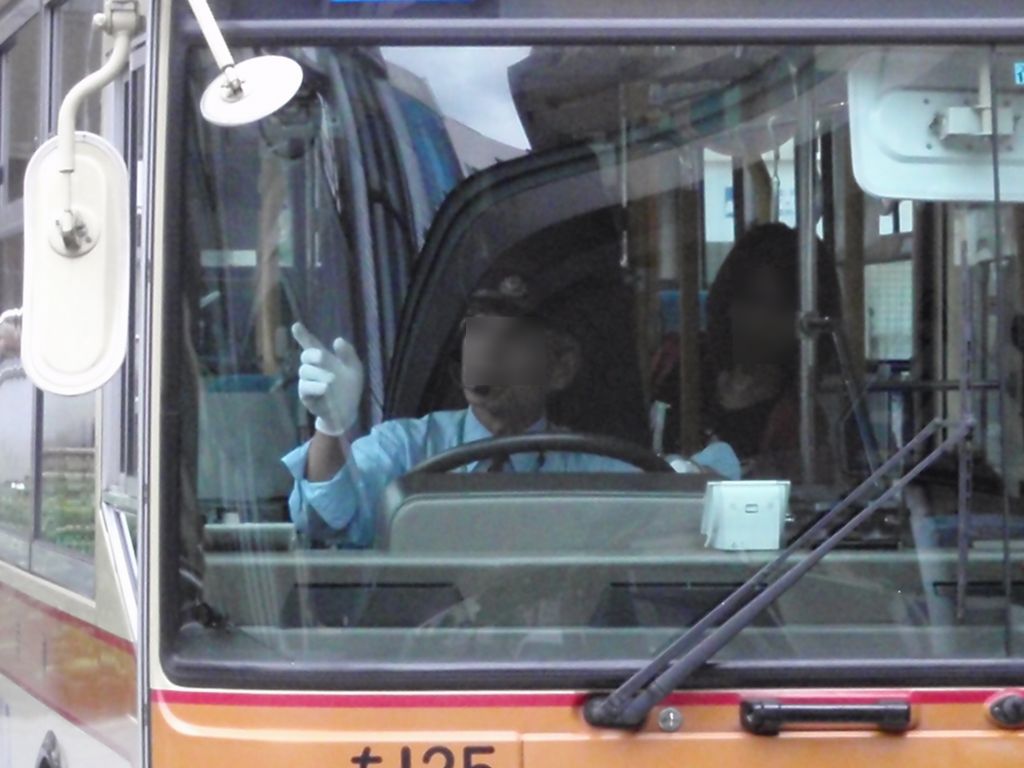
The bus image above is one documented example from road transport, not evidence that every bus company uses the same procedure. The person’s face was blurred in the source image and has not been altered. The exact target and words cannot be determined from the photograph.
Pointing and calling outside Japan
Comparable practices exist outside Japan, sometimes through direct institutional exchange and sometimes because the same human-factors problem leads to a similar solution. Rail and metro organizations in parts of East Asia and North America have used forms of pointing, verbal confirmation or mandatory response at safety-critical locations.
Taiwan High Speed Rail publishes information on its layered railway safety system, and photographs document platform signal-control staff using a pointing confirmation before departure at Taipei Station. The image specified for this article carries the GNU Free Documentation License. Because the available publishing workflow could not verify that all page-level GFDL reproduction requirements would be satisfied, the image was not embedded. This does not affect the factual discussion of Taiwan’s railway safety practices.
The important conclusion is not that another country has copied a uniquely Japanese custom in every detail. It is that explicit physical and verbal confirmation can be useful wherever repetitive work, visual selection and safety-critical action intersect.
How passengers can observe the practice safely
Passengers may notice pointing and calling from a normal waiting position on a platform or through a train window. Observation should never interfere with work. Stay behind tactile paving and safety lines, follow staff instructions, avoid blocking doors or narrow platform areas, and do not lean into a cab window or cross barriers for a photograph.
Do not use a worker’s uniform alone to identify a precise job, and do not guess the call if it cannot be heard clearly. A short video or social-media post can show a movement but usually cannot establish the formal procedure, target, operating context or current company rule.
Pointing and calling versus a checklist
A checklist externalizes a sequence: it records items that must be completed and can support coordination across time or people. Pointing and calling externalizes a moment of perception and action: it binds a specific object to a spoken state and intended response. The two methods can complement each other. A maintenance team may use a written checklist for the overall job and a point-and-call check for each critical switch, valve or isolation point.
Neither method is automatically effective. A checklist can be ticked without verification, and a call can be spoken without looking. Good design selects the method that matches the hazard and makes noncompliance or mismatch easier to detect.
A closer look at the checking sequence
A useful point-and-call check has a sequence, even when it lasts only a second or two. First, the worker identifies the correct target. Second, the eyes settle on it. Third, the hand points in a way that makes the selected object unambiguous. Fourth, the worker states the observed condition or required action. Fifth, the next operation follows only when the spoken statement agrees with the target and the rule.
The order matters. Calling before looking can turn the phrase into a prediction rather than a confirmation. Looking without identifying the target can leave room for a neighboring indication to be mistaken for the intended one. Acting before the call is complete removes the opportunity for verbalization to expose an error. Training therefore needs to emphasize coordination, not merely the outward shape of the gesture.
This sequence also explains why the technique is valuable when a worker is alone. The voice is not necessarily addressed to another person. It creates an external signal that the speaker can hear and compare with what is seen. In effect, the worker becomes both sender and receiver of a small read-back.
Prospective calling: remembering what comes next
Some railway tasks require more than confirming the present state. A driver may need to remember an upcoming speed restriction, stopping point or operating action. RTRI has studied senshu kankō, or prospective calling, in which the worker states a future requirement before reaching the point where action is needed.
Prospective calling supports prospective memory—the ability to remember to perform an intended action later. It is especially relevant where a familiar route contains an unusual temporary restriction or where a required action occurs after an interval filled with other tasks. The verbal statement can keep the future requirement active, but it still needs appropriate timing and a clearly defined trigger.
This is different from repeatedly chanting an instruction. The call should connect a specific future condition to a specific action. If the interval is too long, the call may be forgotten; if it is too late, there may be no time to respond. As with ordinary pointing and calling, procedure design matters.
Why accident reports rarely yield a simple percentage
Railway accidents are statistically and causally different from laboratory selection errors. A laboratory study can create hundreds or thousands of opportunities for a participant to choose among alternatives, producing enough errors to compare conditions. Serious railway accidents are far rarer, and each event emerges from a particular combination of technical, human and organizational factors.
Japan Transport Safety Board reports typically reconstruct the sequence of an occurrence, the condition of equipment, rules, training, communication and other contributing circumstances. They do not reduce safety to whether one visible check was performed. Even when a missed confirmation appears in an event, the investigation may also identify weaknesses in equipment design, supervision, workload, information flow or risk control.
For this reason, the strongest responsible claim is limited: pointing and calling can reduce certain kinds of human error and can strengthen deliberate checking. It cannot be assigned a universal accident-reduction percentage, and its presence does not prove that an operation is safe.
Safety-I, everyday reliability and organizational learning
Traditional safety management often asks why something failed and how to prevent recurrence. This is sometimes called Safety-I. That approach remains essential, especially after an accident or serious incident. But railway operations also depend on thousands of ordinary adjustments that keep service stable every day.
Pointing and calling can be understood as one of those routine stabilizing practices. It helps workers make the current state explicit, coordinate attention and maintain a shared standard in changing conditions. This does not mean celebrating every routine as successful. It means examining why a practice works on normal days as well as why it sometimes breaks down.
Organizations learn when they compare written procedures with real work, invite reports of awkward or ambiguous checks, and modify systems before a serious event occurs. A procedure that is physically impossible, excessively repetitive or disconnected from the hazard invites superficial compliance. A well-designed procedure gives the worker a clear target, enough time and an understandable reason.
How to research a company-specific procedure
A company’s current procedure should be established from current official material wherever possible. Useful sources include safety reports, operating guides, training publications, procurement documents, public demonstrations and statements issued after incidents. Historical manuals can show development, but they should not be treated as current rules without corroboration.
Railway photographs and on-site observation are valuable for documenting visible behavior. They are weak evidence for the exact spoken phrase, internal rule or purpose unless those details are independently confirmed. Uniforms can also mislead: employees of different roles or contractors may wear similar clothing.
Video and social media can help locate examples, but they should not be the final authority for a formal procedure. Sound may be unclear, context may be missing and the clip may show an exceptional or outdated practice. Responsible observation must never obstruct staff, cross barriers or distract workers.
What good training should demonstrate
Training is strongest when workers experience the difference between conditions rather than being told only that the method is traditional. A simple simulation can compare silent checking, calling, pointing and the combined action. The exercise can then examine which errors occurred and why.
Instructors should explain the five mechanisms, identify the checks where each matters and demonstrate appropriate force and volume. They should also discuss failure modes: calling the expected answer, pointing at the wrong object, moving the hand while the eyes look elsewhere, or starting the operation before the check ends.
Refresher training should use realistic changes and distractions rather than only ideal demonstrations. Workers need practice noticing the one condition that differs from routine. Supervisors, in turn, need criteria for observing quality without turning the exercise into a contest for the loudest voice or largest movement.
A practical comparison of safety tools
Pointing and calling is strongest for immediate visual selection and action confirmation. Checklists are strongest for sequences that must be completed and recorded. Read-backs are strongest when information passes between people. Interlocks and automatic protection are strongest when an unsafe action can be prevented or corrected by design.
These tools should not compete for symbolic status. A task may use several at once: an interlock prevents a conflicting route, a display presents the route, a worker points and calls the indication, and a checklist records completion of a maintenance sequence. Defence in depth is created by independence and complementarity, not by repeating the same weak control.
The correct question is therefore not, “Does pointing and calling work?” in the abstract. It is, “Which error is this check intended to prevent, under what conditions, and what other layer catches the error if the check fails?”
FAQ
Why do Japanese train drivers point at signals?
To focus visual attention on the correct signal, state what it shows and create a pause before acting. The exact procedure varies by railway.
Why do conductors point at the platform?
They may be structuring a platform sweep and checking door areas, train sides, indicators or departure conditions. A photograph alone cannot reveal the exact target.
What does shisa kanko mean?
Shisa kankō means “pointing and calling.” It is a self-check technique linking a target, a spoken confirmation and the next action.
Does every Japanese railway use the same procedure?
No. Wording, gestures, timing and targets vary by company, job, route, equipment and risk.
Where did it originate?
It developed in Japanese railway operations, commonly traced to signal confirmation in the steam-locomotive era. A single inventor and exact date are less certain than popular accounts suggest.
Does it really reduce errors?
Controlled experiments support error reduction in certain tasks. They do not prove a fixed reduction in real-world railway accidents.
Does it reduce accidents by 85 percent?
That claim misstates a laboratory result. A 1994 task showed a large relative reduction in selection errors, not an 85-percent reduction in railway accidents.
Is it still needed with ATC and other automation?
Sometimes. Automation removes some checks and creates new ones. Pointing and calling is useful only where it addresses a defined human-factors risk.
Is it used outside railways?
Yes. Related methods are used in occupational safety, manufacturing, construction, road transport and other industries, with procedures adapted to each workplace.
Related Stories
- Japan’s First Railway: How the Shinbashi–Yokohama Line Changed the Country
- How Standard Time and Railways Changed Time in Japan
Sources and Further Reading
- Railway Technical Research Institute, “Pointing and Calling Viewed through Its Mechanisms”
- Railway Technical Research Institute, research on the gaze-focusing function of pointing
- Railway Technical Research Institute, experiential training on the error-prevention effect of pointing and calling
- Masuda, Shigemori, Sato and Haga, “Verification of the Error-Prevention Effect of Pointing and Calling,” RTRI Report 28(5), 2014
- Ministry of Health, Labour and Welfare, Workplace Safety Site: Pointing and Naming
- Japan Private Railway Association glossary: Pointing and Calling
- National Diet Library Reference Collaborative Database: origins and terminology
- Ministry of Land, Infrastructure, Transport and Tourism: railway safety measures
- Japan Transport Safety Board: railway accident and serious incident reports
- JR East: train operation and maintenance safety measures
- Taiwan High Speed Rail: Railway Safety
Conclusion: safety made visible—but never by gesture alone
Pointing and calling is a self-checking technique that distributes confirmation across the eyes, hand, voice, ears and brain. The large movement inserts a beat into routine action and identifies a concrete target. Speaking turns a seen condition or planned operation into words, making a mismatch easier to notice before the operation begins.
The practice grew from railway work in the steam-locomotive era, then spread through station operations, maintenance and other industries. Names and exact procedures vary. Experiments support an error-reduction effect in controlled tasks, but they do not provide a simple percentage for real railway accident reduction.
The method can also become empty if repeated without attention. It must work alongside equipment, operating rules, training, fatigue management and organizational learning. Similar practices outside Japan show that it is not an isolated cultural curiosity. What passengers see is only the visible edge of a much larger safety-management system.
The central lesson is not that moving a finger creates safety. Experienced people naturally become automatic. At selected critical moments, pointing and calling reconnects perception with action. It works only when the target, the words and the next step genuinely match.