Tokyo’s most famous fish market was built over a former international district—and both existed on land that had once been part of Edo Bay. Before the tuna auctions, Tsukiji contained foreign diplomats, Christian missionaries, naval schools, printing rooms and some of Japan’s earliest modern educational institutions. Before any of those, worshippers reclaimed the shoreline so a Buddhist temple displaced by fire could rebuild there.
This is the surprise at the heart of Tsukiji: the neighborhood did not become important because of one market. It became important because governments and institutions repeatedly needed waterfront land close to the center of power. Reclamation made the ground. Edo’s reconstruction brought Tsukiji Hongwanji. The opening of Tokyo brought a foreign settlement. The Great Kanto Earthquake brought the wholesale fish trade from Nihonbashi. The market’s move to Toyosu has now opened the same land to another enormous redevelopment.
Modern Tsukiji exists because every new role reused advantages created by the one before it—water access, central location, large institutional sites and networks of merchants, students, specialists and visitors. The fish market was not the beginning of Tsukiji’s history, and its closure was not the end. This is a waterfront that Tokyo has repeatedly rebuilt whenever the city needed a new gateway to religion, foreign knowledge, food or urban investment.
Quick Facts
- Japanese name: 築地
- Municipality: Chuo City, Tokyo
- Main access: Tsukiji, Shintomicho and Tsukijishijo stations
- Core historical layers: reclaimed waterfront, temple town, samurai estates, naval education, foreign settlement, missionary schools, modern medicine, wholesale food distribution and redevelopment
- Foreign settlement: generally described here as operating from 1869 to 1899
- Tsukiji Central Wholesale Market: formally opened in 1935; wholesale functions moved to Toyosu in 2018
Why Tsukiji Became More Than a Fish Market
Tsukiji occupied an unusually useful position near Edo Castle, the Sumida River and the waters of Edo Bay. Boats could carry construction materials, food and people directly into the district. The political center was close enough for official institutions, while the waterfront offered space that could be expanded through reclamation.
That combination explains the repeated changes in function. A temple displaced by fire needed new land. The shogunate and Meiji government needed waterfront sites for military education. Treaty obligations required a district for foreign residents. After the 1923 earthquake, Tokyo needed a modern wholesale market to replace Nihonbashi Uogashi. In each case, Tsukiji absorbed a function that could no longer remain elsewhere.
Reclaimed Land at the Edge of Edo Bay
The characters 築地 literally suggest constructed ground. In the seventeenth century, the shoreline lay farther inland, and the area was a changing landscape of tidal shallows, embankments, canals and newly made land. Reclamation occurred in stages rather than through a single project.
Old maps show how deeply water shaped the district. Canals divided blocks, boats approached residences and warehouses, and wharves connected Tsukiji to the wider economy of Edo. Many of those waterways have disappeared beneath roads and buildings, but the neighborhood’s original purpose cannot be understood without them.
A Great Fire Brings Tsukiji Hongwanji
The Great Fire of Meireki destroyed much of Edo in 1657, including Asakusa Gobo, the predecessor of Tsukiji Hongwanji. The shogunate did not permit the temple to rebuild at its former site. Instead, its followers helped reclaim waterfront land, and the temple was rebuilt here in 1679.
The move formed part of Edo’s broader reconstruction. Temples and estates were relocated away from the congested center, new roads and bridges were created, and urban development spread into waterfront areas. Tsukiji therefore began as part of a citywide response to catastrophe.
The present main hall is not a seventeenth-century survivor. The 1923 earthquake and fires destroyed the earlier building. Architect Ito Chuta designed the current hall, completed in 1934 with forms inspired by South and Central Asian Buddhist architecture. It expresses both the temple’s long institutional continuity and the ambitions of modern reconstruction.
Temple Town, Samurai Estates and Waterfront Commerce
Tsukiji Hongwanji attracted clergy, worshippers, craftspeople, tenants and businesses. A monzen-machi, or temple-front town, developed around it. Nearby wharves handled food, fuel and construction materials. Fish dealers connected with Nihonbashi Uogashi also established a community south of the temple in the seventeenth century, giving Tsukiji a relationship with seafood long before the modern market.
Much of the district was also occupied by samurai estates and official facilities. Gardens, secondary residences, canals and storehouses existed beside temple and commoner areas. Tsukiji was already a mixed waterfront before foreign residents or market workers arrived.
Naval Training and the Pressure to Modernize
During the final years of the Tokugawa shogunate, Japan faced the military power of foreign fleets. Tsukiji’s waterfront became a site for navigation, gunnery, seamanship and related technical education. The institutions changed names and jurisdictions rapidly across the Meiji Restoration, but the larger pattern is clear: the district helped train people for a modern navy and state.
These facilities should not be confused with better-known naval training centers in Nagasaki or Kobe. Tsukiji’s importance came from its position in the capital, where military science, translation and government reorganization could intersect.
Tokyo’s Foreign Settlement
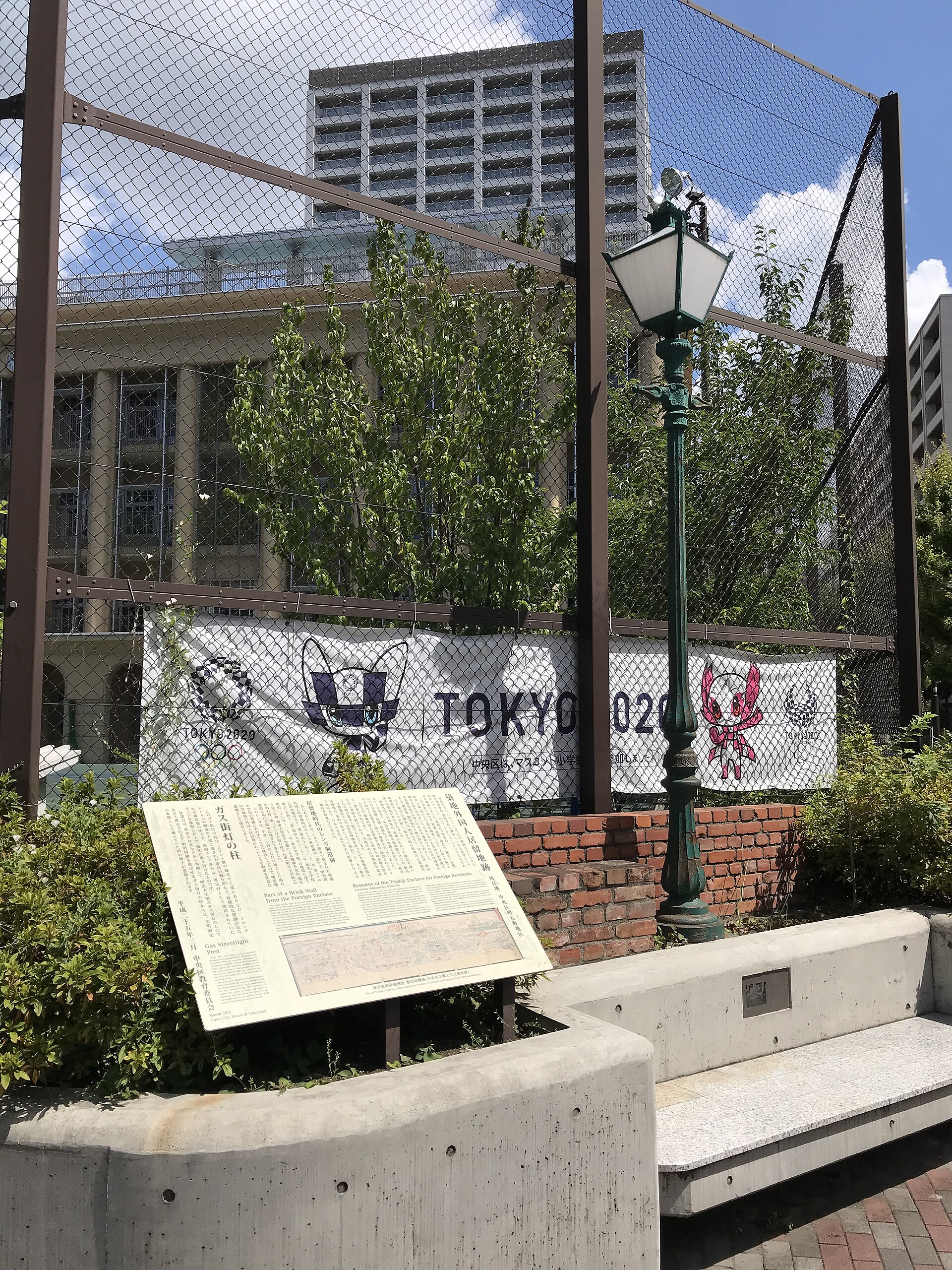
Under the unequal treaties, Tokyo was opened to foreign residence and trade. A designated settlement was laid out around present-day Akashicho. It never became a treaty-port trading center on the scale of Yokohama, because international shipping remained concentrated there. Tsukiji instead became an institutional gateway.
Diplomatic compounds, missionary residences, churches, schools, translation work and printing clustered in a compact area. Foreign residents possessed legal privileges under the treaty system, but the settlement was never socially sealed. Japanese builders, teachers, translators, printers, servants and merchants worked within and around it.
The practical period of the settlement is best described as 1869–1899. Revised treaties ended the old extraterritorial system in 1899, but the schools, churches and professional networks established in Tsukiji continued long afterward.
The Tsukiji Hotel and the Image of an International Capital
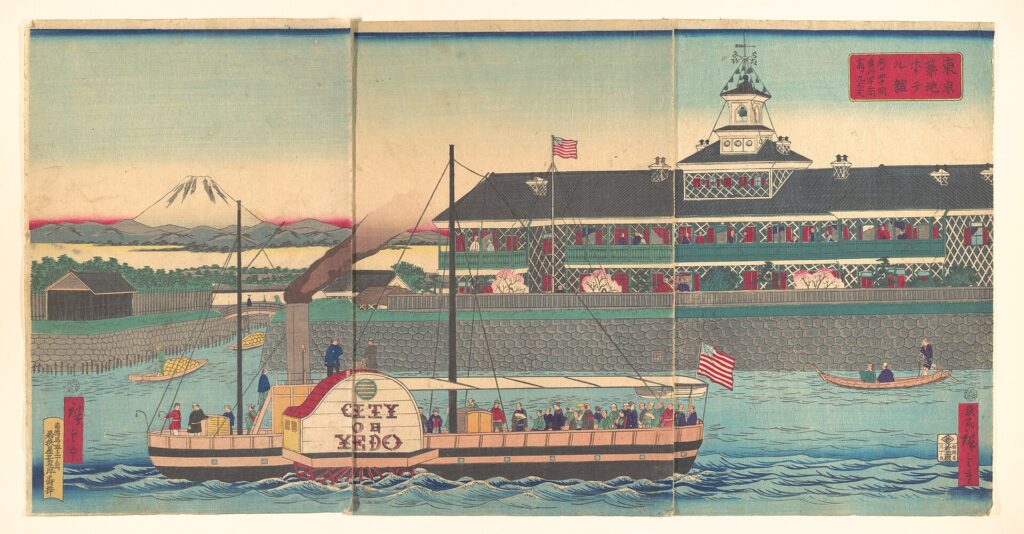
The Tsukiji Hotel was built to accommodate foreign visitors and became one of early Meiji Tokyo’s most striking symbols. Prints showed a Western-influenced building beside ships, foreign guests and Japanese townspeople. The hotel was short-lived, but its image announced that the former shogunal capital intended to present itself as an international city.
Descriptions of it as Japan’s “first hotel” depend on how hotel and Western-style accommodation are defined. It is more accurate to call it one of the capital’s earliest prominent purpose-built facilities for foreign guests.
Schools, Printing and Christianity
Tsukiji’s international influence came less from imported cargo than from institutions that trained people and circulated ideas. Mission schools taught English, Christianity and modern subjects. Printing rooms produced religious texts, textbooks and language materials. Japanese students and teachers actively selected, translated and reshaped what they encountered.
Rikkyo traces its origin to a school opened by Anglican missionary Channing Moore Williams in 1874. The institution later moved to Ikebukuro and developed into Rikkyo University. Its present campus buildings are not surviving structures from Tsukiji, but its institutional history began here.
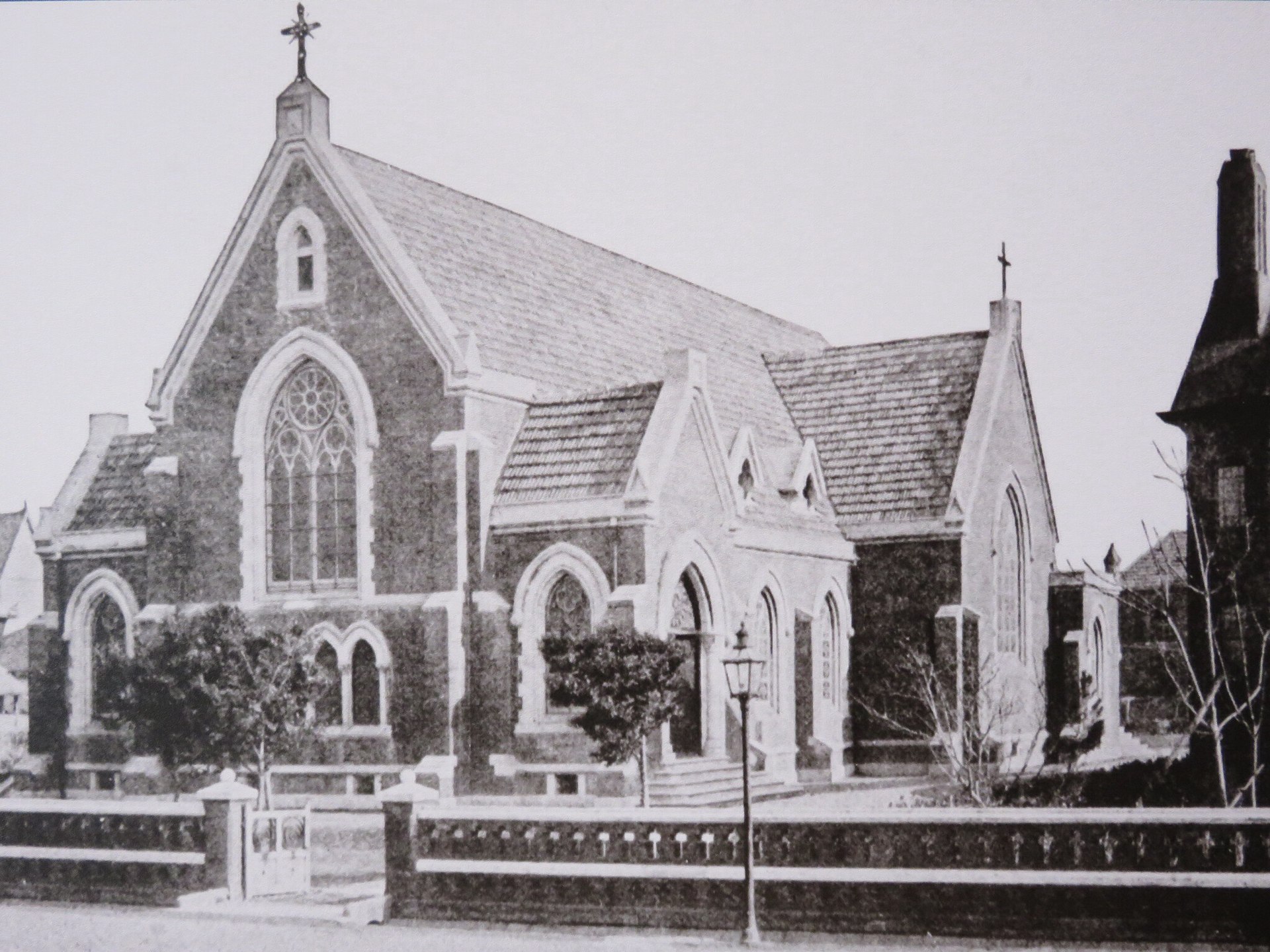
Girls’ education was another important part of the district. Joshigakuin and Rikkyo Jogakuin both trace significant parts of their institutional history to schools connected with Tsukiji. These institutions did not create women’s education in Japan from nothing, but they became part of a wider transformation involving Japanese educators, government programs and private schools.
Catholic Tsukiji Church and St. Luke’s
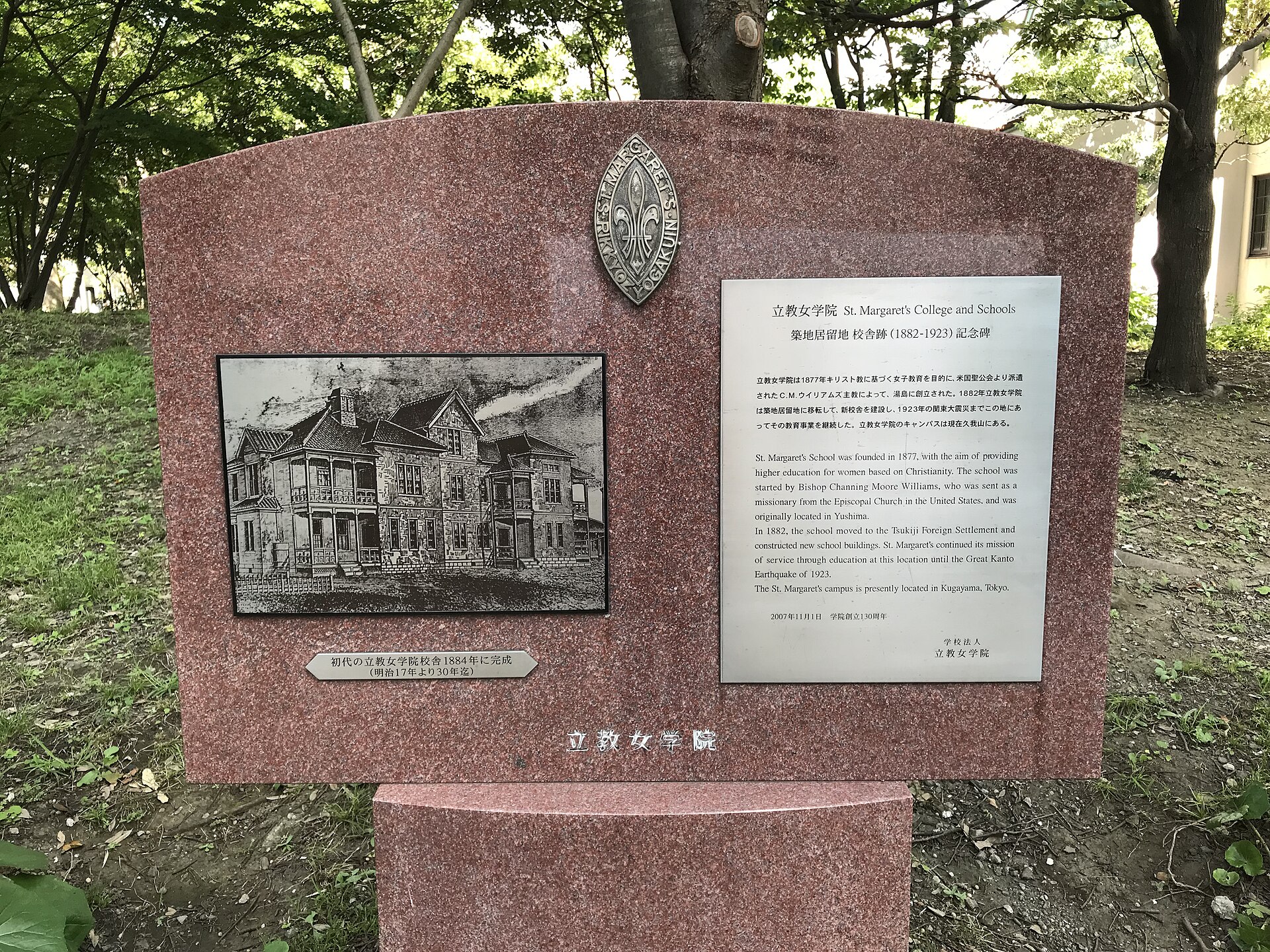
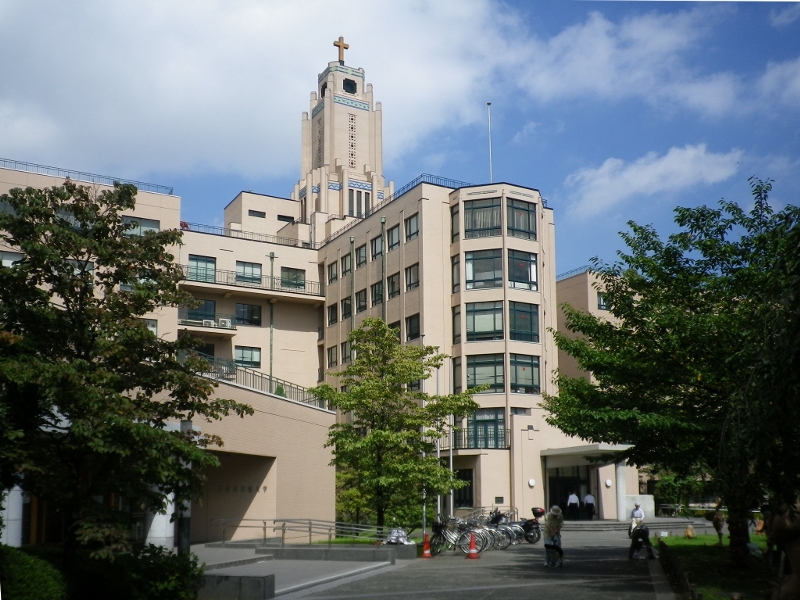
Catholic missionaries established the Church of St. Joseph in the settlement in the 1870s. The original building was destroyed in 1923, and the present Catholic Tsukiji Church was completed in 1927. It is a successor institution rather than an untouched settlement-era building.
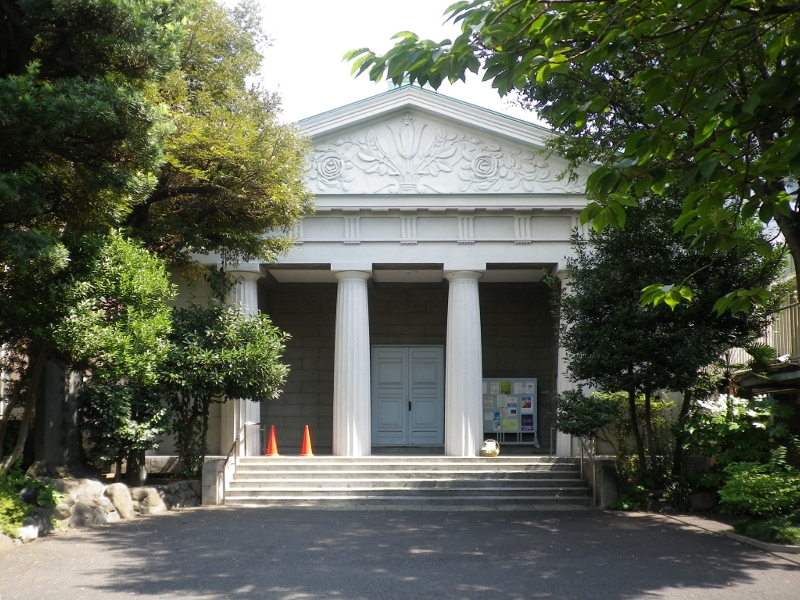
St. Luke’s belongs to the district’s post-settlement legacy. Rudolf Bolling Teusler established the forerunner of St. Luke’s Hospital in 1901, after the legal settlement had ended. The hospital nevertheless continued Anglican, medical and international networks associated with Akashicho.
The Great Kanto Earthquake Remakes Tsukiji
The Great Kanto Earthquake struck on September 1, 1923. Collapse and fire devastated Tsukiji and Akashicho. Churches, schools, temple buildings and residences were destroyed. Reconstruction widened roads, reorganized land and produced many of the institutional buildings visible today.
The earthquake also transformed Tsukiji’s economic role. Nihonbashi Uogashi, the historic center of Tokyo’s fish trade, was destroyed. Wholesale activity moved temporarily to Tsukiji while the city designed a modern central market.
How the Fish Market Arrived
Tsukiji did not instantly become the famous market in 1923. Tokyo needed a permanent complex for auctions, inspection, refrigeration, rail and water access, and large-scale distribution. Tsukiji Central Wholesale Market formally opened in 1935.
The market was a regulated metropolitan system, not simply a collection of fish shops. Wholesalers received goods from producers and fishing ports. Intermediate wholesalers evaluated and divided lots. Authorized buyers purchased for restaurants and retailers. Transport workers moved products through a complex that operated around the clock.
The tuna auction became the market’s best-known image, but Tsukiji handled a far wider range of seafood and produce. Its prices, specialist knowledge and distribution networks shaped food businesses across Tokyo and beyond.
The Outer Market
The Outer Market developed around the wholesale complex as a district of specialist food retailers, restaurants, utensil shops and wholesalers. It was administratively separate from the central market but economically connected to it.
When wholesale operations moved to Toyosu in 2018, the Outer Market remained in Tsukiji. This distinction is essential. The former inner market is now a redevelopment site, Toyosu handles the main wholesale functions, and Tsukiji Outer Market continues as an active food district.
The Move to Toyosu
By the late twentieth century, the old market faced aging buildings, congestion and changing requirements for sanitation and truck logistics. Tokyo chose to relocate the wholesale system to Toyosu rather than rebuild it while keeping the Tsukiji site in full operation.
The inner market closed in October 2018, and Toyosu Market opened soon afterward. Auctions and core wholesale operations moved, but businesses and expertise did not transfer in a single uniform way. Some firms relocated, some opened branches, and others remained in the Outer Market.
The Former Market Site and Tsukiji’s Next Reinvention
The former wholesale-market site is now being prepared for another large transformation. The announced project envisions a waterfront district with public space, cultural and entertainment functions, business facilities and new connections between land and water transport. Its opening is targeted for the early 2030s.
These plans remain subject to design and construction changes. As in earlier centuries, however, the logic is familiar: centrally located waterfront land is being reassigned to meet a new metropolitan priority.
What Historical Traces Can Be Seen Today
- Tsukiji Hongwanji: a continuing temple institution whose present hall dates from 1934.
- Tsukiji Outer Market: the active commercial successor to the food economy surrounding the former wholesale complex.
- Catholic Tsukiji Church: a post-earthquake building continuing a settlement-era parish.
- St. Luke’s: a medical institution linked to the international and Anglican history of Akashicho.
- Memorial stones: markers for vanished schools, diplomatic compounds and settlement institutions.
- The Sumida River waterfront: the geographic key to reclamation, naval education, transport and future redevelopment.
Timeline
| 1657 | The Great Fire of Meireki destroys Asakusa Gobo. |
| 1679 | The temple is rebuilt on reclaimed waterfront land. |
| Late Edo period | Tsukiji contains temple districts, estates, canals and military training facilities. |
| 1869 | The Tsukiji Foreign Settlement begins operating around present-day Akashicho. |
| 1874 | The school from which Rikkyo traces its origin opens. |
| 1899 | The legal foreign-settlement system ends. |
| 1901 | The forerunner of St. Luke’s Hospital is established. |
| 1923 | The Great Kanto Earthquake destroys much of Tsukiji and Nihonbashi Uogashi. |
| 1934 | The present Tsukiji Hongwanji main hall is completed. |
| 1935 | Tsukiji Central Wholesale Market formally opens. |
| 2018 | Wholesale operations move to Toyosu; the Outer Market remains active. |
| Early 2030s | The current redevelopment plan targets the opening of a new waterfront district. |
Why the Modern Neighborhood Exists
Tsukiji’s present form is the result of repeated institutional relocation. Fire moved a temple here. International treaties brought foreign institutions. Earthquake destruction moved the fish trade from Nihonbashi. Modern logistics moved wholesale operations to Toyosu. Redevelopment is now preparing the old market land for another metropolitan role.
The common cause is not fish but adaptable waterfront land near the center of Tokyo. That is why a Buddhist temple, Christian churches, medical institutions, food streets and a massive redevelopment zone can exist within the same neighborhood. They are successive answers to the same question: what should Tokyo place on this strategically valuable edge of the city?
Related Stories
- The History of Nihonbashi
- Why Edo Burned So Often—and How Fire Rebuilt Tokyo
- Tokyo Neighborhood Histories
Sources and Further Reading
- Tokyo Metropolitan Library: Foreign settlement and civilization in Tsukiji
- Chuo City: Tsukiji Foreign Settlement
- Tsukiji Hongwanji: Official English guide
- Rikkyo University: Institutional history
- Tokyo Metropolitan Central Wholesale Market: Former Tsukiji Market
- Tsukiji Outer Market: History
- Tsukiji district development project