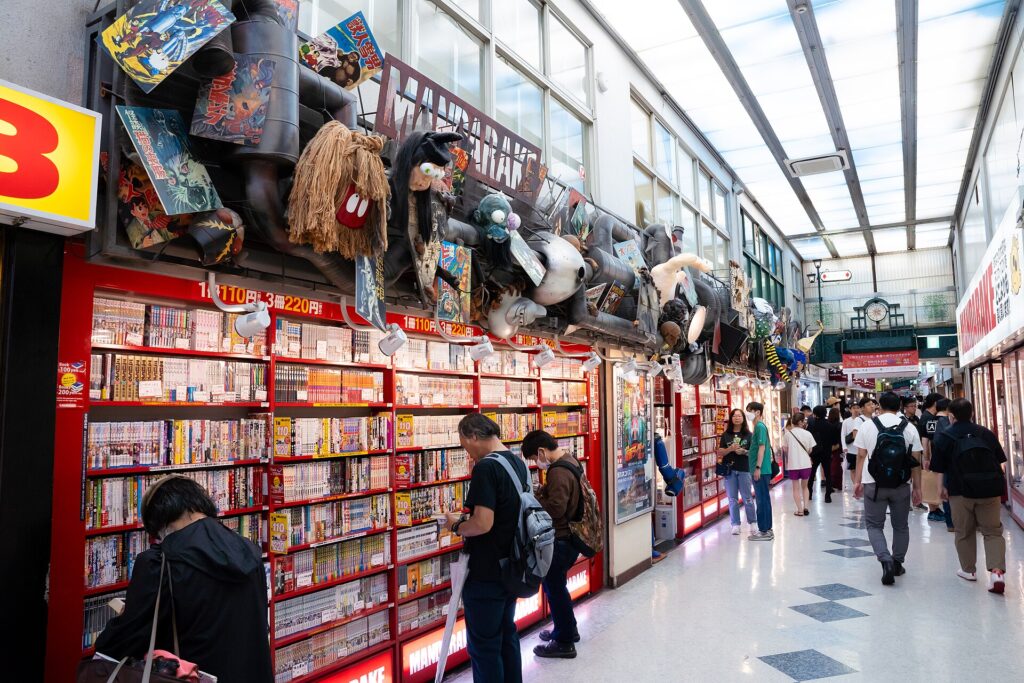
Leave Nakano Station by the north exit and the crowd seems to choose a route for you. It moves beneath the covered entrance of Nakano Sunmall, through a long corridor of everyday shops, and into the deeper, stranger interior of Nakano Broadway. A few minutes farther west, construction fences and open spaces mark another Nakano: the former Sunplaza and municipal district, now being reconsidered as the station itself is rebuilt.
This compact walk crosses several centuries of urban change. Beneath the shopping arcade lies the geography of a Musashino farming settlement. Behind the station crowds is a railway that first arrived in 1889 but took decades to reorganize the district. Behind Nakano Broadway’s manga, toys, watches and collectors’ goods is a mixed commercial and residential building that opened long before it acquired an “otaku” identity. Nakano became a subculture district not through a single plan, but through the interaction of transport, population growth, postwar commerce, architecture, small property units and specialist knowledge.
Why Nakano Became What It Is Today
Nakano’s modern character rests on a sequence of conditions. The railway made the western edge of Tokyo easier to reach. Suburban housing and population growth created daily demand around the station. Earthquake-driven migration and metropolitan expansion accelerated that growth. War damage and postwar reconstruction produced new commercial patterns. Large civic and mixed-use projects then concentrated visitors and floor space near the north exit. Finally, specialist secondhand businesses learned how to use Nakano Broadway’s small units and maze-like upper floors more effectively than conventional department-store retail.
The result is not simply a smaller Akihabara. Nakano remains a dense residential and everyday shopping district whose specialist market is embedded inside an older suburban center. That combination explains both its resilience and the anxiety surrounding current redevelopment.
Geography and the Rural Landscape
The station area lies on the Musashino uplands west of central Edo. The wider landscape was shaped by relatively dry plateau surfaces cut by shallow river valleys and drainage lines. Farming, woodland, paths and settlements responded to those differences. The Momozono River corridor south and west of the station, later heavily altered and culverted, is one reminder that the apparent flatness of modern Nakano hides a more varied terrain.
Nakano was close enough to Edo to supply the growing city, yet far enough away to retain village land uses into the nineteenth century. Fields, vegetable production, woodland resources and roadside activity connected local households to the metropolis. The Ome Kaido to the south remained an older axis of movement and commerce, which helps explain why the first railway station did not instantly create a major station-front town.
Nakano Before and During the Edo Period
The name Nakano appears in older local geography, but the modern ward, the former Nakano village and today’s neighborhood around Nakano Station are not interchangeable. During the Edo period the area consisted of villages and cultivated land governed through rural institutions, not a single urban district matching present boundaries.
The Momozono name preserves one of the area’s best-known historical associations. Nakano City records a tradition that the eighth shogun, Tokugawa Yoshimune, had red and white peach trees planted in the area after visiting for falconry. The peach garden became celebrated as a place for spring viewing. This story belongs to the landscape south of the modern station and should not be used to suggest that every present street preserves an Edo layout.
Meiji Administration and the Arrival of the Railway
In 1889, municipal reorganization combined several villages into Nakano Village. In the same year, the private Kōbu Railway opened its line from Shinjuku toward Tachikawa, with Nakano Station beginning service on April 11. The original station stood roughly 100 meters west of its present position.
Rail access changed Nakano’s possibilities, but development was gradual. Older commerce still faced the Ome Kaido, the station stood amid woodland and fields, and many residents did not immediately reorganize their lives around rail travel. The line first made Nakano a useful gateway between the new railway and older road-based settlements. Only with improved service, population growth and the expanding labor market of Tokyo did the station become a stronger urban center.
From Railway Stop to Commuter Suburb
The railway was nationalized in 1906 and became part of the evolving Chūō route. More frequent service and the growth of central Tokyo made daily commuting increasingly practical. Houses replaced fields, roads were improved, and shops gathered along routes linking the station to residential districts.
Nakano Village became Nakano Town in 1897, a sign of early growth, but the decisive suburban surge came later. The Great Kantō Earthquake of 1923 devastated central and eastern Tokyo and accelerated movement toward less damaged western districts. Nakano’s accessible land and rail connection made it a natural receiver of households, schools, institutions and businesses seeking new sites.
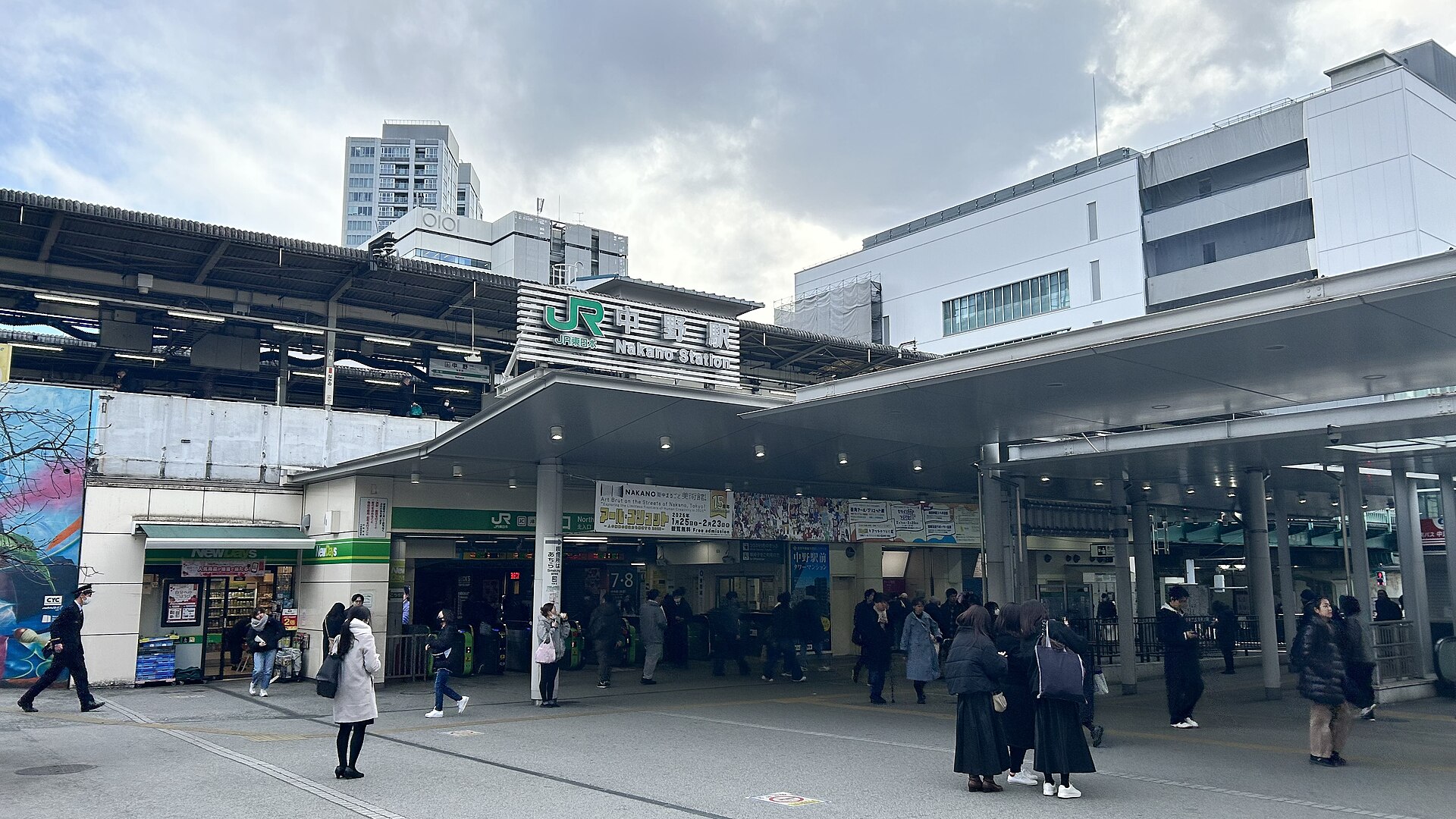
The present station occupies the site adopted in 1929. The 2025 photograph above documents today’s north exit during another period of change; it does not show the appearance of the early railway. In 2026, Nakano City and JR East were completing a new west ticket gate, bridge station building and north-south pedestrian passage, scheduled to open on December 6, 2026. The project is intended to reduce congestion and improve barrier-free movement while creating new connections across the tracks.
Taisho and Early Showa Urbanization
As population increased, the station area became more than a residential suburb. Schools, shops, public services and large institutional sites occupied land around the growing town. Military, police and training facilities formed part of the north-side landscape, where large parcels later made equally large redevelopment projects possible.
In 1932, Nakano Town and Nogata Town were incorporated into Tokyo City as Nakano Ward. That administrative change matters: the history of today’s ward joined two areas that had developed differently. This article remains centered on Nakano Station, the former Nakano settlement and the commercial and institutional land around it.
War, Air Raids and the 1945–1946 Landscape
Wartime mobilization intensified the use of institutional land and placed the district within Tokyo’s military and industrial system. Air raids in 1945 damaged wide parts of Nakano, destroying homes and businesses and leaving uneven patterns of ruin and survival. Recovery therefore began from a landscape where railways, roads and some large sites remained, but much of the surrounding built fabric had to be repaired or replaced.
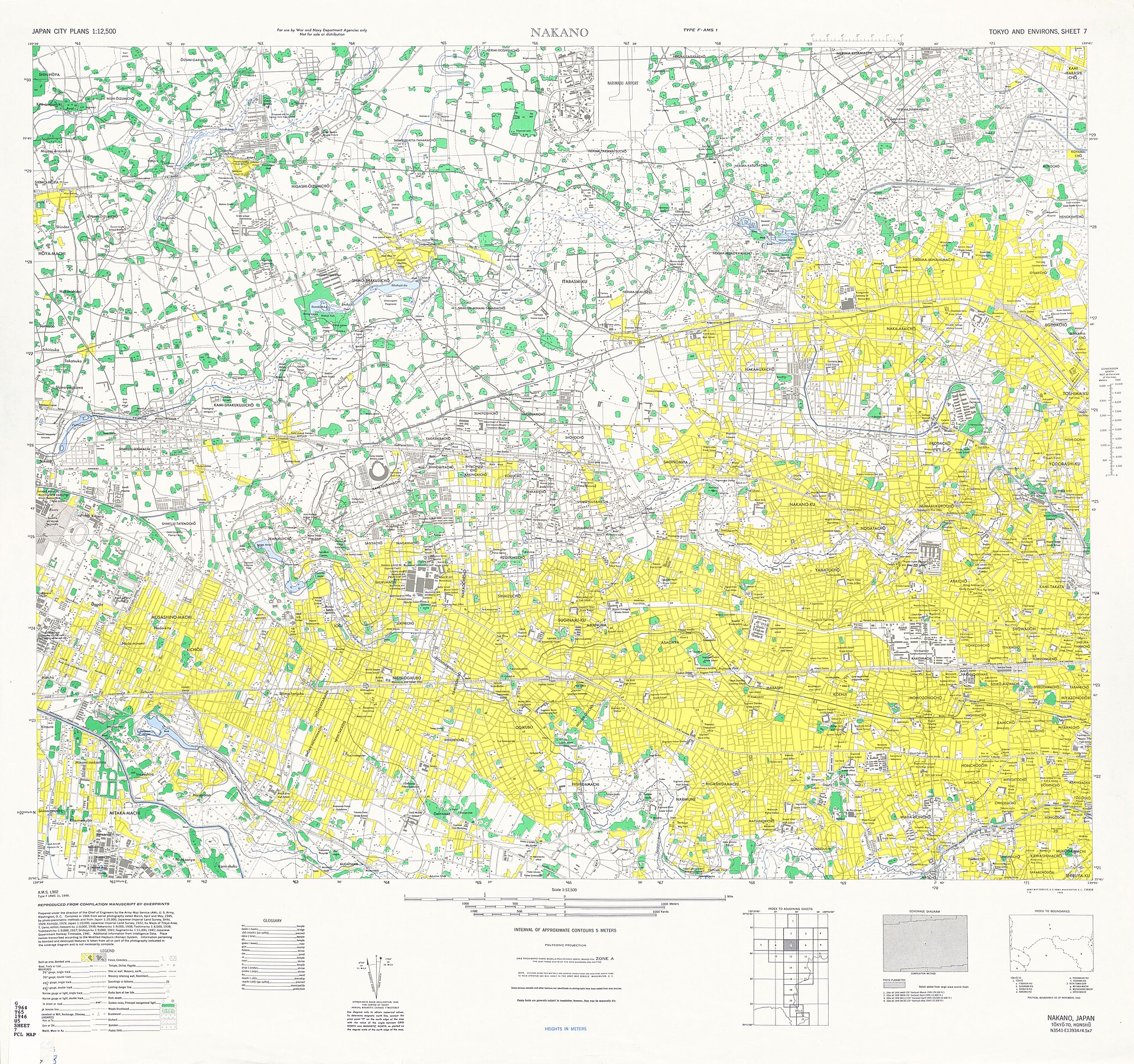
The U.S. Army Map Service sheet above records Nakano and western Tokyo around the end of the war. It is useful for understanding the broad relationship of railways, roads, built-up areas and open land in 1945–1946. It is not an Edo-period map, and its small symbols cannot by themselves prove the exact identity of every facility.
Postwar Reconstruction and Station-Front Commerce
Postwar Nakano grew through necessity as much as planning. Returning residents, new migrants and commuters needed food, clothing, repairs and inexpensive entertainment. Small shops and market-like concentrations filled gaps around the station. North and south of the tracks developed different textures: the north side gained the strongest continuous pedestrian retail axis, while the south side mixed shopping streets, residential blocks and the older Momozono landscape.
The station’s importance was reinforced by the Chūō Line’s fast connection to Shinjuku and central Tokyo and by through service with the Tokyo Metro Tōzai Line in the postwar period. Nakano became both a place to live and a transfer point, giving local businesses a customer base larger than the immediate neighborhood.
Nakano Sunmall and the Pedestrian Commercial Axis
The north-side shopping route became powerful because it linked transport and destination in a nearly continuous pedestrian sequence. What visitors now call Nakano Sunmall is not merely a decorative arcade. It channels everyday movement from the station toward older commercial streets and Nakano Broadway, protecting shoppers from weather and concentrating storefront visibility.
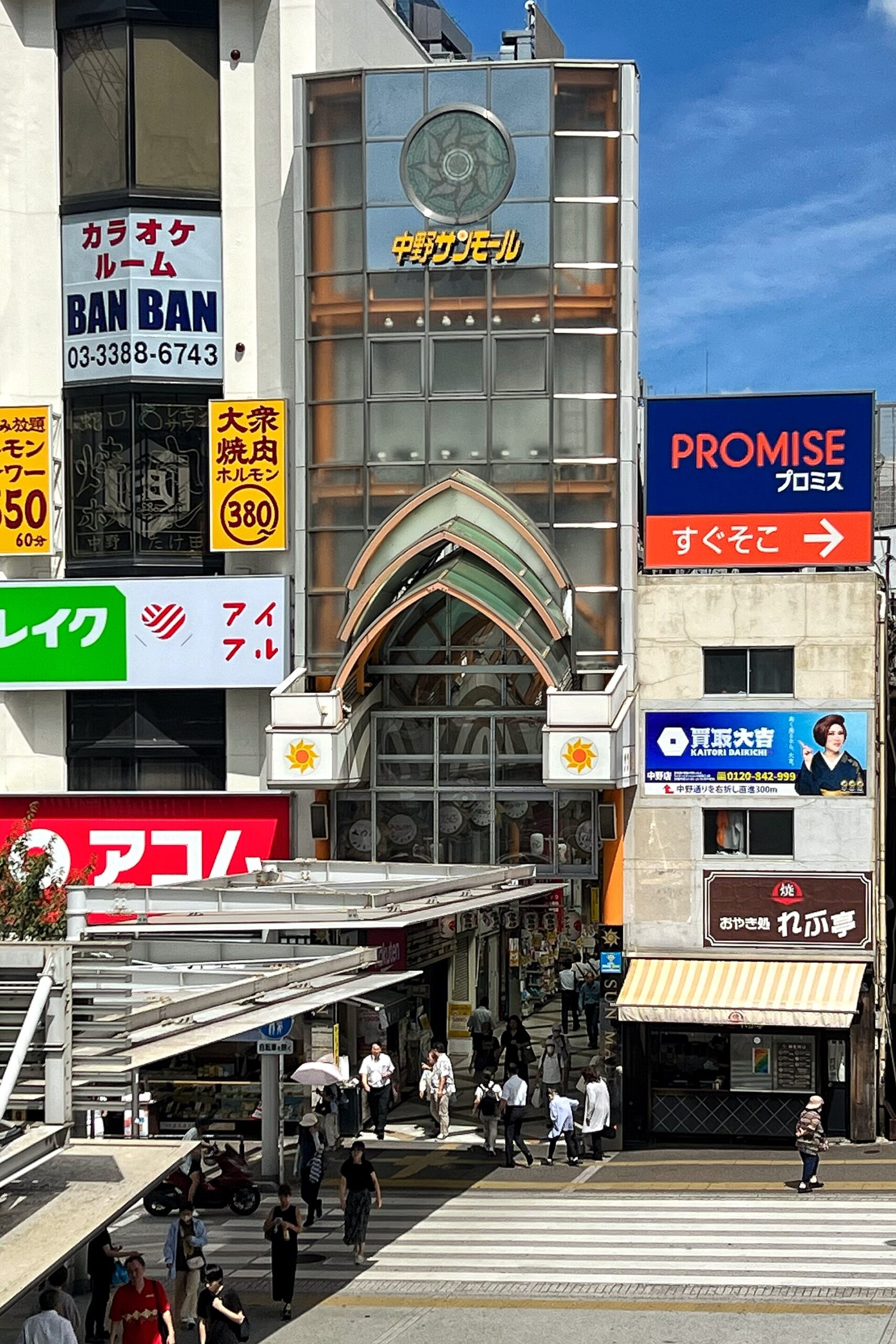
The 2023 photograph shows the current entrance, not the street’s first postwar form. The commercial axis evolved through local merchant organization, rebuilding and later arcade improvements. Its importance lies in continuity: shoppers pass from ordinary groceries, pharmacies and clothing stores into increasingly specialized retail without leaving the same northbound flow.
Nakano Sunplaza and a New Civic Image
Nakano Sunplaza opened in 1973 as part of a broader effort to give the station’s north side a modern civic and cultural presence. Its sharply sloping white façade became one of Tokyo’s most recognizable postwar silhouettes. The complex combined a concert hall, hotel, meeting rooms and other functions, drawing audiences who might otherwise have passed through Nakano only as commuters.
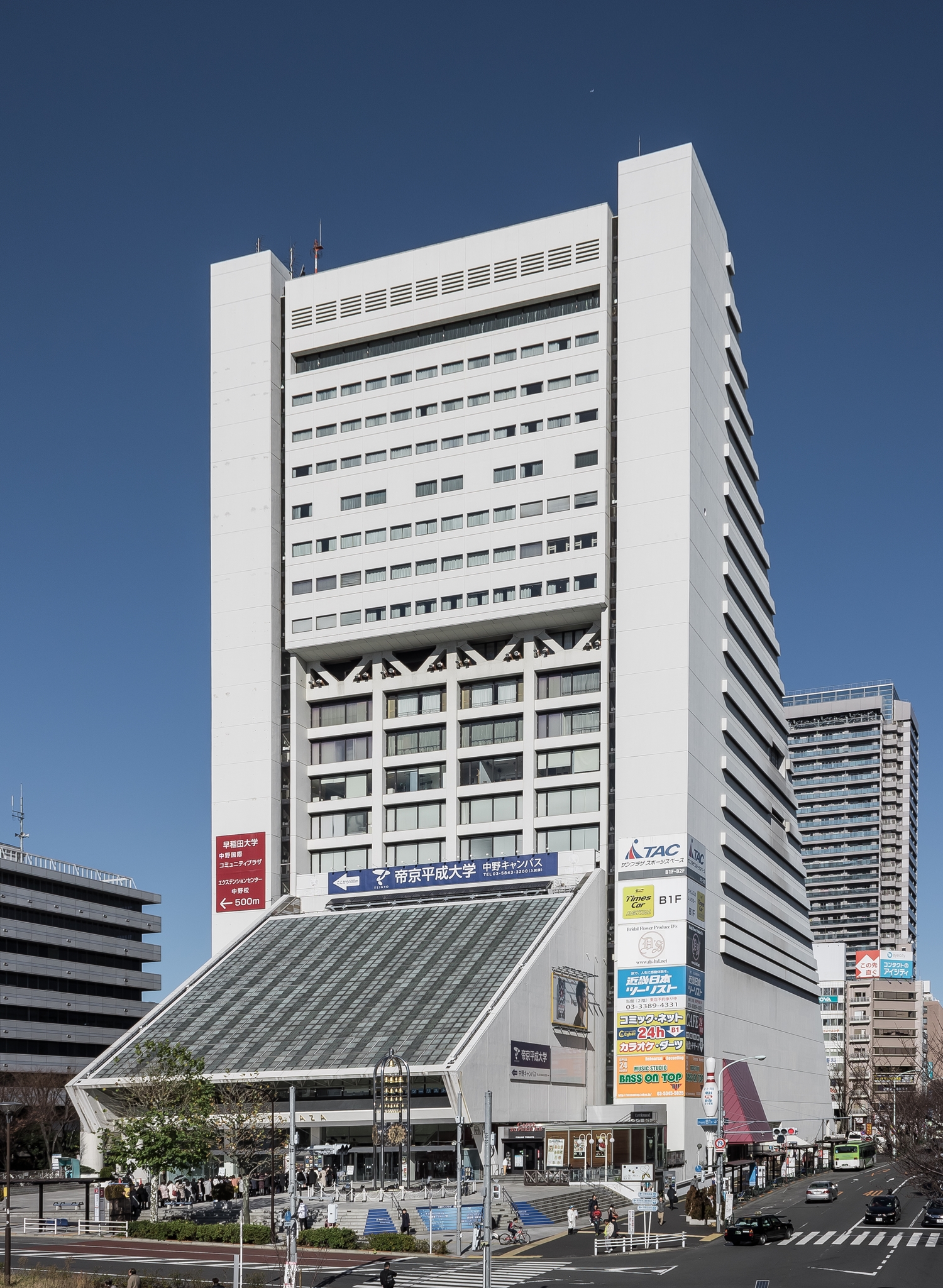
The building helped associate Nakano with music, events and public gathering long before the global fame of anime tourism. It closed in July 2023. A large replacement project was subsequently reconsidered as costs and feasibility changed. As of July 2026, the station infrastructure was moving forward, but the future of the former Sunplaza site remained subject to revised planning rather than a single settled outcome.
Nakano Broadway Before the Subculture Boom
Nakano Broadway opened in 1966 during Japan’s high-growth era. It was a bold mixed-use complex: commercial floors below and apartments above, with facilities that projected a modern urban lifestyle. It was not designed as an anime mall. Its original appeal depended on the idea that shopping, services and residential life could be stacked inside one large building connected to the station through the shopping street.
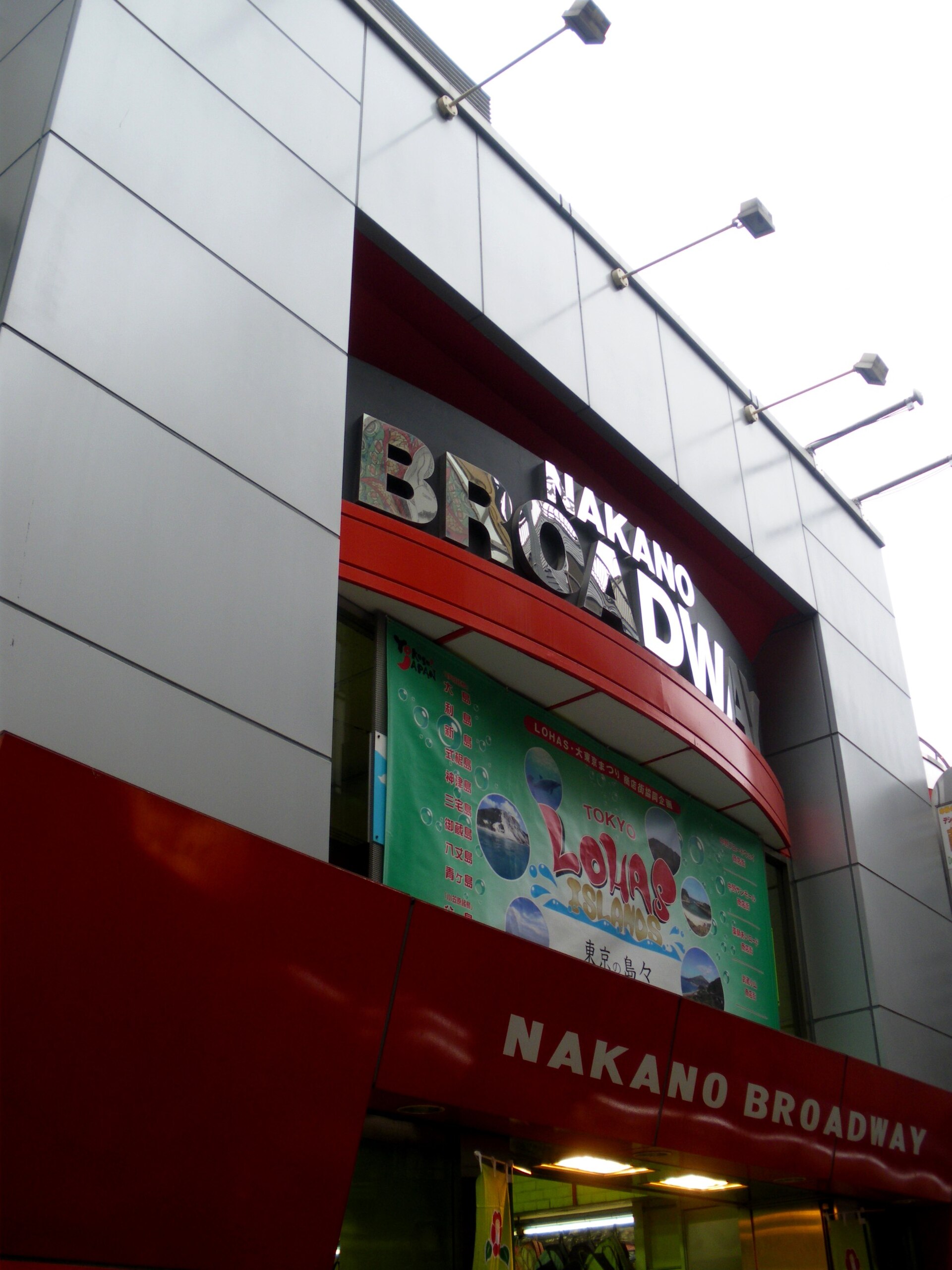
The architecture created an unusual retail environment. Rather than one centrally controlled department store, ownership and tenancy were divided among many units. Corridors, half-hidden corners and upper floors could be difficult for mainstream fashion retail, especially as larger commercial centers in Shinjuku, Shibuya and Ikebukuro grew stronger. Yet those same qualities later suited businesses that relied on destination customers and highly specific inventories.
Mandarake and the Growth of a Specialist Market
Mandarake began as a secondhand manga business in Nakano Broadway in 1980. Its success demonstrated that collectors would travel to a less conventional location when the stock, expertise and possibility of discovery were strong enough. The company expanded into multiple specialized units, separating categories and turning the building’s fragmented plan into an advantage.
Other dealers followed or developed alongside it. Manga and animation goods became part of a broader ecosystem including toys, model kits, music, film materials, idols, trading cards, watches, cameras and rare printed matter. This was not simply the spread of one fashionable genre. It was the formation of a knowledge-intensive secondhand market in which authentication, pricing, memory and collector networks mattered.
Nakano Broadway’s small shops reduced the need for a single retailer to fill a huge floor. A specialist could survive by becoming indispensable to a narrow audience. Clustering then created a shared destination: one shop’s customers became another shop’s foot traffic. The building accumulated cultural value because each new specialty made the whole trip more worthwhile.
Why Nakano Became Different from Akihabara and Ikebukuro
Akihabara’s modern identity grew from an electronics district into a large-scale anime, game and media center with prominent street-facing buildings. Ikebukuro developed a powerful female-oriented manga and character-goods scene around major retail and entertainment institutions. Nakano’s path was more interior and secondhand-oriented. Its identity formed inside a 1960s mixed-use building whose many small units rewarded deep specialization.
The comparison is not a ranking. Nakano’s strength is the proximity of ordinary residential commerce, specialist resale and collectors’ culture. A visitor can move from a neighborhood shopping arcade into a global market for obscure objects within a few minutes, while residents continue to use the same route for daily errands.
The Former Police Academy Site and the New North Side
Large government and training sites north of the station survived long enough to shape the scale of later redevelopment. After the police-related institutions moved, the former site was reorganized as the area now known as Nakano Shikinomori. The district introduced a major park, university campuses, offices, housing and new public spaces.
This redevelopment extended the north side beyond the older Sunmall–Broadway axis. It also changed the social geography of the station, adding students and office workers to the established mix of residents, shoppers and concert audiences. The contrast is visible today: narrow commercial passages lie only a short walk from broad plazas and large contemporary buildings.
Redevelopment Around Nakano Station
Nakano is now being reorganized at several scales. The west-side north-south passage and new west ticket gate are scheduled to open on December 6, 2026, with elevators, escalators and a bridge station building intended to improve circulation and accessibility. Work on plazas, decks and surrounding blocks continues on different schedules.
The former Sunplaza area is more uncertain. Earlier plans for a very large complex were subjected to review, and the city has continued to examine alternatives. Future buildings, completion dates and cultural functions should therefore be treated as proposals until formally confirmed. This uncertainty reveals a central tension: redevelopment seeks capacity, safety and economic value, while Nakano’s appeal depends partly on imperfect spaces, small businesses and cultural uses that did not emerge from top-down planning.
Nakano Today
Nakano today is simultaneously a residential city, a railway hub, an everyday shopping center, a music and event district, a university area and a specialist market with international reach. Calling it an “otaku town” captures one visible layer but hides the urban conditions that support it.
The subculture economy depends on the ordinary city around it: transport frequent enough to support destination trips, local customers who keep ground-floor commerce alive, a building divided into manageable units, and a reputation accumulated over decades. Redevelopment will not simply replace old structures with new ones; it will alter the relationships that made this ecosystem possible.
Historical Traces You Can Still See
- Nakano Station: the 1889 railway turning point, now undergoing another major reorganization.
- Nakano Sunmall: the pedestrian commercial spine linking station life to postwar shopping and Nakano Broadway.
- Nakano Broadway: a 1966 mixed-use complex whose later specialist market transformed its meaning.
- The former Sunplaza site: a reminder of the north exit’s 1970s civic image and today’s unsettled redevelopment debate.
- Nakano Shikinomori: the reuse of large institutional land as park, university and business space.
- Momozono-related places south of the station: traces of an older landscape and place-name history beneath the modern suburb.
- Street scale around the station: the contrast between narrow shopfronts, covered arcades, residential lanes and large redevelopment parcels.
Timeline
| Year | Turning point |
|---|---|
| Edo period | Farming villages, the Ome Kaido sphere and the Momozono landscape connect the area to Edo. |
| 1889 | Nakano Village is formed; the Kōbu Railway opens Nakano Station. |
| 1897 | Nakano becomes a town. |
| 1923 onward | Earthquake-driven westward movement accelerates suburban growth. |
| 1929 | Nakano Station moves to its present site. |
| 1932 | Nakano and Nogata towns become Nakano Ward of Tokyo City. |
| 1945 | Air raids damage the district; postwar reconstruction follows. |
| 1966 | Nakano Broadway opens as a commercial and residential complex. |
| 1973 | Nakano Sunplaza opens, giving the north exit a new civic and cultural landmark. |
| 1980 | Mandarake begins in Nakano Broadway, helping specialist resale cluster there. |
| 2010s | The former police academy area becomes Nakano Shikinomori with park, universities and offices. |
| 2023 | Nakano Sunplaza closes. |
| 2026 | New west gate and north-south passage are scheduled to open on December 6. |
How Each Layer Changed Nakano
| Period | Transport and land use | Commerce and culture | Visible trace |
|---|---|---|---|
| Rural and Edo | Village roads, fields and plateau-valley geography | Agricultural supply and roadside activity | Momozono names and older routes |
| Railway suburb | Station access, housing and institutional expansion | Commuter-oriented shops | Station-centered street pattern |
| Postwar city | Reconstruction and denser station-front land use | Markets, arcades and everyday retail | Sunmall and small shop units |
| High-growth era | Large mixed-use and civic buildings | Broadway and Sunplaza attract new audiences | 1960s–70s architecture |
| Specialist-market era | Fragmented ownership supports small destinations | Manga, toys, watches and collectors’ goods cluster | Upper floors of Nakano Broadway |
| Contemporary redevelopment | New station links, parks, universities and large projects | Pressure to balance capacity with local identity | Shikinomori and station construction |
Frequently Asked Questions
Why is Nakano famous for anime and manga?
Because specialist secondhand dealers, led by Mandarake’s growth after 1980, clustered inside Nakano Broadway. Small retail units, deep expertise and shared destination traffic supported a market that expanded into toys, watches, idols, games and other collectibles.
Was Nakano Broadway originally built for otaku shops?
No. It opened in 1966 as a modern mixed commercial and residential complex. Its subculture identity formed later as specialist businesses adapted its fragmented retail floors.
How did the railway change Nakano?
The 1889 railway improved access to Tokyo, but urbanization was gradual. Better service, commuting, housing demand and migration after the 1923 earthquake eventually made the station the center of a dense suburb.
How is Nakano different from Akihabara?
Nakano’s specialist culture formed mainly inside a 1960s mixed-use building and developed a strong secondhand and collectors’ market. Akihabara grew from a broader electronics district with larger street-facing commercial buildings.
What happened to Nakano Sunplaza?
The hall and hotel complex closed in July 2023. Replacement plans have been reconsidered, so the future of the site remains under official review rather than fully settled.
What historical places can visitors still see around Nakano Station?
The strongest evidence is urban rather than monumental: Nakano Sunmall, Nakano Broadway, the station-centered street pattern, the former Sunplaza site, Nakano Shikinomori and Momozono-related places south of the tracks.
Is Nakano a neighborhood or an entire city ward?
Both names are used. Nakano City is a special ward of Tokyo, while Nakano also refers to the district around Nakano Station. This article focuses on the station area and the former Nakano settlement, not the entire ward.
Related Neighborhood Histories
The neighboring district of Koenji followed a different path from village and railway suburb to shopping streets, music and counterculture. Reading the two histories together shows how adjacent Chūō Line neighborhoods developed distinct cultural economies.
Sources and References
- Nakano City, historical overview of the ward.
- Nakano City, history of the Kōbu Railway and Nakano Station.
- Nakano City, history of the Momozono area and Nakano Station.
- Nakano City, July 7, 2026 announcement on the west gate and north-south passage.
- Nakano City, current station-area planning information.
- Nakano Broadway official website.
- Mandarake official website and company information.
- Eric Hanna, Nakano Flow: Designing for Spatial and Temporal Flow in Urban Tokyo, University of Washington, 2017.
Walk Tokyo’s History with TimeWalk Japan
Nakano rewards visitors who look beyond a single label. Follow the station crowds, compare the scale of Sunmall and Broadway with the newer north-side plazas, and notice how each urban layer changes the next. To explore Tokyo history and culture with others, join a TimeWalk Japan meetup.
Featured image credit: Photo by Dick Thomas Johnson, via Wikimedia Commons and Flickr, CC BY 2.0.