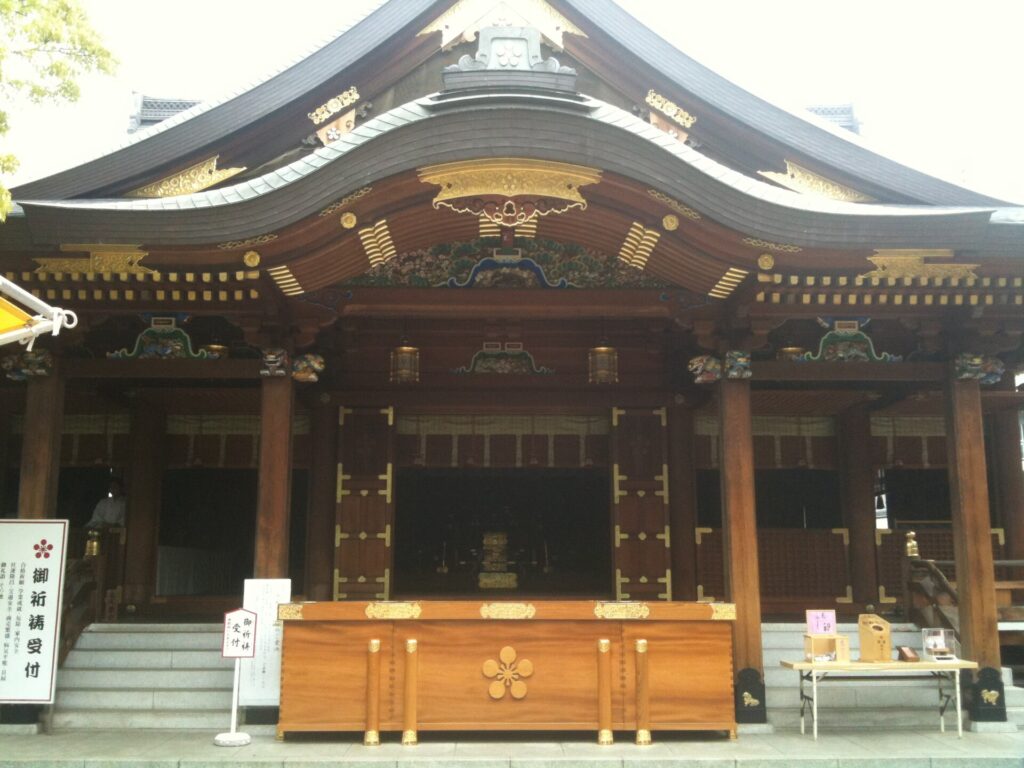
In Tokyo, students still ask a ninth-century statesman to help them pass exams—just a short walk from the shogun’s official Confucian academy.
That striking combination explains Yushima better than any single landmark. Climb from the low streets near Ueno-hirokoji toward Yushima Tenmangu and the ground quickly rises to a plateau above the former wetlands around Shinobazu Pond. Within a short walk are a Shinto shrine devoted to Tenjin, a Confucian ceremonial and educational complex, Buddhist temples, former samurai land, modern schools and places associated with writers.
Modern Yushima exists because several different systems of learning accumulated on the same terrain. Popular faith brought worshippers to Yushima Tenjin. The Tokugawa shogunate created an official center of Confucian scholarship at Yushima Seido and the Shoheizaka academy. After the feudal order collapsed, temple and estate land offered space for modern schools. Nearby universities, publishers, museums and railway districts strengthened the area’s intellectual identity. Yushima is therefore not an untouched academic quarter, but a layered neighborhood where religion, government education and modern scholarship repeatedly reused the plateau.
Quick Facts
- Japanese name: 湯島
- Municipality: Bunkyo City, Tokyo
- Main access: Yushima, Ochanomizu, Hongo-sanchome and Ueno-hirokoji stations
- Historical character: Tenjin worship, Confucian education, temple streets, samurai estates, modern schools, writers and postwar commerce
- Key topography: The eastern edge of the Hongo plateau above Shinobazu Pond
- Important sites: Yushima Tenmangu, Yushima Seido and Rinshoin
Why Yushima Became a District of Learning
Yushima became associated with learning through three distinct traditions. At Yushima Tenjin, learning was expressed through worship of Sugawara no Michizane as Tenjin, prayers, votive tablets and the social life of a shrine-front town. At Yushima Seido and the Shoheizaka Gakumonjo, learning became part of shogunal policy, scholarly training and the authority of Confucian texts. In the Meiji period, modern schools introduced new curricula, credentials and private educational organizations.
These traditions occupied nearby ground but were not the same. A Tenjin shrine is not a Confucian academy, and neither is a Buddhist temple. Their proximity nevertheless created an unusually dense intellectual landscape. Hongo developed as a university district, Ochanomizu and Kanda became centers of schools and publishing, and Ueno accumulated museums and cultural institutions. Yushima’s identity grew stronger because it stood between them.
A Plateau above Shinobazu
Yushima occupies the eastern edge of the Hongo uplands. To the east, the land descends toward Shinobazu Pond and the low streets of Ueno and Okachimachi. To the south, slopes fall toward the Kanda River and Ochanomizu. Westward, the plateau continues into Hongo.
This topography created sharp transitions between elevated religious and residential sites and the busier lowland approaches below. Slopes such as Kiridoshi-zaka organized movement and influenced where entrances, compounds and commercial streets developed. The ridge offered visibility and relative protection from lowland flooding, while the foot of the hill connected to markets, entertainment and transport.
Before Edo and the Origins of Yushima
References to Yushima and Yushima-go appear in premodern records, but the precise early boundaries and origin of the name are not securely fixed. Today’s addresses should not be projected backward as a permanent historical unit. Medieval settlement, religious sites and routes existed in the wider Hongo–Yushima area before the Tokugawa city took shape.
The Edo period transformed the district’s scale and organization. Samurai residences, temples, shrine lands, townspeople’s streets and approach roads were arranged within the administrative geography of the shogunal capital. Later place names belonged to changing systems of neighborhood government, and some now survive only in records or local markers.
Yushima Tenjin: Faith, Festivals and Examination Prayers
According to shrine tradition, Yushima Tenmangu traces its origin to the fifth century, when Ame-no-Tajikarao was enshrined. The same tradition states that Sugawara no Michizane was enshrined in 1355. These dates belong to the shrine’s own historical narrative and should be distinguished from later documentary certainty. Michizane himself never lived or taught in Yushima.
Michizane was a ninth-century scholar, poet and statesman who was later worshipped as Tenjin. By the early modern period, Tenjin devotion had become widely associated with scholarship, poetry and cultivated ability. This long religious development explains why students now visit Yushima Tenjin before entrance examinations.
The shrine was also part of a monzen-machi, a shrine-front town where teahouses, vendors, festivals and entertainments served crowds. In Edo, a visit could combine prayer, seasonal flowers, food and spectacle. The current main buildings are modern reconstructions, but ritual life and repeated rebuilding preserve continuity at the site.
A View over Edo
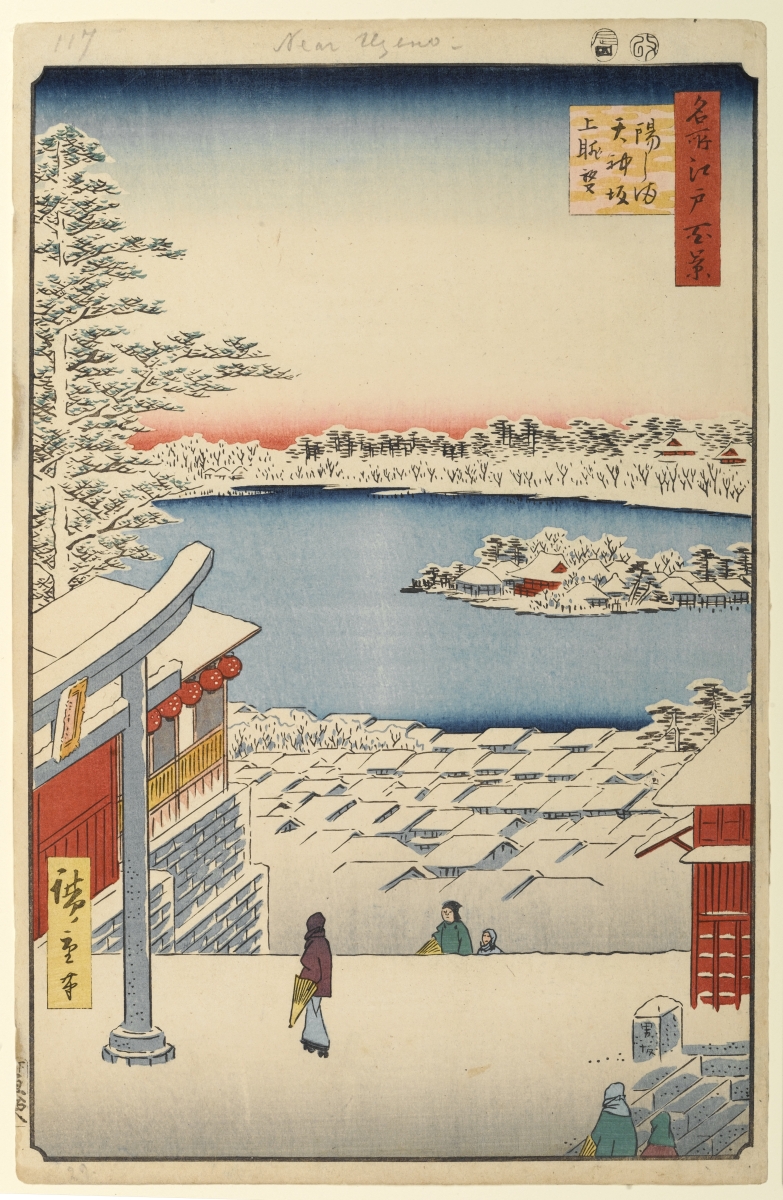
Hiroshige’s 1856 print of Yushima Tenjin looks from the high ground toward the Shinobazu landscape. It is an artistic composition rather than a survey, yet it captures a real urban relationship: worshippers, sightseers and vendors occupied a plateau edge from which Edo opened below.
Temples, Estates and the Urban Fabric of Edo Yushima
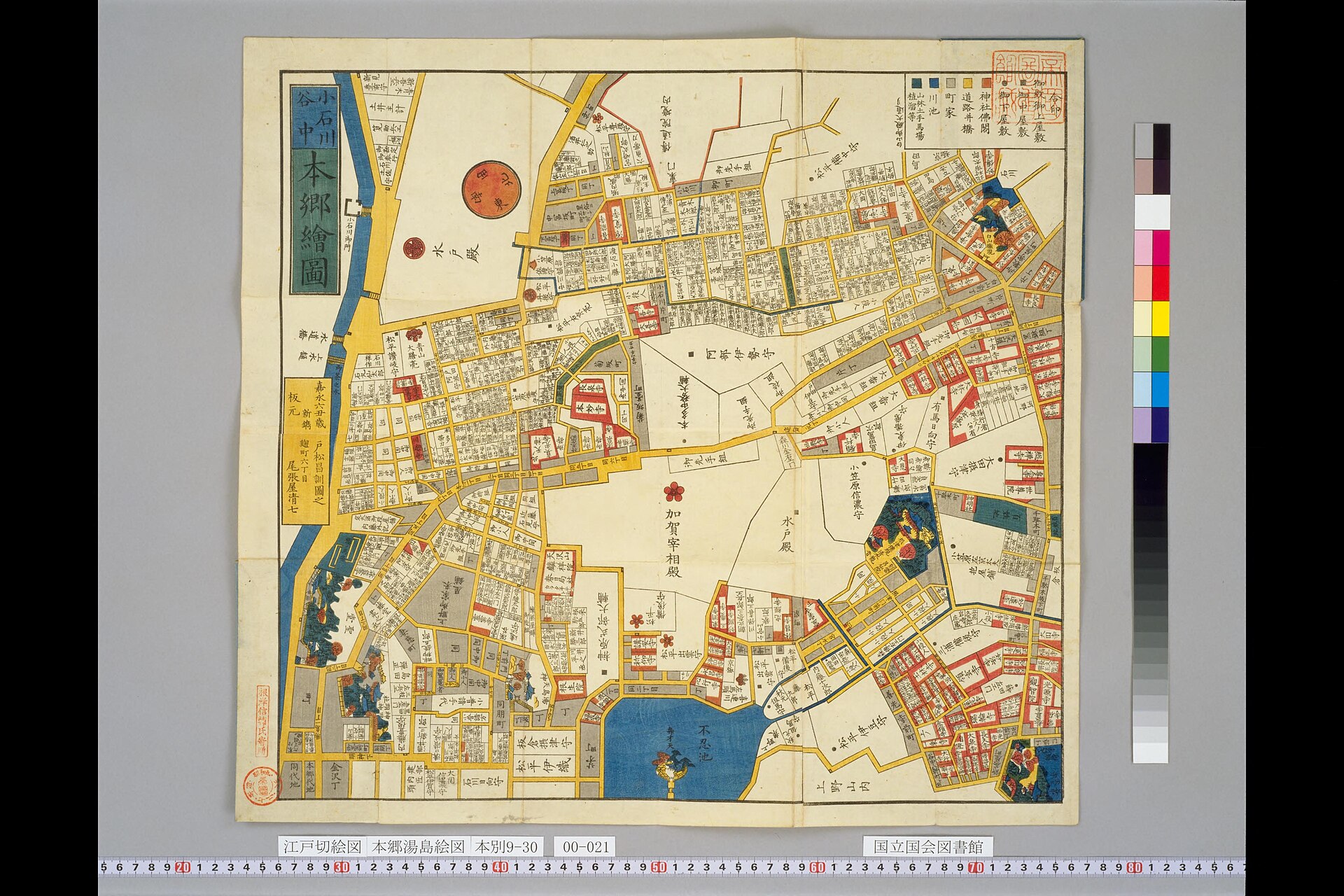
Mid-nineteenth-century kiriezu maps show Yushima as a mosaic rather than a uniform temple town. Buddhist compounds stood beside samurai estates, townspeople’s streets and major religious institutions. Roads connected Hongo, Ueno, Kanda and the approaches to central Edo.
This mixed land use mattered after 1868. When the shogunate fell, samurai estates lost their former function, temple finances changed and new government systems altered ownership. Large plots and existing buildings could be adapted for schools, hospitals and offices. Modern Yushima inherited opportunities created by the breakup of the Edo urban order.
Yushima Seido and the Shogun’s Academy
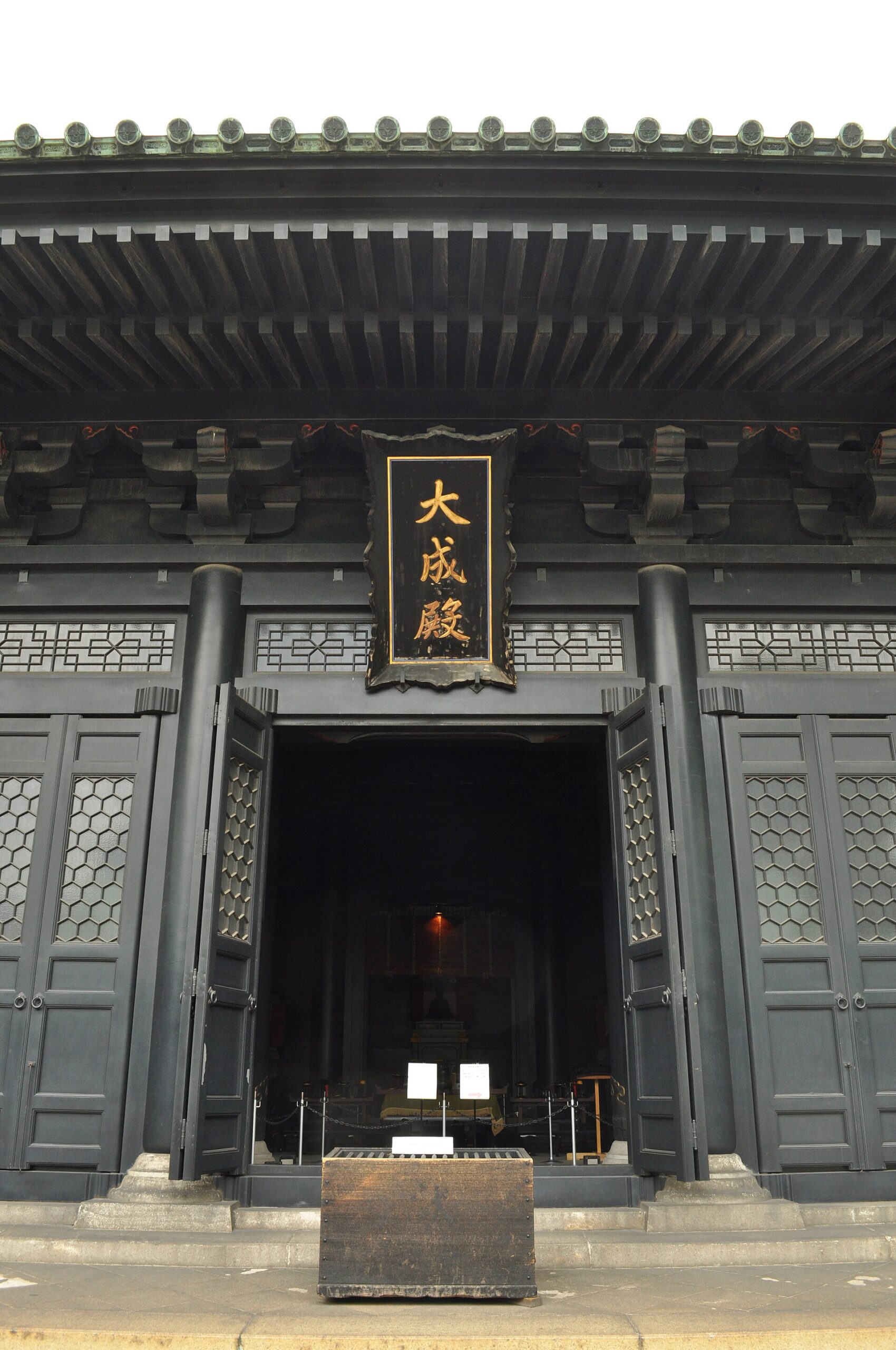
Yushima Seido developed from the Confucian institution associated with the Hayashi scholarly family. In 1690, Tokugawa Tsunayoshi transferred the complex to Yushima and constructed a major ceremonial center. Confucian rites, texts and scholarship served the political culture of the shogunate.
In the late eighteenth century, the shogunate strengthened the associated school under the Kansei reforms. The Shoheizaka Gakumonjo became an official academy that trained scholars and officials and reinforced orthodox Neo-Confucian learning within shogunal education. Its authority came from government policy and institutional organization, not from popular prayer.
After the Meiji Restoration, the site was used by a succession of educational and administrative bodies as Japan’s modern school system developed. Fire and the 1923 Great Kanto Earthquake destroyed much of the complex. The present Taiseiden was reconstructed in 1935.
Three Different Meanings of Learning
| Site | Type | Meaning of learning | What remains today |
|---|---|---|---|
| Yushima Tenjin | Shinto shrine | Tenjin worship, cultivated ability and modern prayers for examination success | Active shrine, reconstructed buildings, festivals and plum culture |
| Yushima Seido and Shoheizaka Gakumonjo | Confucian ceremonial complex and shogunal academy | Official scholarship and training of scholars and officials | Historic site and the 1935 Taiseiden |
| Rinshoin and Tetsugakukan | Buddhist temple temporarily used by a modern private school | Modern philosophy, lectures and institutional education | Active temple and documented connection to Toyo University’s predecessor |
Meiji Transformation: A Temple Becomes a School’s First Home
The Meiji state dismantled the status order that had organized Edo. The separation of Buddhism and Shinto, the loss of hereditary stipends, new property rules and modern education policies changed how religious and former warrior land could be used. Yushima did not simply replace religion with education; older institutions and spaces became resources within a new system.
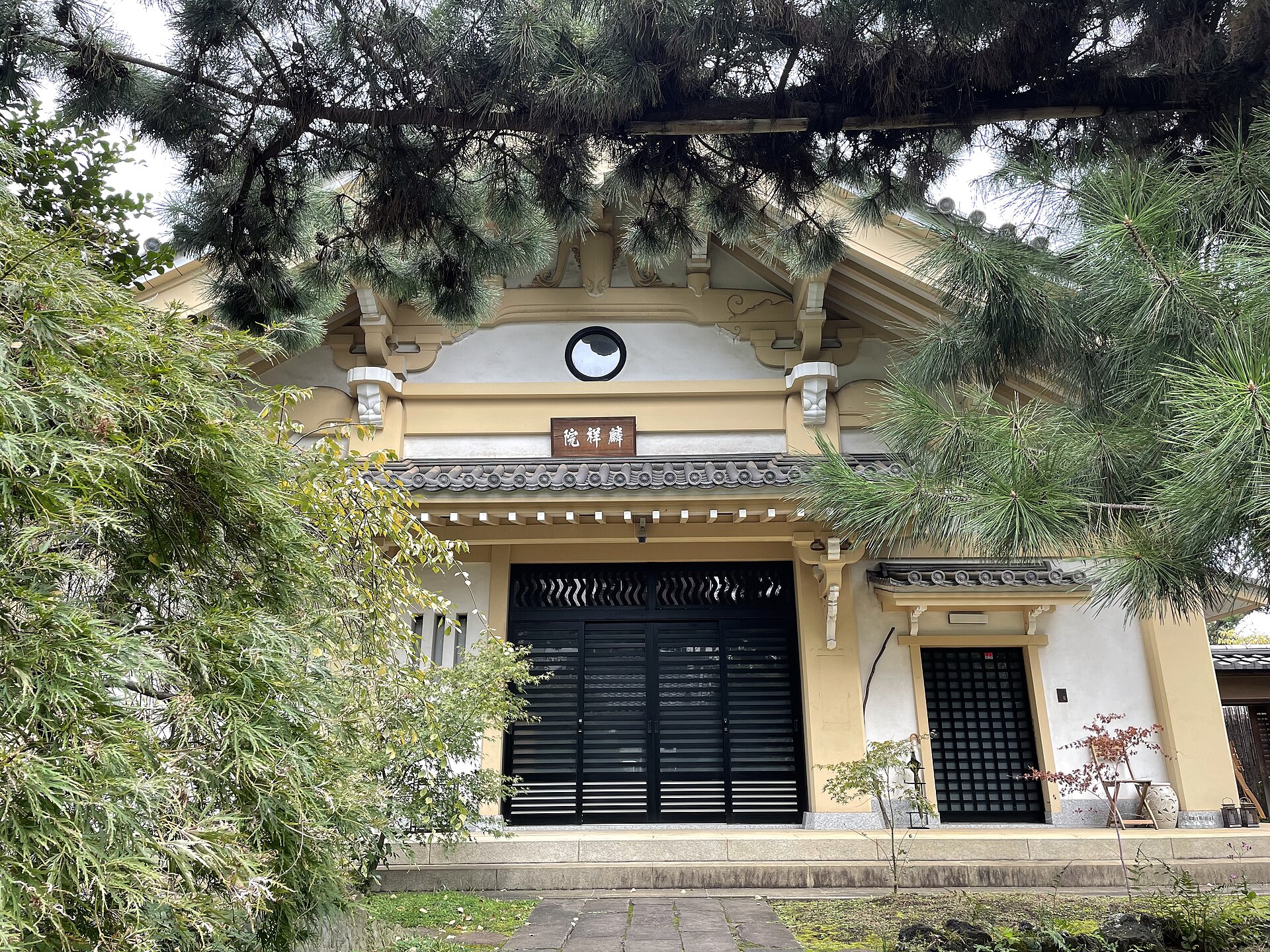
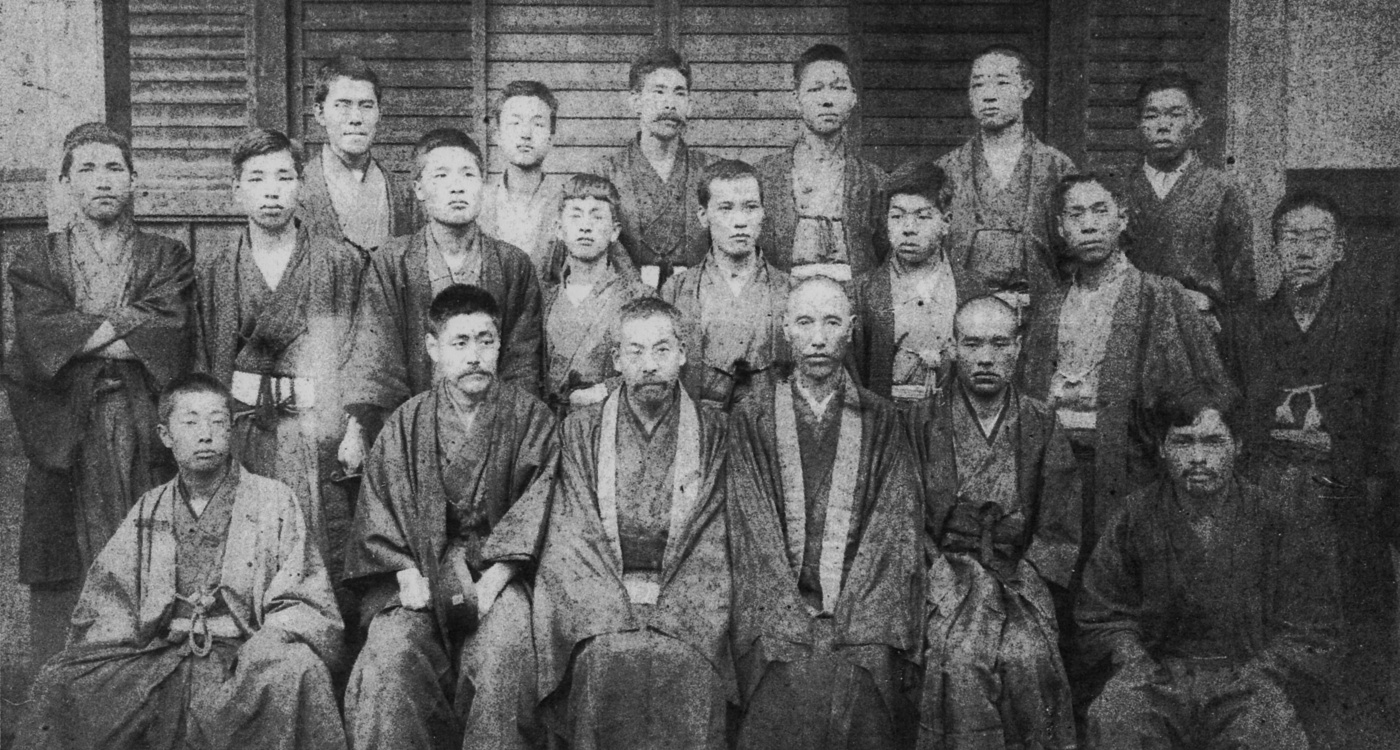
Rinshoin is a Buddhist temple closely associated with Kasuga no Tsubone, an influential figure at the early Tokugawa court. In 1887, Inoue Enryo opened the Tetsugakukan, predecessor of Toyo University, in rented buildings at Rinshoin. The school soon moved, but the episode is revealing: a Buddhist temple provided the first physical setting for a modern private academy devoted to philosophy.
Writers and the Cultural Image of Yushima
Yushima’s reputation also grew through scholars, students, publishers, performers and writers moving across the wider Hongo–Ueno–Kanda zone. The district was near the University of Tokyo, Ochanomizu’s schools, Kanda’s book trade and Ueno’s museums. Lodging houses, restaurants and meeting places connected formal institutions with everyday intellectual life.
Izumi Kyoka’s The Women’s Genealogy became strongly associated with Yushima Tenjin through stage adaptations and later cultural memory. The famous shrine scene should not be treated as a simple documentary record. Its importance lies in the way literature and theater attached emotion and romance to an already famous urban setting.
Earthquake, War and Reconstruction
The Great Kanto Earthquake of September 1, 1923, and the fires that followed devastated large areas of central Tokyo. Yushima Seido burned, and reconstruction brought wider roads, land readjustment and newer fire-resistant buildings. The 1935 Taiseiden belongs to this interwar city rather than to untouched Edo architecture.
Air raids in 1945 brought another wave of destruction. Some religious precincts, stone monuments and street alignments survived, while houses, shops and smaller buildings disappeared. Postwar rebuilding connected Yushima more strongly to the commercial and entertainment districts around Ueno and Okachimachi.
Yushima Today
Today, Yushima combines several urban moods within a small area. Students and families visit Yushima Tenjin to pray for success. Plum blossoms and seasonal festivals draw crowds. Yushima Seido offers a quieter reminder of Tokugawa Confucianism. Rinshoin continues as a Buddhist temple, while its connection to the Tetsugakukan survives through institutional history.
Subway stations and major roads have made the neighborhood easy to reach, but they also divide older patterns. Yushima Station serves the eastern slope, Ochanomizu reaches the southern ridge, Hongo-sanchome connects the plateau, and Ueno-hirokoji opens toward the commercial lowlands.
What to Look For Today
- Yushima Tenjin: an active shrine where Tenjin worship, examination prayers and seasonal plum culture meet.
- The shrine’s stairs and slopes: the clearest way to experience the plateau edge above the former lowlands.
- Yushima Seido: the site of the shogunate’s Confucian academy, with a twentieth-century reconstructed main hall.
- Rinshoin: a Buddhist temple linked both to Kasuga no Tsubone and the first home of the Tetsugakukan.
- Temple walls and irregular streets: surviving clues to older land divisions, even where buildings have changed.
- The transition toward Ueno and Okachimachi: a visible shift from elevated religious and educational sites to postwar commerce and entertainment.
Timeline
| According to shrine tradition: 458 | Foundation of the shrine associated with Ame-no-Tajikarao. |
| According to shrine tradition: 1355 | Sugawara no Michizane is enshrined as Tenjin. |
| 1690 | Tokugawa Tsunayoshi transfers and develops the Confucian complex at Yushima. |
| 1790s | The Shoheizaka academy is strengthened under the Kansei reforms. |
| 1856 | Hiroshige publishes his view of Yushima Tenjin. |
| 1868 | The shogunate falls, transforming religious and former warrior lands. |
| 1887 | Inoue Enryo opens the Tetsugakukan in rented buildings at Rinshoin. |
| 1923 | The Great Kanto Earthquake and fires damage Yushima and destroy Yushima Seido’s main structures. |
| 1935 | The present Taiseiden at Yushima Seido is completed. |
| 1945 | Air raids bring further destruction and displacement. |
| 1995 | Yushima Tenjin’s present main buildings are reconstructed. |
Frequently Asked Questions
Why is Yushima associated with learning?
Popular Tenjin worship, the shogunal Confucian academy, modern schools and nearby university and book districts accumulated in the same area over different periods.
Who is the scholar students pray to at Yushima Tenjin?
They pray to Tenjin, the deified form of Sugawara no Michizane, a ninth-century scholar, poet and statesman later associated with learning and cultivated ability.
What is the difference between Yushima Tenjin and Yushima Seido?
Yushima Tenjin is a Shinto shrine associated with Tenjin worship. Yushima Seido is a Confucian ceremonial and educational site linked to the Tokugawa shogunate.
Is Yushima Seido a Buddhist temple?
No. Despite the word “temple” sometimes appearing in English descriptions, Yushima Seido is a Confucian site.
Are the main historic buildings original?
Many are reconstructions or later replacements. Yushima Seido’s Taiseiden dates to 1935, and Yushima Tenjin’s present main buildings were reconstructed in 1995.
Related Neighborhood Histories
Compare Yushima with Kanda, where universities, publishing and bookselling created a different academic landscape; Ueno, where a Tokugawa temple complex became a park and museum district; and Hongo, whose modern identity grew around the University of Tokyo.
Sources and Further Reading
- Yushima Tenmangu official website
- Yushima Seido official website
- Bunkyo City official website and cultural-property materials
- Toyo University materials on Inoue Enryo and the Tetsugakukan
- National Diet Library Digital Collections
Conclusion: A Neighborhood of Several Traditions
Yushima did not become a district of learning because one institution survived unchanged. Its identity emerged from different systems that occupied the same plateau: Tenjin worship, official Confucian education, Buddhist temple life, modern private schools, writers and the intellectual networks of neighboring districts.
That is why the neighborhood still feels unusually layered. A student’s examination prayer, a reconstructed Confucian hall and a temple once used as a philosophy school are not separate curiosities. Together, they explain how Yushima became one of Tokyo’s most enduring landscapes of learning.